


Picture this. A homeowner hears a loud snap from the garage at 6 in the morning. The spring just broke. The door won’t budge. What do they do? They pull out their phone and type “garage door repair near me” into Google.
Within seconds, Google serves up a handful of local businesses in the map pack and organic results. The companies that show up get the call. Everyone else gets ignored.
That is the power of local search engine optimization in action.
SEO improves local search rankings by optimizing a business’s online presence so that Google recognizes it as a trusted, relevant and nearby option for customers searching for specific services. For garage door companies across the United States, this means more phone calls, more booked jobs and a steady flow of leads without paying for every single click.
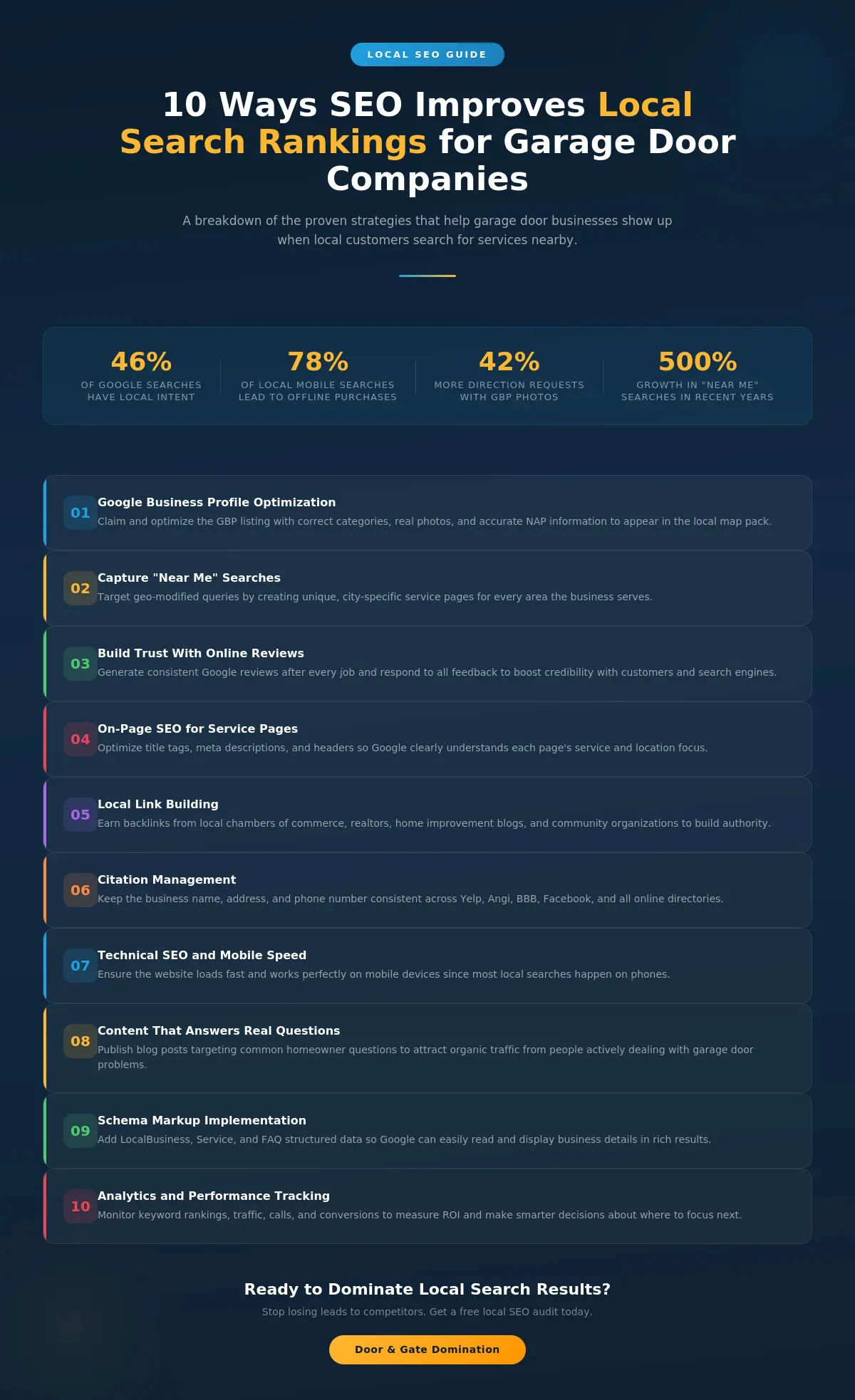
But local SEO is not just one thing. It is a combination of strategies that work together to push a business to the top of local search results. Here are 10 specific ways SEO makes that happen.
It Puts a Business on Google Maps Through Google Business Profile Optimization

The Google Business Profile, formerly known as Google My Business, is the foundation of any local SEO strategy. When someone searches for “garage door repair” in their city, the businesses that appear in the map pack all have one thing in common. They have a properly optimized Google Business Profile.
Optimizing a GBP listing means selecting the right business categories, like “garage door repair service” or “garage door supplier.” It means uploading real photos of completed jobs, keeping business hours accurate and writing a clear business description that includes relevant service keywords.
- What to check: Make sure the business Name, Address and Phone number (also called NAP) is exactly the same on the GBP listing as it is on the company website and every other directory. Even a small difference, like listing “Street” on one platform and “St.” on another, can confuse Google and hurt rankings.
- What to avoid: Never stuff extra keywords into the business name field. Google’s guidelines are clear on this and violating them can result in a suspended listing.
For a deeper look at how SEO impacts a garage door business beyond local rankings, check out the guide on “What Does SEO Do for Garage Door Company Websites?”
It Captures “Near Me” Searches With Geo-Targeted Content
“Near me” searches have exploded over the past few years. Google reports that searches containing “near me” have grown by over 500% in recent years and the garage door industry is no exception. Homeowners across the US search for terms like “garage door installation near me” and “emergency garage door repair [city name]” every single day.
Local SEO targets these geo-modified queries by creating content that matches what people are actually typing into Google. This often means building dedicated service area pages for each city or region a garage door company serves.
- Tip: Each city page should have unique content that speaks to the specific area. Mention local landmarks, neighborhoods, or common garage door issues in that region. For example, companies serving coastal areas in Florida or Texas might mention the impact of humidity and salt air on garage door hardware.
- What to avoid: Do not copy and paste the same page over and over with just the city name swapped out. Google sees through that and it can actually damage rankings instead of helping them.
Capturing these local searches is just one piece of the puzzle. To learn how SEO turns that visibility into actual customers, read “What Does SEO Do for Lead Generation Online?”
It Builds Customer Trust Through Online Review Strategy
Google pays close attention to online reviews when deciding which businesses to show in local search results. A garage door company with 200 genuine reviews and a 4.7-star rating is going to outrank a competitor with 12 reviews almost every time.
But reviews do more than help rankings. In the garage door business, trust is everything. Homeowners are letting a stranger into their garage, which is often a direct entry point into their home. They want to know the company is reliable before they pick up the phone.
A solid local SEO strategy includes a review generation system. After every repair, installation, or maintenance visit, the customer gets a follow-up message with a direct link to leave a Google review. This keeps the reviews flowing consistently.
- What to check: Log into the Google Business Profile regularly and respond to every review, both positive and negative. A professional, thoughtful response to a negative review can actually build more trust than ignoring it.
- What to avoid: Never purchase fake reviews. Google’s algorithm has gotten extremely good at detecting them and getting caught can lead to penalties that are very difficult to recover from.
Building trust through reviews also contributes to steady, organic growth over time. Discover how that momentum compounds by reading “What Does SEO Do To Boost Website Traffic Long-Term?”
It Helps Google Understand the Website Through On-Page SEO
On-page SEO is all about making it crystal clear to Google what each page on a website is about. This includes optimizing title tags, meta descriptions, header tags, image alt text and the actual content on each page.
For a garage door company, this means having dedicated pages for each core service: garage door spring repair, opener installation, new garage door installation, panel replacement and so on. Each page should have a title tag that includes the service name and the primary location. Something like “Garage Door Spring Repair in Dallas, TX” is much more effective than a generic “Services” page title.
- Tip: Use header tags (H1, H2, H3) in a logical structure and naturally include keywords that potential customers would search for. Google uses these headers to understand the hierarchy and topic of the content.
- What to check: Run the company website through Google Search Console and look for crawl errors, missing meta descriptions, or pages that are not being indexed. These issues are more common than most business owners realize, especially on older websites.
It Earns Authority Through Local Link Building
When other reputable websites link to a garage door company’s website, it sends a strong signal to Google that the business is trustworthy and authoritative in its local area. This is known as link building and in the context of local SEO, the most valuable links come from other local sources.
Think local chambers of commerce, home improvement directories, real estate websites, local news outlets and community organizations. A garage door company that sponsors a local little league team and gets a link on the league’s website is building exactly the kind of local relevance that Google rewards.
- Tip: Reach out to local realtors, home inspectors and property managers about referral partnerships. These relationships often lead to natural backlinks and can also generate direct business.
- What to avoid: Never buy links from random websites or participate in link schemes. Google’s algorithm is highly sophisticated at detecting unnatural link patterns and the penalties can set a business back months or even years in rankings.
It Keeps Business Information Consistent With Citation Management
A citation is any online mention of a business’s name, address and phone number. These appear on platforms like Yelp, Angi, BBB, Facebook, Yellow Pages and dozens of other directories across the internet.
When this information is consistent across every platform, it reinforces to Google that the business is legitimate and that the details are accurate. When the information is inconsistent, it creates confusion and Google responds by trusting that business less in local search results.
This is a particularly common problem in the garage door industry. Companies move to a new shop, change phone numbers, or rebrand and forget to update their listings across the web. Those outdated listings keep floating around, slowly chipping away at local search visibility.
- Tip: Audit all citations at least twice a year. A local SEO provider can run a full citation audit and cleanup. For businesses with heavily inconsistent data, it is well worth the investment.
It Improves User Experience With Technical SEO and Mobile Optimization
Google has been clear about the importance of technical SEO factors like page speed, mobile-friendliness and Core Web Vitals. Most local searches happen on mobile devices, which means a garage door company’s website absolutely must work flawlessly on a phone screen.
Think about the typical customer. Their garage door is stuck. They are standing in their driveway, frustrated, searching on their phone. If they tap on a website and it takes five or six seconds to load, or the text is too small to read, or the phone number is not clickable, they are going to hit the back button and call someone else.
- What to check: Run the company website through Google PageSpeed Insights and aim for a performance score above 70 on mobile. Also test the site on an actual phone to make sure buttons are easy to tap, forms are simple to fill out and the phone number is click-to-call enabled.
- What to avoid: Large, uncompressed images are the most common culprit behind slow garage door websites. Photos of completed installations and before-and-after shots look great, but they need to be properly compressed and sized for the web.
It Attracts Customers With Content That Answers Real Questions
Content marketing is a core piece of any strong local SEO strategy. By publishing blog posts, guides and FAQ pages that address the real questions homeowners are asking, a garage door company can attract organic traffic from people who are actively looking for help.
Posts like “How Often Should Garage Door Springs Be Replaced?” or “5 Warning Signs Your Garage Door Opener Is Failing” bring in visitors who are experiencing real problems. These are potential customers at the exact moment they need a professional.
From years of experience in the garage door industry, the most common questions homeowners ask tend to be about strange noises, doors that won’t open or close properly and how long certain parts are expected to last. Creating content around these topics positions a company as the go-to expert in the area.
- AEO and AI Overview Tip: Structure content with clear, concise answers near the top of each section. Google’s featured snippets and AI-generated overviews pull from content that directly answers a question in two to three sentences. Using FAQ schema markup on these pages increases the chances of appearing in “People Also Ask” boxes and voice search results.
It Speaks Google’s Language With Schema Markup
Schema markup is a type of structured data that gets added to a website’s code. It does not change how the site looks to visitors, but it gives Google detailed, organized information about the business in a format it can easily process.
For a local garage door company, the most important types of schema include LocalBusiness schema, Service schema and FAQ schema. These tell Google exactly what services are offered, which areas are served, what the business hours are and what customers are asking about.
- Tip: Adding FAQ schema to blog posts and service pages is one of the easiest wins in local SEO. It increases the chances of appearing in rich results, People Also Ask boxes and the AI-generated answers that are becoming more prominent in Google search results across the United States.
- What to check: Use Google’s Rich Results Test tool to verify that schema markup is properly implemented on key pages. Broken or incorrect schema does not help and can actually prevent a site from earning rich results.
It Tracks Performance So Nothing Gets Wasted
SEO without tracking is like driving with the dashboard lights off. A strong local SEO strategy includes ongoing monitoring of keyword rankings, website traffic, phone calls, form submissions and overall return on investment.
For garage door companies, knowing which keywords drive the most leads is critical. “Garage door repair” might generate ten times more calls than “garage door installation” in a given market. Without proper tracking, there is no way to know where to focus time and resources. Tracking also helps compare performance between organic results and Google Local Service Ads so a business can see which channel is delivering the best return per lead.
- What to check: At a minimum, every garage door company should have Google Analytics 4 and Google Search Console set up on their website. Call tracking is also highly recommended so that phone leads can be tied back to specific keywords and pages.
- Tip: Review performance data at least once a month. Look for trends in which pages are driving the most traffic, which keywords are climbing or dropping and which service areas are generating the most calls. This data informs every future SEO decision.
Common Mistakes Garage Door Companies Make With Local SEO
Even with the best intentions, many garage door businesses across the US make the same local SEO mistakes over and over again. Recognizing these pitfalls early can save months of frustration and lost revenue.
- Ignoring the Google Business Profile entirely is probably the most common mistake. Some companies claim their listing but never optimize it, never add photos and never respond to reviews. This is a missed opportunity that hands leads directly to the competition.
- Having one generic service page that tries to target 15 different cities is another frequent issue. Google wants to see unique, relevant content for each location, not a wall of city names stuffed into a single page.
- Treating web design as separate from SEO is a costly oversight. A website that looks good but loads slowly, lacks proper heading structure, or is not mobile-friendly will struggle to rank no matter how much optimization is done elsewhere.
- Failing to respond to negative reviews hurts more than most business owners realize. A thoughtful, professional response shows potential customers that the company cares about doing things right.
- Forgetting to update business hours for holidays, seasonal changes, or temporary closures creates a poor customer experience and can also confuse Google.
- Having no blog or content strategy at all means missing out on a massive pool of potential customers who are searching for answers to their garage door questions every single day.
Why Local SEO Is the Key to Growing a Garage Door Business

Local SEO is not a single tactic. It is a system of interconnected strategies that work together to get a garage door business in front of the right customers at the right time.
From optimizing a Google Business Profile and building local citations to creating helpful content and earning genuine reviews, every piece of the puzzle plays a role in improving local search rankings. Unlike paid search, which stops delivering results the moment the budget runs out, local SEO builds long-term visibility that keeps working around the clock.
Garage door companies that take local SEO seriously tend to see a noticeable difference in call volume within a few months. Those that ignore it keep wondering why the phone is not ringing while their competitors stay fully booked.
The first step is simple. Audit the current online presence, identify the biggest gaps and start closing them one by one. For businesses that want expert help, a professional local SEO audit can provide a clear roadmap tailored to the company’s specific market and goals.
Get Expert Local SEO Built for the Garage Door and Gate Industry
Door & Gate Domination specializes in helping garage door and gate companies across the United States take control of their local search rankings. With deep industry knowledge and a proven track record of driving real results, our team understands the unique challenges garage door businesses face when competing online. From Google Business Profile optimization and local citations to content strategy and review management, every service is built specifically for the door and gate industry. Ready to dominate the local search results? Contact us today or give us a call to get a free SEO audit and start turning online searches into booked jobs.