


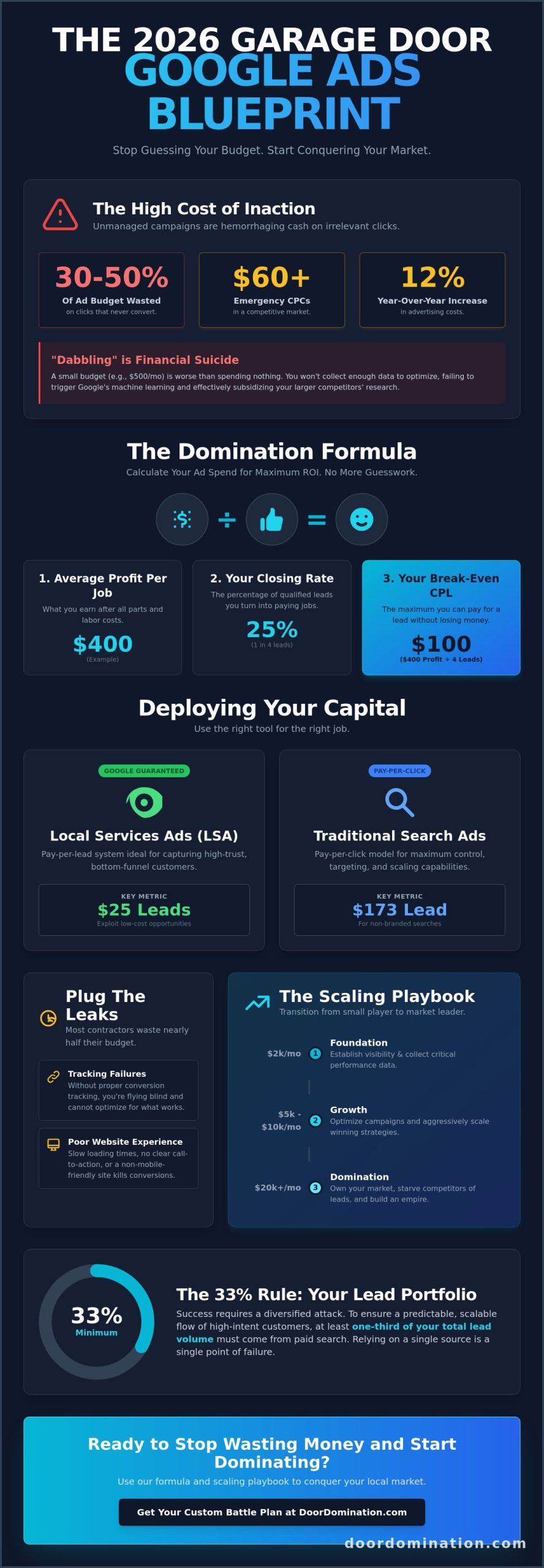
If you’re treating your marketing budget like a suggestion, you’ve already lost the war. Right now, unmanaged campaigns are hemorrhaging 30% to 50% of their capital on irrelevant clicks that never turn into a closed job. You’re likely asking exactly how much to spend on google ads for garage doors to finally stop the bleeding and start crushing your local rivals. In a market where emergency CPCs hit $60 and year-over-year costs have spiked by 12%, dabbling is a death sentence.
You know that inconsistent call volume is a cancer to your operations. Paying $173 for a non-branded lead feels like a robbery because it is. Stop guessing. We’re handing you the exact mathematical formula to build a 2026 war chest that doesn’t just compete; it conquers. You’ll learn the precise metrics required to scale your garage door business, from exploiting $25 LSA leads to navigating the June 15th policy shift that will bankrupt your slower competitors. It’s time to stop being a victim of the algorithm and start owning it.
Key Takeaways
- Stop burning cash on “dabbling” and understand why a weak budget is a guaranteed recipe for failure in the 2026 market.
- Use our hard-hitting mathematical formula to calculate exactly how much to spend on google ads for garage doors to hit your specific profit targets.
- Learn to weaponize the “Google Guaranteed” badge and traditional search ads to corner your local market before your competitors wake up.
- Stop the bleeding by identifying the tracking failures and website flaws that are currently wasting nearly half of your investment.
- Follow a ruthless scaling playbook to transition from a small-time player to a market leader with a $20k monthly war chest.
The 2026 Reality Check: Why ‘Dabbling’ in Google Ads is Financial Suicide
The 2026 garage door market is a winner-take-all battlefield. There is no middle ground. You either dominate your local service area or you get cannibalized by the elite players who understand that capital is a weapon. If you are still trying to figure out how much to spend on google ads for garage doors by looking at what you spent two years ago, you are already obsolete. The “dabbler” is a dead man walking. The market has moved, and it doesn’t care about your feelings or your “test” budgets.
A $500 monthly budget is worse than spending nothing. It is financial suicide. At that level, you aren’t buying leads; you are buying a front-row seat to your own demise. You won’t collect enough data to optimize your campaigns. You won’t trigger the machine-learning algorithms that prioritize high-volume, high-converting accounts. You are simply subsidizing the research for the big guys who are spending $10,000 or more. You must hit the “Threshold of Visibility” to even be considered a threat. This requires a “War Chest” mentality. Stop viewing ad spend as an expense to be minimized. Start viewing it as the fuel that powers your growth engine.
The Cost of Inaction in a Crowded Market
Every single lead you fail to capture is a direct deposit into your rival’s bank account. In 2026, Google’s AI Max and Performance Max campaigns favor the aggressors. The algorithm has a memory. It rewards accounts that provide consistent, high-quality data. If your ad schedule is spotty because your budget is thin, you’re training the system to ignore you. Waiting for “organic” growth is a slow, agonizing death sentence. While you wait for a blog post to rank, your competitor is scaling their fleet with the revenue from three new installs they closed today via paid search. The first company to answer the phone wins the job. If you aren’t at the top of the page, you aren’t even in the room.
The 33% Rule: Your Lead Generation Portfolio
Success requires a diversified attack. We follow the 33% Rule: at least one third of your total lead volume must come from paid search. This ensures you have a predictable, scalable flow of high-intent customers. You cannot rely on a single lead source. That is a single point of failure. You must integrate your ad spend into a comprehensive garage door marketing plan that balances LSAs, PPC, and reputation management. To win, you have to understand your Cost Per Action (CPA). If you don’t know the exact price you’re willing to pay for a signed contract, you’re just gambling. And in this industry, the house always wins unless you bring a bigger hammer.
The Domination Formula: Calculating Your Ad Spend for Max ROI
Stop guessing. Hope is not a strategy. If you want to know exactly how much to spend on google ads for garage doors, you need to treat your budget like a high-precision weapon. Most contractors fail because they pick a random number that feels “safe.” Safety is for the weak. We use math to dictate our moves. The Domination Formula requires you to look at your business with brutal, clinical honesty. If you can’t face your numbers, you can’t lead your market.
Start with your average profit per job. This isn’t your top-line revenue; it’s what’s left after parts and labor. Next, define your Customer Acquisition Cost (CAC) limit. This is the maximum bounty you’re willing to pay to secure a new customer. While the average business spends a small percentage of revenue on marketing, winners in the garage door space invest heavily to starve their competition. Finally, factor in your closing rate. If you only close 25% of your leads, you need four leads to get one job. Multiply that by your desired monthly revenue growth to find your target spend. This is how you build a war chest that actually produces results.
The Math Behind the Money
In the 2026 garage door market, Cost Per Lead (CPL) is the total price paid to generate a single phone call or form submission from a high-intent prospect. To find your break-even point, divide your average profit per job by the number of leads required to close a sale. If your profit is $400 and you close one in four, your break-even CPL is $100. Your closing rate is the secret lever. When you improve your sales process, your ads effectively become cheaper because every lead is worth more. You can win even more ground by optimizing your reputation management to ensure those leads trust you before they even call.
Variable Costs: Why Dallas Isn’t Des Moines
Geography dictates the cost of combat. In high-density metros like Dallas or Chicago, Cost Per Click (CPC) spikes because every major player is bidding for the same “broken spring” searches. You must adjust your budget based on local competitor density. You’re paying a “Niche Premium” because garage door leads are high-intent and immediate. A general contractor might wait weeks for a lead to move; you’re solving a crisis in hours. In competitive cities, emergency keywords can hit $60 per click. If you aren’t prepared to pay the entry fee, don’t step into the ring. You need a budget that accounts for these local realities or you’ll be outbid and invisible before noon.
LSA vs. Google Search Ads: Where to Deploy Your Capital
Choosing where to put your money is the difference between a thriving fleet and a silent phone. In the 2026 landscape, you have two primary fronts: Local Service Ads (LSAs) and traditional Search Ads. If you’re trying to figure out how much to spend on google ads for garage doors, you must understand that these are not interchangeable. They are distinct weapons. LSAs are your frontline infantry, capturing high-intent emergency repair calls with the “Google Guaranteed” badge. Search Ads are your precision snipers, allowing you to bypass the noise and target high-margin installation projects that keep your profit margins fat.
We recommend a 70/30 capital split for most markets. Allocate 70% of your budget to LSAs to secure a steady stream of repair leads at a lower cost per lead. Use the remaining 30% for Search Ads to dominate specific, high-value keywords. This aggressive approach ensures you aren’t just surviving on scraps. It creates a massive presence that feeds into your broader strategy for seo for garage door companies. When you own the top of the page through both paid and organic channels, you starve your competition of oxygen. They can’t win if the customer never sees their name.
LSAs: The ‘Pay-Per-Call’ Safety Net
LSAs are the first place your capital should go. You only pay when a customer actually calls or messages you. This is a massive advantage, but it’s not a “set it and forget it” system. You must manage your “Google Guaranteed” status ruthlessly. This means maintaining a high volume of five-star reviews and responding to every inquiry within minutes. To protect your war chest, you have to dispute junk leads immediately. Don’t let Google charge you for out-of-area calls or telemarketers. Following the rules and guidelines that protect consumers and advertisers is the only way to keep your lead cost within the $25 to $50 range while your competitors overpay.
Search Ads: The Scalpel for High-Value Installs
Traditional Search Ads give you the control that LSAs lack. You can bid specifically for “custom wood garage door installation” or “smart opener upgrades” while using negative keywords to filter out the DIY crowd. This prevents you from burning cash on people looking for YouTube tutorials. However, the ad is only half the battle. Your landing page is the closer. High-octane garage door website development is required to convert a $60 click into a $4,000 sale. If your site is slow or confusing, you’re just throwing money into a furnace. Build a digital closer that justifies every cent of your ad spend.
Plugging the Leaks: Why Most Contractors Waste 40% of Their Budget
You are bleeding money. It’s that simple. If you’re obsessing over how much to spend on google ads for garage doors but ignoring your conversion leaks, you’re just a high-volume donor to Google’s profit margin. Most contractors waste 40% of their budget before a single technician even leaves the shop. They send elite, high-intent traffic to a generic home page that offers no clear direction. That is “Leaky Bucket” syndrome. It’s professional negligence. You wouldn’t leave a job site with a broken spring; don’t leave your marketing campaign with a broken funnel.
Failure to track is the quickest way to go bankrupt. If you can’t measure the call, you can’t manage the spend. You need to know exactly which keyword triggered the phone call. Otherwise, you’re just throwing darts in the dark. You’re also likely suffering from the “Weekend Blackout.” You spend thousands on ads, but no one answers the phone on Saturday morning. That desperate lead doesn’t wait. They call your rival. Finally, stop falling for the Broad Match trap. Google wants you to use it because it’s profitable for them. It shows your ads for “free garage door hinges” or “DIY repair tips.” You pay for those clicks. You get zero ROI. Use phrase and exact match or get out of the game.
Landing Pages That Actually Close
A home page is where ad budgets go to die. To convert at 20% or higher, your landing page needs three non-negotiables: a crisis-focused headline, a massive click-to-call button, and immediate social proof. It must be mobile-first. 80% of your customers are searching on a phone with one hand while staring at a stuck door. If your site doesn’t load in two seconds or requires them to pinch and zoom, they’re gone. You’ve lost the lead and the click cost. Don’t build a digital brochure. Build a digital closer.
The AI Factor: AEO and Ad Efficiency
The 2026 landscape is dominated by machine learning. Implementing Answer Engine Optimization is the new play to reduce your reliance on expensive paid clicks. AEO positions your brand as the definitive answer for AI-driven searches, building the authority needed to lower your average CPC. AI now predicts search intent with lethal accuracy. It filters out the tire-kickers before you pay for the click. The future belongs to those who provide high-quality data to the algorithm, not those who just spend the most. Stop wasting your war chest and optimize your conversion path to ensure every dollar works as hard as your best lead tech.
The Door Domination Playbook: From $2k to $20k Monthly Spend
You have the formula. You have the strategy. Now you need the nerve to execute. Deciding how much to spend on google ads for garage doors is not a static choice; it is a tactical evolution. We utilize a “Crawl, Walk, Run” approach to ensure your operations don’t collapse under the weight of your own success. You don’t start by lighting $20,000 on fire. You start with a surgical $2,000 to $5,000 investment to proof the concept, refine your landing pages, and train your dispatchers to close at a high level. Once the machine is printing money, you reinvest every cent of profit back into the war chest. This is the only way to triple your sales by 2027 and leave your rivals wondering what hit them.
Professional management is effectively free when it triples your conversion rate. If an amateur is wasting 40% of your budget on junk clicks, hiring an elite unit to optimize that spend pays for itself before the first week is over. You are buying speed and certainty. Every dollar you spend is a soldier. If those soldiers are unmanaged, they’ll desert. If they’re led by professionals who live and breathe the garage door niche, they’ll conquer your entire metro area. You have a choice: dominate your market or get left in the dust by someone who isn’t afraid to spend. The 2026 market does not reward the timid.
Scaling Without Breaking the Bank
You scale when the data gives you the green light. Monitor your “Search Impression Share” ruthlessly. If you’re only showing up for 30% of the available searches in your area, you are leaving 70% of the revenue on the table for your competitors. Increase your daily cap in increments of 20% to maintain stability. You should also weaponize reputation management for contractors to boost your click-through rate. When your ads are surrounded by five-star proof, your cost-per-click actually drops because Google rewards your relevance. Only expand your service radius after you have achieved total saturation in your core zip codes.
The Elite Unit: Partnering for Total Domination
Generalist agencies will fail you. They don’t understand the difference between a torsion spring and an extension spring. They don’t know that a 2:00 AM emergency call is worth ten times a mid-day inquiry. You need a partner that speaks your language. Door & Gate Domination is that partner. We have a singular mission: tripling sales for 300 elite contractors. We don’t offer suggestions; we provide the blueprint for survival and victory in a cutthroat industry. Stop guessing and start winning. Stop wasting money and start printing it—Book your Strategy Call.
Build Your 2026 War Chest or Get Left Behind
The time for hesitation is over. You’ve seen the math. You’ve seen the battlefield. If you are still paralyzed by how much to spend on google ads for garage doors, your competitors are already picking your pocket. You must transition from an expense mindset to a war chest mentality immediately. Stop the bleeding by fixing your leaky funnels and weaponizing AEO to lower your acquisition costs. The 2026 market belongs to the aggressors who reinvest profits to scale their operations with lethal efficiency.
We are on a mission to triple the sales of 300 elite garage door and gate contractors by 2027. Our unit specializes exclusively in your niche. We don’t play games with your capital. We use high-conversion landing pages and specialized industry expertise to turn every click into a signed contract. Don’t let another lead slip to a rival who is willing to outwork and outspend you. It’s time to own your streets. It’s time to win.
Ready to Dominate? Secure Your Market Before Your Competitors Do.
Frequently Asked Questions
Is $1,000 a month enough for Google Ads in the garage door industry?
No, a $1,000 monthly budget is a recipe for failure in the 2026 garage door landscape. With emergency clicks reaching $60 in competitive metros, that budget will be incinerated before your first technician finishes their coffee. You need a war chest that hits the threshold of visibility to trigger Google’s machine learning. Anything less is just a donation to your rivals’ research. Focus on a budget that allows for consistent data collection and lead volume.
What is the average cost-per-click (CPC) for garage door repair in 2026?
The average cost per click for garage door keywords in 2026 typically ranges from $8 to $25. However, if you’re operating in a high-density metro during peak emergency hours, expect to pay as much as $60 per click. This 12% year-over-year inflation means you must be surgical with your bidding strategy to avoid burning through your capital on low-intent searches. High-intent, crisis-driven keywords are expensive because they convert.
Should I spend more on Google LSAs or traditional Search Ads?
You should deploy your capital using a 70/30 split between LSAs and traditional Search Ads. LSAs provide a high-volume safety net for emergency repairs at a lower cost per lead, usually between $25 and $50. Search Ads act as a scalpel; they allow you to target the high-margin installation jobs that LSAs often miss. You need both to achieve total market domination and squeeze the competition out of the results.
How do I know if my Google Ads agency is actually doing a good job?
A high-performing agency provides absolute transparency regarding your cost per lead and actual revenue generated. If they’re hiding behind “impressions” or “click-through rates” without showing you signed contracts, they’re failing you. A real partner focuses on the bottom line and constantly optimizes to reduce the 40% waste that plagues unmanaged accounts. They should be proactive, identifying trends and adjusting bids before your budget disappears.
What is a good conversion rate for a garage door landing page?
A high-octane garage door landing page should convert at 20% or higher. If your conversion rate is hovering in the single digits, you’re sending elite traffic into a leaky bucket. To hit these numbers, your site must be mobile-first and feature a crisis-focused headline with a massive click-to-call button. Stop building digital brochures and start building digital closers that justify every cent of your ad investment.
Can I run Google Ads myself or do I need an agency?
Running ads yourself is a distraction that costs more in wasted spend than a professional management fee ever will. You’re a contractor, not an algorithm specialist. Professionals pay for themselves by plugging the 30% to 50% budget leaks that amateurs overlook. We handle the complex bidding and policy shifts while you focus on scaling your fleet and managing your crews. Don’t play hobbyist with your company’s future.
How long does it take to see results from a new Google Ads campaign?
You will see phone calls from LSAs almost immediately after your “Google Guaranteed” badge goes live. Traditional Search Ads require a 2-week to 4-week ramp-up period for the AI to collect enough data to optimize for your specific market. Patience is a weapon here. Once the machine has the right inputs, it starts printing money with relentless consistency. Don’t pull the plug before the algorithm learns how to win.
What happens if my competitors are outspending me on every keyword?
If your rivals are outspending you, you must out-convert them. You don’t need the biggest budget to win if you have a superior strategy for how much to spend on google ads for garage doors and a higher Quality Score. By utilizing AEO and high-conversion landing pages, you can secure the top spot at a lower cost than a competitor who is blindly throwing money at the wall. Efficiency beats ego every time.