


Most garage door owners are playing house. Their competitors are playing for blood. If you’re still treating your marketing budget like a pesky utility bill, you’ve already lost. You need to know exactly how much should a garage door company spend on marketing to achieve total dominance. The truth is brutal. Research shows companies spending under 5 percent of their gross revenue are choosing to stagnate. In 2026, if you aren’t spending to win, you’re spending to die.
You’ve been burned by soft agencies that deliver junk leads. You’re tired of watching your Google Ads cost-per-lead climb while your revenue stays flat. It’s time to stop the excuses. This is your 2026 blueprint for budgets that actually scale. We are moving past the 2 percent spending trap. We’re talking about the 8 percent to 12 percent investment required to fuel 3x revenue growth. We’ll break down the math of the local map pack, Google LSAs, and Answer Engine Optimization. Stop guessing. Start dominating.
Key Takeaways
- Expose the SBA trap and why 2-3% marketing spend is a blueprint for bankruptcy in a digital-first market.
- Master the Dominator’s Framework to determine exactly how much should a garage door company spend on marketing to scale 3x.
- Deploy your 2026 war chest with a ruthless 40/40/20 allocation between Paid, Organic, and Brand reputation.
- Weaponize Answer Engine Optimization (AEO) to capture high-intent leads before your competitors even know they exist.
- Eliminate the “Generalist Tax” by leveraging specialized industry data that slashes lead costs and maximizes ROI.
The SBA Trap: Why 2-3% Marketing Spend is Financial Suicide in 2026
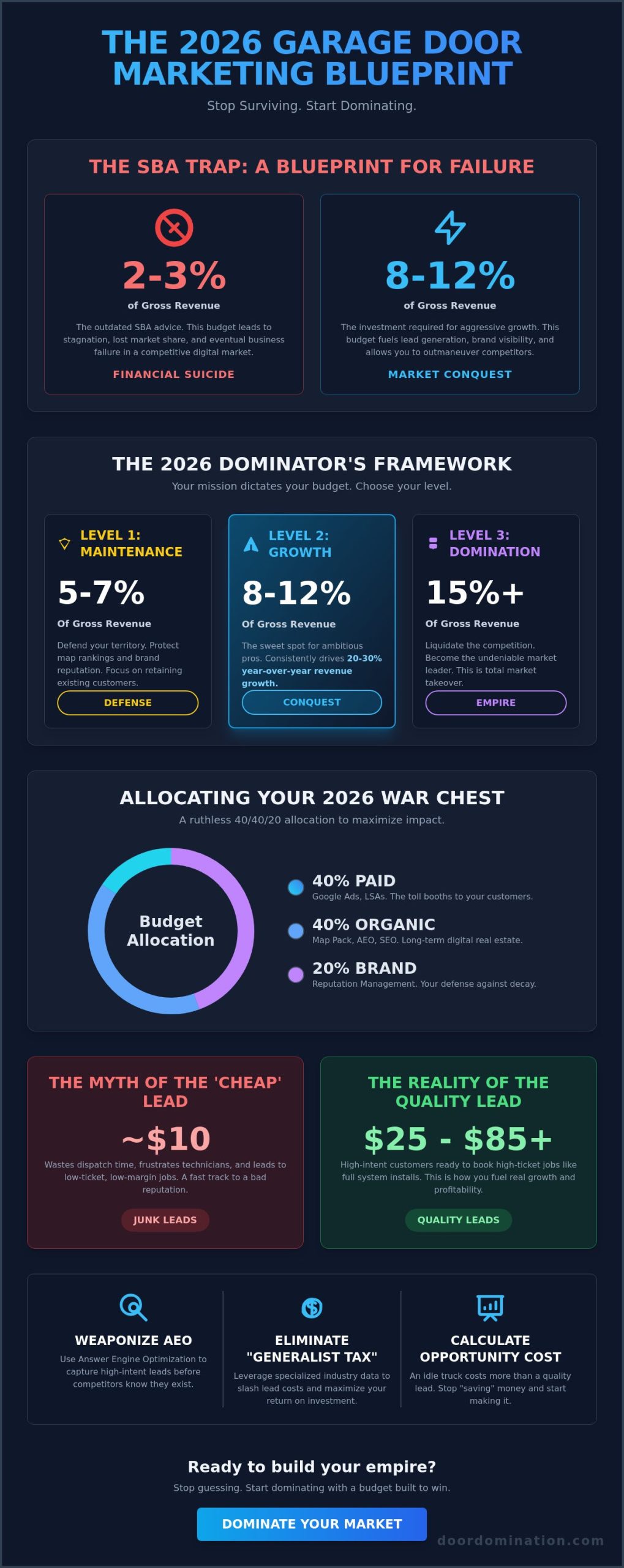
The Small Business Administration (SBA) is handing out advice that will bury your garage door business. They often suggest a marketing spending level of 2 to 3 percent of gross revenue. That might work for a corner bakery with zero competition. For a high-ticket contractor in a cutthroat market, it is financial suicide. If you are asking how much should a garage door company spend on marketing, the answer starts by rejecting these outdated survival budgets. You aren’t here to survive; you are here to take over.
The referral-only model is dead. Relying on word of mouth is a strategy for hobbyists, not heavy hitters. While you wait for the phone to ring, your invisible competitor is spending 10 percent of their revenue to dominate the local map pack. They are paying the digital rent required to stay visible. Inflation has hit the digital landscape hard. Google Ads costs are rising, and average clicks now range from $8 to $25 depending on your market. If you only spend 2 percent, you aren’t even in the game. You are just watching from the sidelines while others take your territory.
Digital rent is the price of entry. Google Ads and Local Service Ads (LSAs) are not optional. They are the toll booths on the road to your customers’ driveways. With Google Ads Search conversion rates averaging 5 to 10 percent, you need a high-octane budget just to keep the pipeline moving. Research shows that companies spending under 5 percent typically stagnate. They can’t afford to test new channels. They can’t afford to scale. They are stuck in a loop of mediocrity while the market leaders pull away with a growth-mode budget of 8 to 12 percent.
The Myth of the ‘Cheap’ Lead
Stop hunting for $10 leads. They are junk. They waste your dispatch team’s time and frustrate your technicians. In 2026, a quality Google Local Service Ad lead costs between $25 and $50. A well-optimized Google Ads lead runs between $35 and $85. You must pay for quality. High-margin technicians need high-intent calls to stay busy. Cheap leads result in cheap outcomes. If you want the $2,000 full-system installs, you have to stop acting like a bargain-bin service provider.
Opportunity Cost: The Price of Playing It Safe
Every empty truck slot is a leak in your bank account. You think you’re saving money by playing it safe with a tiny budget. You’re actually losing thousands in potential revenue. When you calculate how much should a garage door company spend on marketing, you must weigh the cost of the ad against the cost of an idle installer. Conservative budgeting allows more aggressive companies to outbid you on every high-value keyword. You lose the install. You lose the lifetime value of that customer. Play safe. Stay small. Get crushed. Real growth requires a war chest, not a piggy bank.
The 2026 Dominator’s Framework: Maintenance vs. Market Conquest
Stop listening to the “what can you afford” crowd. They’re broke. You need a strategy based on where you want to go. If you’re asking how much should a garage door company spend on marketing, you first have to decide if you’re defending a castle or building an empire. The U.S. Small Business Administration provides generic guidelines, but real-world data from 2026 shows a clear divide between the survivors and the winners. Your mission dictates your budget. Period.
Level 1 is the Maintenance Tier. You spend 5 to 7 percent of gross revenue. This isn’t for growth. It’s for keeping your current trucks rolling and your name in the conversation. Level 2 is the Growth Tier. This is the sweet spot for ambitious pros. Spending 8 to 12 percent consistently drives 20 to 30 percent year-over-year revenue growth. Finally, there’s Level 3: The Domination Tier. At 15 percent or more, you aren’t just growing. You’re liquidating the competition. A $1M company spending 10 percent is putting about $8,300 a month into the engine. That’s how you scale.
Maintenance: Defending Your Current Territory
At the maintenance level, your goal is defense. You must protect your map rankings and your brand from younger, hungrier shops. This means a heavy focus on Reputation Management for Contractors. If your reviews slip, your organic visibility dies. You also need to budget for database re-marketing to your existing customers. It’s always cheaper to keep a customer than to buy a new one. Spend the minimum required to prevent organic decay, or watch your territory shrink month by month.
Market Conquest: Buying Your Competitor’s Market Share
Conquesting is about aggression. You need a war chest, not a budget. This requires a massive allocation for high-intent SEO for Garage Door Companies to own the long-term search results. While SEO builds your foundation, you fund the blitz. Use Google LSAs and PPC to choke out local rivals. You’re literally buying the leads they think they deserve. When you decide how much should a garage door company spend on marketing for conquest, remember that every dollar spent is a tactical strike. If you’re ready to stop playing small, it’s time to build a lead generation machine that scales with your ambition.
Where the Money Goes: Allocating Your 2026 War Chest
Stop playing with pennies. Start funding a war. If you want to know how much should a garage door company spend on marketing, you have to understand the 2026 split. We aren’t throwing money at the wall to see what sticks. We are deploying capital with surgical precision. The winning formula is a ruthless 40/40/20 split. 40 percent goes to Paid channels like LSA and PPC. 40 percent goes to Organic growth through SEO and AEO. The final 20 percent fuels your Brand and Reputation management. This isn’t a suggestion. It’s the standard for elite operators who refuse to settle for second place.
Your budget is a weapon. Use it. A massive part of your organic allocation must go toward Answer Engine Optimization. If AI isn’t recommending your trucks, you don’t exist. You also need a high-performance hub. Your Garage Door Website Development isn’t just a digital brochure. It is your best salesperson. It’s a digital closer that prints money while you sleep. If your site looks like it’s from 2015, you are bleeding leads every single hour. Fix it or go home.
The AEO Revolution: Budgeting for AI Search
Traditional SEO is the floor. AEO is the ceiling. In 2026, customers don’t just search; they ask. They ask ChatGPT. They ask Gemini. They ask Siri. If your data isn’t structured for AI, your competitors will steal the lead before the customer even sees a search results page. You must allocate funds to ensure these engines recommend your technicians first. Your 2026 marketing budget is a strategic investment in market share, not an overhead cost.
Paid Lead Gen: Google LSA vs. Traditional PPC
Paid lead generation is about balance. Google Local Service Ads (LSAs) are the “LSA Tax” you pay to play in the Google Guaranteed ecosystem. It’s a pay-per-call model that keeps the phone ringing. But don’t ignore traditional PPC. Search ads allow you to target specific, high-intent keywords that LSAs might miss. The key is professional management. You need a specialized unit to manage negative keywords. Stop wasting money on DIYers looking for “garage door parts” or “how to fix a spring.” You want the installs. You want the full-service repairs. Lower your cost-per-lead by cutting the fat. Every dollar in your war chest must be a tactical strike.
The Math of Domination: CAC, LTV, and ROI Realities
Stop playing business. Start calculating. Marketing isn’t a feeling. It’s a cold, hard formula. If you don’t know your numbers, you’re just gambling with your family’s future. When you ask how much should a garage door company spend on marketing, you’re really asking what your Customer Acquisition Cost (CAC) needs to be to crush the competition. A new install lead that costs $85 is a gift if your average ticket is $2,500. It’s a death sentence if your technicians can’t close. Stop staring at the total bill. Start tracking the return. Numbers are the only truth in this industry.
Most owners are shortsighted. They see a $200 spring repair and complain about a $50 lead. That’s amateur hour. A $200 repair lead is actually worth $5,000 or more over ten years in Lifetime Value (LTV). That customer will eventually need a new opener. They will buy a new door. They will refer their neighbors. If you aren’t willing to pay to acquire that long-term asset, your competitors will. Target a Return on Ad Spend (ROAS) of at least 5:1. That is the threshold of victory. Anything less means your machine is broken. Anything more means it’s time to pour gasoline on the fire.
Calculating Your Maximum Profitable CAC
You need to know your limit. Subtract your parts, labor, and overhead from your average ticket. What’s left is your profit margin. A portion of that must go to marketing. A winning Garage Door Marketing Plan accounts for lead conversion rates. A “cheap” $10 lead that converts at 5 percent is actually more expensive than a $50 lead that converts at 40 percent. Do the math. Don’t be fooled by low-cost garbage. You want high-intent buyers, not tire kickers. Victory metrics aren’t “likes” or “impressions.” If it doesn’t show up in your bank account, it doesn’t count.
The ‘Speed to Lead’ Multiplier
Your internal sales process is the multiplier. If you take thirty minutes to call a lead back, you’ve already lost. In 2026, speed is the only currency that matters. A slow response time effectively doubles your marketing spend because those leads go cold. You are paying for the opportunity, not the sale. You have to earn the sale at the front desk. Answer Engine Optimization is the process of optimizing for AI-generated answers to secure the top recommendation. If you’re ready to stop wasting leads and start winning, it’s time to deploy a system that actually converts.
Scaling to 3x: Why Your Budget Needs a Specialized Unit
The “Generalist Tax” is a silent killer. If your current agency is splitting their focus between your garage door leads and a local dental office’s root canal promotions, you are paying a tax on their ignorance. They don’t know the difference between a torsion spring and an extension spring. They don’t understand the urgency of a “car stuck in garage” call. When you calculate how much should a garage door company spend on marketing, you cannot afford to fund an agency’s learning curve. You need a specialized unit that speaks the language of the garage door industry. Generalists guess. Specialists execute. You win.
We leverage the “300 Mission.” This is about the power of collective data. By managing hundreds of garage door accounts, we possess a massive database of what works and what doesn’t. We don’t “test” on your dime. We deploy proven strategies that have already been battle-tested in markets across the country. This shared industry data allows us to lower your cost-per-lead while your competitors are still trying to figure out which keywords to bid on. You aren’t just buying a service. You are buying a shortcut to the top of your market.
The 2026 ultimatum is here. Adapt your budget now or be phased out by AI-ready rivals who have already mastered Answer Engine Optimization and LSA management. If you aren’t optimizing for the way people search today, you are essentially invisible. Here is your “Go/No-Go” criteria for your 2026 marketing investment:
- Go: Your budget is at least 8 percent of gross revenue and managed by industry specialists.
- Go: You have a dedicated line item for AEO and reputation management.
- No-Go: You are still relying on a generalist agency that “does it all” for every industry.
- No-Go: Your lead tracking is non-existent or fails to calculate true ROI.
The Power of Niche Expertise
At Door & Gate Domination, we don’t play games with your capital. We follow specialized Garage Door Marketing playbooks that outperform generalist strategies every single time. We know which zip codes convert and which ones are a waste of money. We know how to structure your Google Business Profile to dominate the local map pack. Stop paying for mediocre results from people who don’t know your business. It is time to work with an elite unit that is as focused on the bottom line as you are.
Ready to Dominate? Your Next Step
The market is moving. Every second you hesitate, your top competitor is locking in territory that should be yours. You need a 5-minute audit to see if your current spend is being lit on fire by a generalist who doesn’t understand your margins. Don’t wait for your lead flow to dry up before you make a change. Stop wasting money and start dominating; book your free strategy session now.
Take Your Territory Or Watch It Burn
The days of “trying out” marketing are over. You now have the blueprint. You know that the 2 percent SBA trap is a slow death. You understand that market conquest requires an 8 percent to 12 percent war chest. Real growth isn’t about spending less. It’s about investing better. We’ve shown you how to calculate your CAC and leverage LTV to build a machine that prints money. Now you face a choice. You can keep guessing how much should a garage door company spend on marketing, or you can execute with surgical precision.
We are on a mission to scale 300 contractors to 3x sales by 2027. We don’t guess. We use data-driven playbooks that eliminate marketing waste. Our specialized AEO and SEO experts live and breathe the garage door industry. Your competitors are already looking for an edge. Don’t let them find it first. Lock in your market territory and build the empire you deserve. Success is a choice. Make it today.
Ready to triple your sales? Secure your market before your competition does.
Frequently Asked Questions
How much should a garage door company spend on marketing in 2026?
A growth-oriented company must invest 8 to 12 percent of gross revenue to scale effectively. Maintenance mode requires 5 to 7 percent just to defend your current territory. If you are asking how much should a garage door company spend on marketing to achieve total dominance, anything less than 8 percent is choosing to stagnate. Real growth requires a war chest. You must fuel the engine if you want to win.
Is 10% of revenue too much to spend on marketing for a startup?
No, 10 percent is the bare minimum for a startup that actually wants to survive the first year. You have zero brand equity and zero organic presence. You are buying your way into a cutthroat market. If you spend less, you’re just a hobbyist. High-ticket service contractors need aggressive spending to build a customer database from scratch. Don’t be afraid to invest in your own conquest.
What is the average cost-per-lead for garage door repair in 2026?
The average cost-per-lead for a well-optimized campaign ranges from $35 to $85 on Google Ads. Google Local Service Ads (LSAs) typically cost between $25 and $50 per lead. These are high-intent calls from customers ready to buy right now. If you’re paying less, you’re likely buying junk leads that waste your dispatch team’s time. Quality leads require a quality investment. Stop hunting for bargains.
Should I spend more on Google LSA or traditional SEO?
You need both to dominate, but prioritize LSAs for immediate cash flow and SEO for long-term equity. LSAs put your trucks in front of customers today. SEO builds a foundation that lowers your average lead cost over time. In 2026, you must also allocate funds for Answer Engine Optimization. This ensures AI tools recommend your business before the customer even finishes their search. Balance is the key to victory.
How do I calculate the ROI of my garage door marketing spend?
Calculate ROI by subtracting your total marketing spend from the gross profit generated by those specific leads. Use a Target Return on Ad Spend (ROAS) of 5:1 as your baseline benchmark. If you spend $1,000, you should see at least $5,000 in revenue. Track every call and every click. If you don’t know your numbers, you’re just gambling with your future. Elite operators demand absolute clarity.
Can a small contractor compete with big national brands on a limited budget?
Yes, by dominating the local map pack and winning the speed-to-lead game every single time. National brands have massive budgets, but they’re often slow and impersonal. You win by being the local authority. Focus your budget on a tight geographic radius. Use Answer Engine Optimization to capture local intent. A specialized unit can help you outmaneuver the slow-moving giants and steal their market share.
What are the biggest marketing budget mistakes garage door companies make?
The biggest mistake is the “SBA Trap” of spending only 2 to 3 percent on marketing. This is a recipe for bankruptcy. Another fatal error is hiring generalist agencies that don’t understand the garage door industry. They waste your budget on DIY keywords and low-intent traffic. Finally, failing to track lead sources makes it impossible to scale what works. Stop guessing and start measuring your results.
How long does it take to see a return on my marketing investment?
Google Ads and LSAs provide immediate leads within days, while SEO and AEO take three to six months to hit full speed. You need a mix of short-term strikes and long-term sieges. Don’t pull the plug on a campaign because it didn’t triple your revenue in forty-eight hours. Real market dominance is built through consistent, aggressive investment over time. Stay the course and keep the pressure on.