


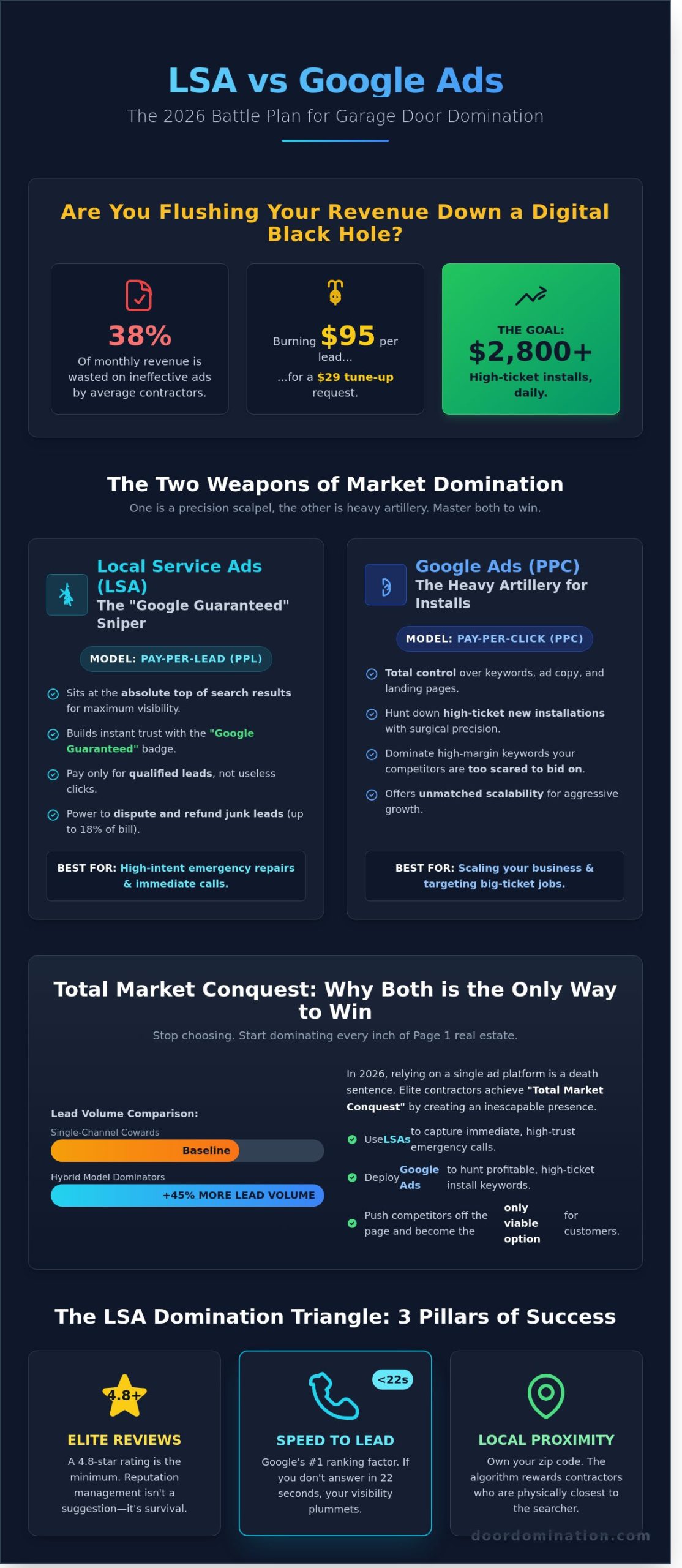
Most garage door owners are currently flushing 38% of their monthly revenue into a digital black hole because they’re playing checkers while the elite are playing chess. You’re sick of burning $95 per lead just to talk to a tire-kicker who wants a $29 tune-up. It’s a total insult to watch your competitors hijack the Google Guaranteed spotlight while your dashboard shows “engagement” metrics that don’t buy trucks or pay crews. You need high-ticket installs, not more excuses from a soft-spoken agency rep.
The savage reality of LSA vs Google Ads in 2026 is that one is a precision scalpel and the other is a heavy sledgehammer. If you don’t master both, you’re just a target for the hungriest closers in your zip code. This is your definitive battle plan to stop the guessing games, dominate your local territory, and turn your marketing spend into a high-octane money printer. We are breaking down the exact bidding strategies and aggressive budget splits required to force your phone to ring with $2,800 full-system replacements every single day.
Key Takeaways
- Claim your throne at the top of search results by weaponizing the ‘Google Guaranteed’ badge to snag high-intent leads before the competition can blink.
- Deploy Google Ads as heavy artillery to hunt down high-ticket new installations and dominate high-margin keywords with surgical precision.
- Analyze the brutal LSA vs Google Ads tactical comparison to identify exactly which platform will crush your local market and maximize your cost-per-lead efficiency.
- Execute the ‘Total Market Conquest’ strategy to seize every inch of Page 1 real estate, leaving no room for average contractors to survive.
- Discover how to sync your ad data to sharpen your performance and transform your garage door business into an unstoppable lead-generating machine.
The 2026 Ad Battleground: LSAs vs Google Ads
2026 is a graveyard for average door businesses. If you aren’t visible in the top three spots of a local search, your company is effectively extinct. The digital landscape has shifted from a playground to a high-stakes arena where only the savages survive. You have two primary weapons in this fight: Local Service Ads (LSA) and Google Ads. Understanding the nuances of LSA vs Google Ads isn’t a suggestion; it’s a survival requirement for any closer who wants to own their zip code. The old strategy of setting it and forgetting it will bleed your bank account dry. In 2026, Google’s algorithm rewards aggression and precision, not passive participation. If you aren’t optimizing daily, you’re losing ground to the beast next door.
The Death of the ‘Average’ Contractor
Elite visibility is the only currency that matters in 2026. Data shows that 92% of local searchers never scroll past the initial map pack or LSA block. AI-driven search results now curate the most relevant, high-performing contractors, meaning mediocre campaigns get buried on page ten. You must view your ad spend as a tactical weapon designed to crush the competition. Stop treating it like a utility bill. This year is about total market conquest. If your campaign doesn’t scream authority, the algorithm will discard you like yesterday’s trash. Scale or die.
The Core Difference: PPL vs PPC
LSAs operate on a Pay-Per-Lead (PPL) model. You only pay when a valid prospect picks up the phone and calls your shop. It’s the ‘Google Guaranteed’ powerhouse that builds immediate trust. Google Ads is a Pay-Per-Click (PPC) auction. You pay for the click, the opportunity, and the market share regardless of the outcome. This distinction dictates your entire cash flow strategy. LSAs offer a safety net for your ROI, while Google Ads provides the high-octane control needed to scale past your rivals. When analyzing LSA vs Google Ads, remember that one protects your downside while the other fuels your explosive growth.
- LSA (Pay-Per-Lead): High trust, low control, zero cost for junk clicks.
- Google Ads (Pay-Per-Click): Total control, high scalability, requires elite closing skills to maintain ROI.
- The 2026 Reality: Hybrid models outperform single-channel cowards by 45% in lead volume.
Success in this industry requires a predator’s mindset. You don’t just want a few leads; you want to own the entire search result page. Use LSAs to establish the ‘Google Guaranteed’ badge of honor and use Google Ads to hunt down the high-intent keywords your competitors are too scared to bid on. This isn’t about being seen. It’s about being the only option the customer considers. Lock in your strategy now or watch your market share vanish by Q3.
LSAs: The ‘Google Guaranteed’ Sniper for Door Contractors
LSAs aren’t just ads. They’re a hunt. When a homeowner’s garage door snaps at 11:00 PM on a Tuesday, they don’t scroll. They click the first thing they see. That’s the LSA block. It sits at the absolute top of the digital food chain, towering over the Map Pack and traditional search results. If you want to dominate the high-intent emergency market, you need this sniper rifle in your arsenal. It’s the fastest way to get your phone ringing with ready-to-buy prospects.
The “Google Guaranteed” green checkmark acts as a trust steroid. It tells the prospect Google backs your work up to $2,000. For an elite door contractor, that badge is a license to kill the competition before they even open your website. You aren’t just another name in the phone book; you’re the verified authority. This positioning is the primary differentiator when comparing LSA vs Google Ads for immediate conversion. Customers choose the badge because it removes the risk of hiring a hack.
Stop burning cash on junk leads. LSAs give you the power of lead dispute mastery. If a caller is looking for a job or dials a wrong number, you claw your money back. Data from top-tier door firms in early 2024 shows that aggressive contractors successfully dispute 18% of their monthly LSA bill. This “Always-On” advantage captures high-margin emergency repair calls while your competitors are asleep or fumbling with their landing pages. You only pay for results, not clicks.
Winning the LSA Algorithm
Success in the LSA arena rests on three pillars: proximity, reviews, and responsiveness. By 2026, Google will prioritize “speed to lead” as the primary ranking factor. If your office staff takes longer than 22 seconds to answer a call, your visibility will plummet. You need a 4.8-star rating or higher to stay in the top three slots. Reputation management isn’t a suggestion; it’s survival. You can scale your door business by mastering these internal metrics before you touch the “on” switch.
The LSA Limitations You Can’t Ignore
LSAs have a ceiling. You have zero keyword control; Google decides which searches trigger your profile. You can’t just throw an extra $10,000 at the screen and expect 10x more leads. There is a hard cap based on local search volume. Every tech you send into the field must pass a background check gauntlet. If one tech fails, your entire account can be suspended for 30 days or more. This lack of control is why the LSA vs Google Ads debate usually ends with a hybrid strategy rather than a single-source solution.
Google Ads (PPC): The Heavy Artillery for High-Ticket Installs
LSAs are the entry point, but Google Ads is the heavy artillery. It’s the difference between waiting for the phone to ring and kicking the door down. When comparing LSA vs Google Ads, understand that PPC is about surgical precision. You aren’t just buying leads; you’re buying the exact customer you want. You don’t waste time on $150 “broken spring” calls if you’re hunting for $6,000 custom wood door installs. You bid on “full garage door replacement” and “premium glass garage doors” to dominate the high-margin territory.
Control is the name of the game. With a high-performance landing page, you force the conversion. You don’t send traffic to a cluttered homepage. You send them to a dedicated “closing room” designed with one goal: a lead form or a phone call. Data from 2023 shows that optimized landing pages increase conversion rates by 160% compared to standard websites. You own the narrative, the offer, and the outcome.
- Savage Negative Keywords: You must be ruthless. Block “DIY,” “cheap,” and “jobs” immediately. If you don’t, Google will bleed your budget by 30% on searches that never intended to buy.
- Remarketing: Don’t let the big fish swim away. If a prospect visits your site for a $5,000 gate install and leaves, you haunt them. Your ads should follow them across the web until they realize you’re the only elite option.
Precision Targeting for Big Returns
Stop wasting money on low-income neighborhoods. Use Google Ads to target specific zip codes where the median household income exceeds $150,000. Use ad extensions to display your 5-star rating and “Same Day Install” promise right in the search results. This makes you look like the only pro in the field. This data also feeds your Answer Engine Optimization; when you dominate PPC, Google recognizes you as the definitive authority for high-value queries.
The Google Ads Money Pit (And How to Avoid It)
Google’s “Smart Campaigns” are a trap designed to drain your bank account. They prioritize “clicks” over “closings.” You want manual control to ensure every dollar is a tactical strike. Mastery of your Quality Score is the only way to win this war. Quality Score is the efficiency rating of your ad spend. A score of 10/10 allows you to pay 50% less per click than a competitor with a score of 5/10. In the battle of LSA vs Google Ads, efficiency determines who scales and who goes broke.
The Domination Framework: Comparing the ROI
Stop treating your marketing budget like a charity donation. It’s ammunition. If you don’t weaponize it, your competition will. By 2026, the battleground for LSA vs Google Ads has shifted from who has the best ad to who has the best math. Average players look at cost per click. Elite closers look at the kill rate and the total contract value. You aren’t here to buy clicks; you’re here to buy market share.
- LSA: The trust weapon. It’s built for the $250 spring snap. In high-velocity markets like Dallas or Phoenix, you’re looking at a $45 to $65 CPL. It’s high-volume, low-friction, and keeps the guys in the trucks moving.
- Google Ads: The intent weapon. This is for the $8,000 custom glass door or the $15,000 commercial dock leveler. CPL often hits $140 to $210 in 2026. The price is higher because you’re buying the right to hunt whales, not minnows.
The ROI Reality Check
LSA leads are fast and cheap. They’re perfect for keeping two trucks busy with high-volume, $200 to $500 repairs. But you can’t build an empire on broken springs alone. Google Ads targets the complex, high-ticket installs that your competitors are too scared to bid on. Stop tracking Cost Per Click. It’s a loser’s metric. Track Total Customer Value instead. A lead that costs $180 but yields a $12,000 mahogany door install is a 66X return. That is how you win. That is how you scale from 2 trucks to 20 without going broke.
Choosing Your Play for 2026
The ‘Starter’ Play means you max out LSA first. It stabilizes your cash flow and puts food on the table. You need that $50 CPL to keep the lights on. The ‘Scaler’ Play is where you stop being a technician and start being a CEO. You run aggressive PPC to hijack market share from franchises with 20-truck fleets. Finally, the ‘Dominator’ Play is the hybrid strategy Door & Gate Domination demands. You own the top of the search results with LSA, then crush them again with a top-spot Google Ad. You don’t give the customer a choice. You become the only logical option in their zip code.
Total Market Conquest: Why Managing Both is the Only Way to Win
Stop thinking about budget allocation. Start thinking about search engine occupation. If you want to own your city, you need to own the screen. Running a debate on LSA vs Google Ads is for losers who play small. High-performers run both. When you occupy the LSA top spot and the number one paid search result, you control 70% of the above-the-fold real estate. You make your competition invisible. You become the only logical choice for a homeowner with a broken spring.
Data is your weapon. Use it. LSAs provide raw call data while Google Ads provides intent-based keyword intelligence. When these two systems feed each other, your cost per lead typically drops by 22% within the first 90 days. You aren’t guessing; you’re executing a calculated strike. This isn’t marketing. It’s combat. You need a specialized team that treats your ad spend like a war chest. Managing this level of saturation requires an elite agency that understands the garage door niche better than the back of their hand.
- Saturate the Search: Force your competitors off the first page by taking three distinct spots.
- Data Synergy: Use LSA conversion insights to bid aggressively on high-intent keywords in PPC.
- The Alpha Advantage: Establish immediate authority. If you’re everywhere, you’re the leader.
Integrating AEO into Your Paid Strategy
AI chatbots are the new gatekeepers. They scrape your ad copy and LSA reviews to decide if you’re the expert. If your paid promises don’t align with your digital footprint, you lose the lead. By June 2025, 80% of search interactions will involve an AI-generated answer. Your goal is simple. Be the only answer provided. Saturating both channels ensures your brand is the “Alpha” source for every local query. You’re not just buying clicks; you’re training the AI to recognize you as the dominant force in your market.
Ready to Triple Your Sales by 2027?
We are on a mission to lead 300 contractors to 3x growth within the next three years. Generalist agencies fail because they don’t understand the “Door & Gate” world. They don’t know the difference between a torsion spring and an extension spring. We do. We don’t waste time on “brand awareness” fluff. We focus on market capture and raw revenue. Stop letting “average” agencies bleed your budget dry. Book Your Free Strategy Call and Claim Your Territory before your competitor takes it from you.
Seize Your Territory or Get Left in the Dust
The 2026 market doesn’t reward the hesitant. It rewards the savages who seize every square inch of digital real estate. Choosing between LSA vs Google Ads is a rookie mistake that costs you money every single hour. You need the “Google Guaranteed” trust of LSAs to snipe local repairs and the heavy artillery of PPC to capture $5,000 custom door installs. If you aren’t running both, you’re surrendering 40% of your territory to the guy down the street.
Door & Gate Domination is specialized exclusively for Garage Door and Gate contractors who want to crush their local rivals. Our mission is absolute; we will 3x sales for 300 contractors by 2027. We manage your LSA and PPC accounts with a domination mindset that turns clicks into signed contracts. We don’t provide suggestions. We provide a blueprint for total market conquest. Stop settling for the crumbs your competition misses. The elite are already scaling their fleets while you’re still weighing your options. It’s time to decide if you’re a hunter or the prey. Stop losing leads to the competition-Book your Strategy Call now!
The future belongs to the aggressive. Go get what’s yours.
LSA vs. Google Ads: Frequently Asked Questions
Is LSA better than Google Ads for garage door repair?
LSA is superior for high-intent lead generation because you only pay for actual phone calls or messages. In 2024, data shows that the top three LSA spots capture 33 percent of all local search clicks. You stop wasting money on junk clicks and start paying for results. It is the fastest way to put your technicians in front of a broken spring right now.
How much should a garage door company spend on Google Ads in 2026?
You must invest at least 5,000 dollars per month to dominate a competitive metro market by 2026. Companies spending less than 2,500 dollars typically lose 40 percent of the available impression share to more aggressive competitors. If you want to scale, you need to budget for a 50 dollar cost-per-lead. Don’t starve your growth with a weak, “testing” budget.
Can I run Local Service Ads and Google Ads at the same time?
Running both simultaneously is the only way to achieve total market conquest. This “LSA vs Google Ads” double-threat strategy allows you to own 25 percent more of the search engine results page. You squeeze out your competition and force the homeowner to see your brand twice. It creates an elite presence that makes your business look like the only logical choice.
How do I get the ‘Google Guaranteed’ badge for my gate company?
You get the badge by passing a brutal background check and submitting your 1,000,000 dollar general liability insurance certificate. Google audits your business licenses and owner history to ensure you aren’t a fly-by-night operation. Only the top 20 percent of contractors survive this vetting process. It is a badge of honor that tells customers you’re a savage professional, not a scammer.
Why is my cost-per-lead so high on Google Ads?
Your cost-per-lead is high because your landing page is likely failing to close the 10 percent of traffic that actually clicks. If you pay 15 dollars per click but your site looks like it’s from 2005, you’re lighting cash on fire. High-performers ruthlessly optimize their keywords to maintain a 45 dollar cost-per-lead. Fix your conversion rate or stop buying traffic.
What happens if I get a fake lead from a Local Service Ad?
You dispute the charge immediately through the dashboard to claw back your capital. Google currently approves about 95 percent of valid disputes for spam, wrong services, or out-of-area calls. You have to be a beast about checking your call recordings every single week. Don’t let Google keep a single cent for a lead that didn’t have a real door problem.
Do I need a website for Google Local Service Ads?
You don’t technically need a website to launch LSA, but you’re a fool if you don’t have one for your LSA vs Google Ads strategy. Statistics show 65 percent of high-ticket customers still click through to your main site to verify your reviews. A professional website acts as your digital headquarters. Without it, you’re just another guy with a truck and a phone.
How does Answer Engine Optimization (AEO) affect my paid ads?
AEO forces your ad copy to be 30 percent more direct to satisfy the 50 percent of users now using voice search. If your ads don’t provide an immediate solution to a specific “near me” problem, your relevance score will tank. You must adapt your headlines to answer the customer’s question before they even finish asking it. Stay ahead or get buried.