

Start by fixing what happens to the leads you already get, then claim your free visibility, then make your website capable of converting, and only then spend money on ads. The correct order for a garage door or gate company is: lead response, Google Business Profile and reviews, website conversion, paid channels, local SEO, and finally AI search and database reactivation. Companies that switch everything on at once cannot tell what worked, cannot fix what failed, and usually conclude that marketing does not work. The order is not a preference. It is the difference between compounding and burning money.
Key Takeaways
- Sequence beats selection. Running the right channels in the wrong order wastes more money than picking the wrong channels.
- The first two phases cost close to nothing and typically produce the fastest revenue change, which is why skipping them to buy ads is the most common expensive mistake.
- Never turn on paid traffic before your website and your phone can handle it. Paid spend multiplies whatever conversion rate you already have, including a bad one.
- Each phase should prove itself before the next one starts. If you cannot measure phase two, do not begin phase three.
- A realistic full rollout takes nine to eighteen months. Anyone selling you all six phases starting Monday is selling you an invoice, not a plan.
For context on what these six phases are actually rolling out, the full inventory is here: What Are Digital Marketing Solutions? 9 That Actually Book Jobs for Garage Door and Gate Companies. This post is about what order to build them in.
Phase 1: Fix Lead Response Before You Spend Anything
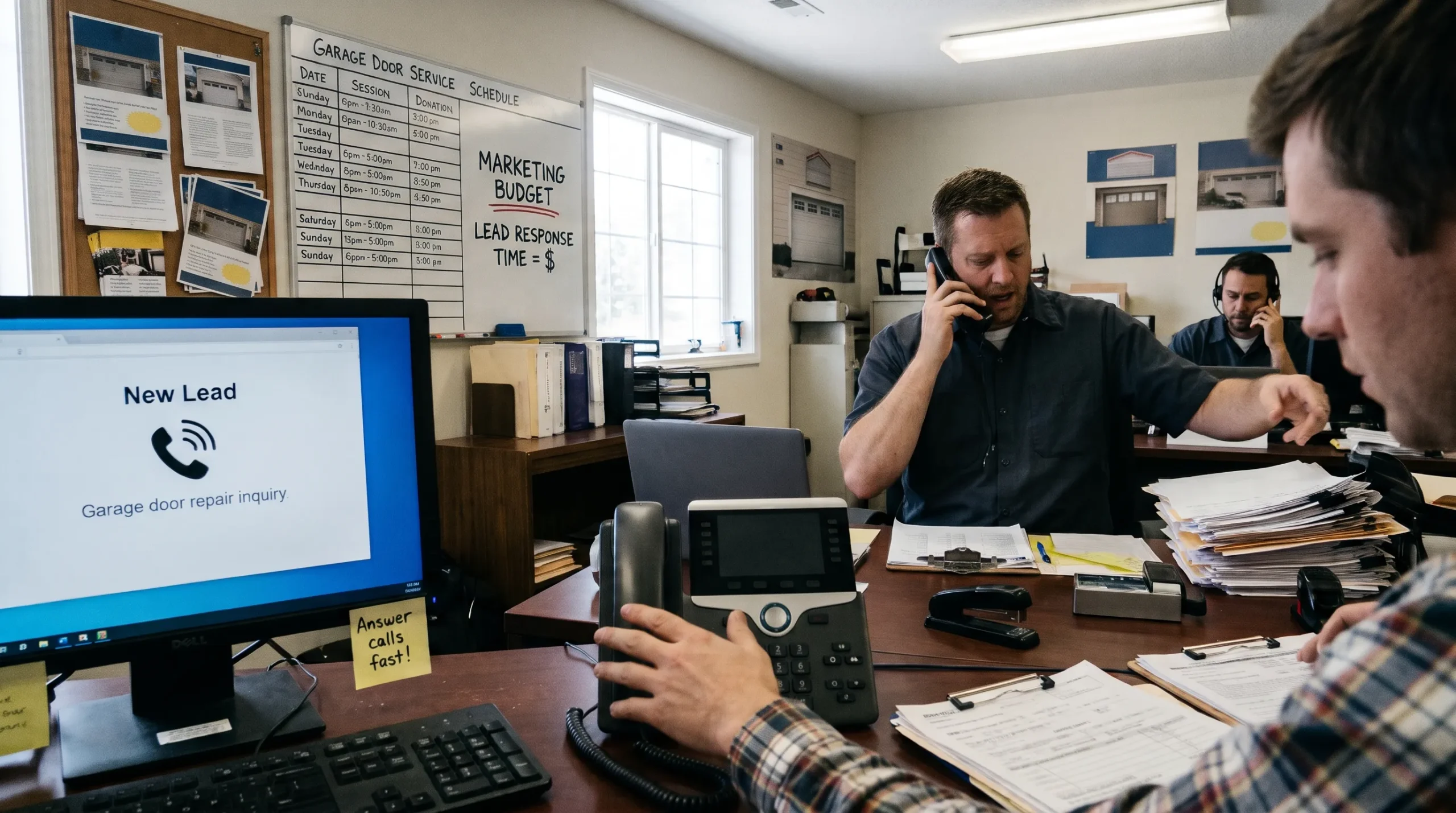
Do this first, always. Before a single dollar goes to advertising, make sure the leads you already generate actually reach a human being quickly.
Why Lead Response Comes Before Any Garage Door Marketing Spend
The logic is arithmetic. Every channel in the later phases produces leads, and every one of those leads passes through the same funnel: someone answers, or nobody does. If that funnel leaks at thirty percent, then every dollar you spend in phases four through six loses thirty percent of its value on the way through.
What it costs: almost nothing. A missed-call text back tool and a decision about who owns the phone.
How long until it pays: immediately. This is the only phase that can change revenue in the same week you start it.
What to do:
- Count your missed calls over the last thirty days.
- Turn on automatic missed-call text back.
- Name one person accountable for returning missed calls and answering form submissions, with a response time in minutes.
- Re-measure after thirty days.
The full breakdown of where leads die and how to plug each gap is here: Why Are My Marketing Leads Not Turning Into Booked Jobs? 7 Speed-to-Lead Leaks Costing You Money.
Move to phase 2 when: your missed call rate is under ten percent and someone owns the inbox.
Phase 2: Claim Your Free Visibility and Start Collecting Reviews
Do this second because it is free and it works fast. Your Google Business Profile is the highest-intent traffic source available to a door company, and it costs nothing but attention.
How to Set Up Google Business Profile Before Spending on Ads
Most door companies have a profile. Few have one that is actually complete, and an incomplete profile is the single most common thing we find on a first audit.
What it costs: nothing but time.
How long until it pays: weeks, not months. Profile changes often move map pack visibility faster than anything else on this list.
What to do:
- Verify you have owner-level access, not just management access through a vendor.
- Set the correct primary category, service area, and complete hours including emergency availability.
- Add real photos of your trucks, your crews, and finished installs. Not stock images.
- Start asking every customer for a review at the moment the job finishes.
- Respond to every review, including and especially the negative ones.
Two cautions. Keyword stuffing your business name is one of the fastest ways to get a profile suspended, and the rules are laid out plainly in Google’s official Business Profile help documentation. Second, review generation has real legal exposure attached to it. Incentivizing positive reviews and gating requests so only happy customers get asked both violate federal rules as well as platform policy. Consistent, compliant reputation management is the version that survives.
Move to phase 3 when: your profile is complete, you are gaining reviews steadily, and you are responding to all of them.
Phase 3: Make Your Website Able to Convert
Do this third because everything after it depends on it. Phases four through six all send traffic somewhere. If that destination does not convert, you are paying to fill a bucket with a hole in it.
Why Your Garage Door Website Must Convert Before You Scale Spend
This phase is not a redesign. It is a short list of specific fixes, most of which are cheaper than one month of ad spend.
What it costs: modest if it is fixes, significant if it is a rebuild. Diagnose before you assume.
How long until it pays: immediately once live, because it raises the yield on every channel simultaneously.
What to do:
- Test your site on a phone over a weak connection. If it is slow, fix that before anything cosmetic.
- Put the phone number where a thumb rests, on every page, tap-to-call.
- State the service area in plain text that a person and a crawler can both read.
- Give each service and each city its own page rather than one page listing everything.
- Add real proof: photos of your work, review counts, license and insurance details.
Risk warning: if this phase becomes a rebuild, you need a redirect map before launch. Changing URLs without redirects erases rankings you spent years earning, and it is a genuinely difficult thing to recover from.
Move to phase 4 when: the site loads fast on mobile, the phone number is unmissable, and your core services have their own pages.
Phase 4: Turn On Paid Channels for Volume Now
Do this fourth, not first. Paid is the phase most companies want to start with, because it is the only one that produces calls this week. It is also the one that punishes an unprepared business hardest.
When to Turn On Paid Ads for a Garage Door Company
Turn them on when you can answer the phone and your website converts. Not before. Paid traffic multiplies your existing conversion rate, which means it magnifies problems just as efficiently as it magnifies strengths.
What it costs: the most of any phase, and it is ongoing rather than one-time.
How long until it pays: days. This is the fastest lead source available, which is exactly why it is so tempting to start here.
What to do:
- Start with Local Services Ads if you can pass verification. Pay-per-lead beats pay-per-click when you are learning.
- Add Google Ads second, targeting specific job types rather than broad terms.
- Build a negative keyword list on day one, not month three.
- Point ads at the specific service page, never the homepage.
- Set a review cadence and actually keep it.
This is the phase where doing it yourself costs the most real money. A badly built account can spend a month’s budget in a week with nothing to show, which is why paid search is the first thing most door companies should hand to a specialist even if they run everything else in house.
Move to phase 5 when: paid is producing leads at a cost per booked job you can live with, and you want to stop renting every one of them.
Phase 5: Build the Organic Asset Underneath
Do this fifth, and start it while paid is running. Local SEO is the slowest phase and the only one that keeps working after you stop paying, which is why it needs to be running in the background well before you need it.
How Long Local SEO Takes to Pay Off for a Garage Door Company
Months, typically six or more before meaningful movement, and that timeline is precisely why most competitors abandon it. The ones who do not abandon it end up with a cost per lead nobody buying every click can match.
What it costs: moderate and ongoing, but it accumulates rather than resets each month.
How long until it pays: six to twelve months for real traction. Budget accordingly and do not judge it at month three.
What to do:
- Build a page for each service you offer and each city you serve, with genuinely distinct content on each.
- Make your name, address, and phone number consistent across every directory listing.
- Publish content answering the questions customers actually ask, not keyword lists.
- Earn links from local and trade sources rather than buying them.
Be careful whose advice you follow here. Bought links and scaled auto-generated pages are covered explicitly by Google’s spam policies, which are published openly in Google’s official Search Central developer documentation. Recovering from a penalty costs considerably more than doing the work properly would have. Sustainable SEO work is slower and it is the only version that holds.
Move to phase 6 when: your service and city pages are live and you are seeing organic traffic that is not branded.
Phase 6: Layer AI Search and Database Reactivation
Do this last, because both depend on everything before them. These two compound on top of a working foundation. Attempted first, they do very little.
How to Layer AI Search and Database Marketing Onto a Garage Door Business
AI search visibility rewards content that already demonstrates real expertise and structure, which is what phase five produces. Database reactivation requires a customer list, which is what phases one through four produce.
What it costs: moderate. Mostly content work and marketing automation tooling.
How long until it pays: months for AI visibility, weeks for reactivation once a list exists.
What to do:
- Restructure your best content to lead with direct answers under descriptive headings.
- Add genuine firsthand detail. Generic rewritten content does not get cited by anything.
- Build a follow-up sequence for every quote that did not close.
- Set up tune-up reminders and opener replacement offers to past customers.
- Confirm SMS consent before texting anyone. Penalties there are assessed per message.
The reason answer engine optimization sits in the final phase rather than the first is not that it is unimportant. It is that the work it depends on happens earlier, and companies that try to shortcut straight to it end up paying for tactics that have nothing underneath them.
You are done when: all six phases are running and measured. Then the work becomes maintenance and iteration rather than rollout.
The 6-Phase Rollout at a Glance
Phase | Focus | Cost | Time to results | Run it yourself? |
1 | Lead response and call handling | Near zero | Same week | Yes |
2 | Business Profile and reviews | Free | Weeks | Yes |
3 | Website conversion | Low to high | Immediate once live | Partly |
4 | Local Services Ads and Google Ads | Highest, ongoing | Days | No |
5 | Local SEO and service area pages | Moderate, ongoing | Six to twelve months | Partly |
6 | AI search and database reactivation | Moderate | Weeks to months | Partly |
Two things this table cannot decide for you. How fast to move through the phases depends on your cash position and how badly you need work right now. And who executes each phase is a separate question entirely, covered here: Should You Hire In-House or Use a Digital Marketing Agency? 8 Factors for Garage Door and Gate Companies.
The Short Version
Fix the phone, then claim the free visibility, then make the website work, then buy traffic, then build the organic asset, then layer on the advanced pieces. Six phases, roughly nine to eighteen months, and the first two are nearly free.
The reason this order matters is that each phase makes the next one cheaper. Fixing lead response raises the return on every ad you will ever run. A complete profile makes your paid clicks convert better. A converting website makes SEO traffic worth having. Reversed, the same investments produce a fraction of the result and you cannot tell which one failed.
Door & Gate Domination builds this rollout exclusively for garage door, overhead door, and gate companies, which means we know which phase you are actually in rather than guessing. Book a free strategy call and we will tell you where to start, even if you build it yourself.