


Quick answer: AI decides which local businesses to recommend by running a search, pulling the most relevant results, and then choosing the businesses it can verify and trust. For a garage door company, that comes down to seven factors: which sources the engine searches, how well you match the question, where you are, whether AI can read your website, whether your business facts are consistent, what your reviews say, and how often trusted third parties mention you. The engines do not use a secret list. They pick the companies with the clearest, most confirmed information.
Key takeaways
- Most AI engines search the web before they answer, so the businesses they recommend usually come from a search index, not from memory alone.
- Relevance comes first. A company that clearly states “garage door spring repair in [city]” matches more questions than one with a vague services page.
- Location still matters. Your service area and address have to be stated plainly, in text, in several places.
- AI trusts facts it can confirm. Inconsistent names, phone numbers, or service areas make the engine less confident in recommending you.
- Reviews and third-party mentions are the tiebreakers. When several companies match, AI favors the one customers and outside sources vouch for.
Part 1: Understand AI. Know where the engines look and how they judge a match before anything else.
1. Which sources the AI engine searches
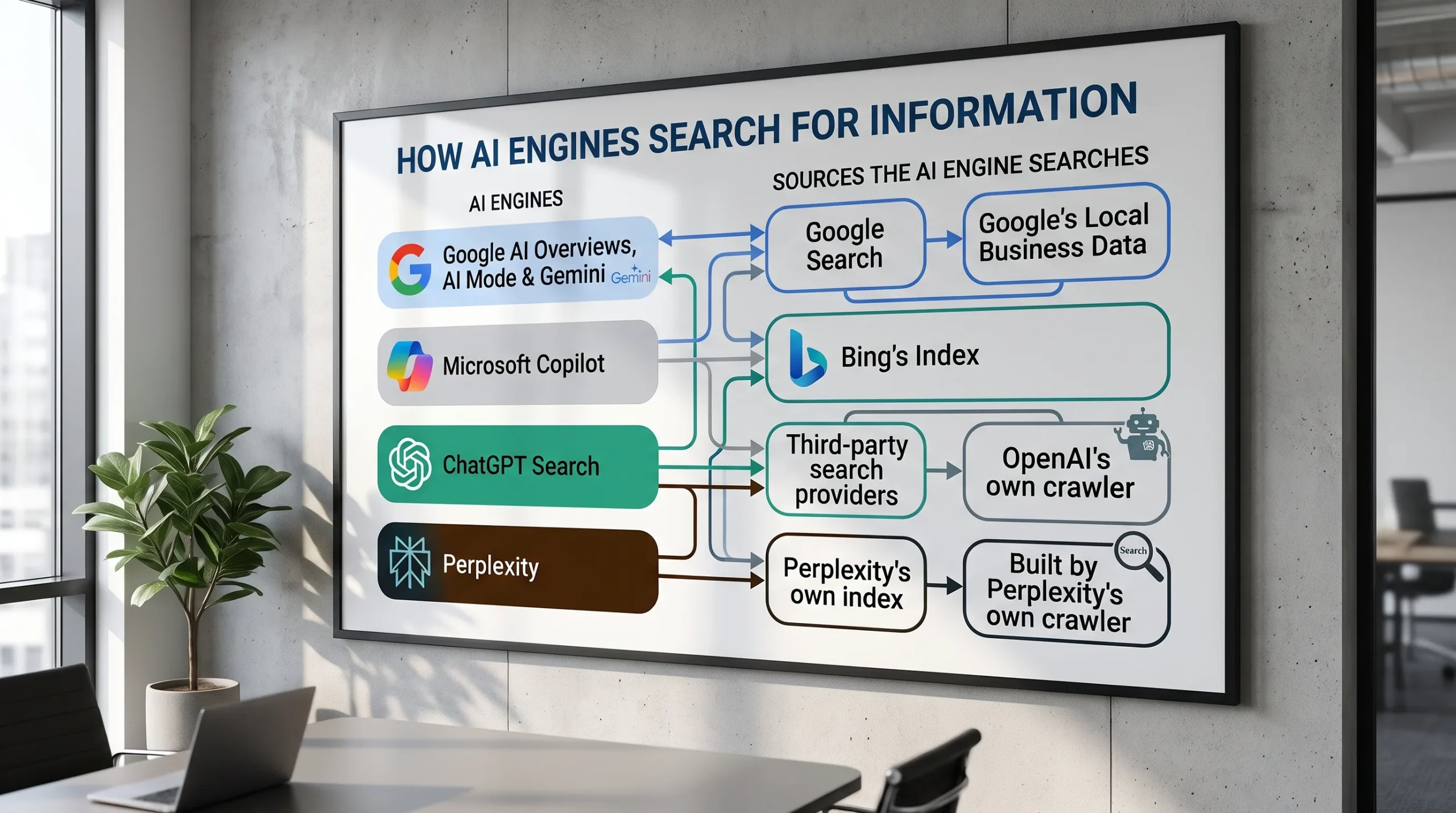
How AI engines find local businesses before they recommend one
AI engines recommend businesses they find in a search, so the first factor is simply which search each engine runs. If your business is missing from that search, it cannot be recommended, no matter how good your work is.
Here is where the major engines look:
- Google AI Overviews, AI Mode, and Gemini draw on Google Search and Google’s local business data.
- Microsoft Copilot draws on Bing’s index.
- ChatGPT search uses third-party search providers plus OpenAI’s own crawler.
- Perplexity uses its own index, built by its own crawler.
This is why a garage door company can appear in Google’s AI answer and be missing from ChatGPT, or the other way around. Each engine sees a slightly different slice of the web. Our guide on how to get listed in ChatGPT covers the ChatGPT side in detail, and our overview of AEO for local service businesses explains how the engines compare.
If you want the full step-by-step plan built on these factors, start with How to Get Your Garage Door Company Recommended by AI.
What to do: search for your own business by name in each engine. If an engine cannot find you by name, it will not find you for “best garage door company near me.”
2. How well you match the homeowner’s question
How AI judges relevance for garage door services
AI engines recommend the businesses that most clearly match what the person asked. A homeowner who asks about a broken torsion spring wants a company that obviously does spring repair, not a general contractor that might.
AI reads relevance from the words on your pages, your business categories, and your listed services. It works best when those signals are specific:
- Service-specific pages. “Garage door spring repair,” “garage door opener installation,” and “commercial overhead doors” each deserve their own page.
- Plain descriptions. State what you do, who you do it for, and where, in the first few sentences.
- The customer’s words. Homeowners say “my garage door won’t open,” not “door operator malfunction.” Use their language.
AI engines also break a broad question into several smaller searches. Google calls this query fan-out. A question like “who should fix my noisy garage door?” might trigger searches for garage door repair, opener repair, and lubrication service at once. The more of those sub-questions your site answers, the more chances you have to be picked.
This is where garage door SEO and AI visibility overlap completely. Our list of garage door keywords that actually drive calls is a good starting point for the phrases homeowners use.
What to do: list the ten questions your office hears most often, then check whether your website answers each one directly.
3. Where you are and where you work
How location affects AI recommendations for local businesses
For local questions, AI engines favor businesses that clearly serve the homeowner’s area. Google has long named three factors for local results (relevance, distance, and prominence), and AI answers built on local data follow the same logic.
The engine needs to know, with confidence, where you operate. That means:
- A clear address or service area on your Google Business Profile and website.
- City or neighborhood pages that describe real work in each area, not copies with the city name swapped.
- Location in plain text. A service-area map image alone does not tell AI where you work.
Being the closest company is not required. A company slightly farther away with stronger signals can still be recommended. But if the engine cannot tell whether you serve a town at all, it will skip you. Our guide to getting your garage door business on Google Maps covers the map side of location signals.
What to do: ask an AI engine “Does [your company] serve [town]?” for each town you cover. Any wrong answer points to a gap in your location information.
Part 2: Build Authority. Once you know how AI judges a match, make your business easy to read and easy to verify.
4. Whether AI can read your website
How crawlability affects which businesses AI recommends
AI engines can only cite pages their crawlers are allowed to read. A blocked or hard-to-read website quietly removes you from consideration, even if everything else about your business is strong.
For Google, there is no separate AI setting. Google’s guidance on AI features and your website says a page only needs to be indexed and eligible to appear in Search with a snippet, with no extra technical requirements. Other engines have their own crawlers. Perplexity’s documentation on its crawlers explains how its robots.txt settings work, and OpenAI states that sites blocking OAI-SearchBot will not appear in ChatGPT search answers.
Beyond access, readability matters. AI engines lift short, self-contained answers, so pages built answer-first get quoted more often:
- Lead with the answer in the first two sentences of each section.
- Use question-style headings that match what homeowners ask.
- Put key facts in text, not in images, sliders, or PDFs.
- Load fast and work on phones, since most homeowners search from a phone.
If your site is slow, image-heavy, or hard to update, website design built for AI search can fix the foundation. Our guide to mobile-friendly websites for garage door contractors covers the phone experience in detail.
What to do: open yourdomain.com/robots.txt and confirm Googlebot, Bingbot, OAI-SearchBot, and PerplexityBot are not blocked. If you are unsure, ask your developer before changing anything.
5. Whether your business facts are consistent everywhere
How consistent business information builds AI confidence
AI engines trust facts they can confirm in more than one place. When your name, phone number, address, hours, and services match across your website, Google Business Profile, and directories, the engine can recommend you with confidence. When they conflict, it hedges or picks a competitor.
Your Google Business Profile carries the most weight for Google’s AI features. Google’s own tips to improve your local ranking on Google focus on verifying your business and keeping your information complete and accurate. From there, the same details should match on Bing Places, Apple Business Connect, Yelp, the BBB, Facebook, and industry directories. Our Google Business Profile optimization playbook for contractors walks through each field.
Verified programs add another layer of confirmation. Google Local Services Ads require businesses to pass Google’s screening before they can advertise, which gives the engines one more trusted source that says you are real.
We cover every signal in this group, from listings to author bylines to schema markup, in How Can Garage Door Companies Build Trust Signals for AI Search?
What to do: search your company name and phone number together. Every listing that shows an old number, old address, or different business name is a fact AI may repeat.
Part 3: Build Reputation. When several businesses match, reputation decides which one AI names.
6. What your reviews say, and how recently
How AI uses online reviews to choose a local business
AI engines use reviews to judge whether real customers trust a business. They look at your rating, how many reviews you have, how recent they are, and what customers actually say. Then they summarize those themes in plain language when they describe you.
Reviews also shape how homeowners research. BrightLocal’s 2026 Local Consumer Review Survey of U.S. adults found that AI tools like ChatGPT have climbed to third place as a source for local business recommendations, and that consumers now check an average of six review sites.
For a garage door company, the review signals that matter most are:
- Recency. A steady flow of new reviews shows you are active now.
- Specifics. Reviews that mention “spring replacement” or “new opener install” connect your name to those services.
- Spread. Reviews on Google plus Yelp, Facebook, and the BBB give AI more than one source to confirm.
- Responses. Thoughtful replies add your side of the story to what AI reads.
Our breakdown of whether reviews help local SEO and the map pack covers the ranking side, and Do Online Reviews Affect AI Recommendations for Garage Door Companies? goes deep on how AI reads and summarizes them. If keeping up with reviews across platforms is a struggle, professional reputation management keeps requests and replies on schedule.
What to do: ask an AI engine “What do customers say about [your company]?” The summary you get back is a preview of what homeowners will hear.
7. How often trusted third parties mention you
How third-party mentions make AI more likely to recommend you
AI engines give extra weight to what other people say about a business, because any company can praise itself. Mentions on local news sites, community pages, industry associations, manufacturer dealer locators, and trusted directories all act as outside confirmation that you are real, local, and reputable.
This is the “prominence” part of local search, and it is often what separates two companies with similar reviews. Useful sources of mentions for garage door companies include:
- Manufacturer dealer and installer listings from the door and opener brands you carry.
- Trade association member directories.
- Local media, sponsorships, and community events.
- Local “best of” polls run by city publications.
- Active social profiles where customers tag and share your work.
Consistent, useful posting through social media marketing keeps your name in front of both homeowners and the engines. Paid ads do not buy AI recommendations, but pay-per-click advertising drives more jobs, and more jobs lead to more reviews, more branded searches, and more mentions over time. For more ways to stand out, see our guide on how to outrank other garage door companies on Google.
What to do: search your company name in quotes and count how many results are not your own website or listings. If the number is small, this factor is your biggest opportunity.
How the major AI engines compare
Which sources each AI engine uses for local recommendations
Every engine weighs the same seven factors, but each pulls from different places. This table shows where each one looks and which crawler you must allow.
AI engine | Main search source | Crawler to allow | Local data it leans on |
Google AI Overviews and AI Mode | Google Search index | Googlebot | Google Business Profile, Google reviews |
Gemini | Google Search | Googlebot | Google Business Profile, Google Maps data |
Microsoft Copilot | Bing index | Bingbot | Bing Places, web listings |
ChatGPT search | Third-party search providers plus its own crawl | OAI-SearchBot | Web listings, review sites, directories |
Perplexity | Its own index | PerplexityBot | Web pages, review sites, directories |
The practical takeaway: strong fundamentals work across all of them. Allow every crawler, keep your facts consistent, and build reviews and mentions, and you improve your odds in every engine at once. That is the core of answer engine optimization.
Conclusion: AI recommends the businesses it can verify
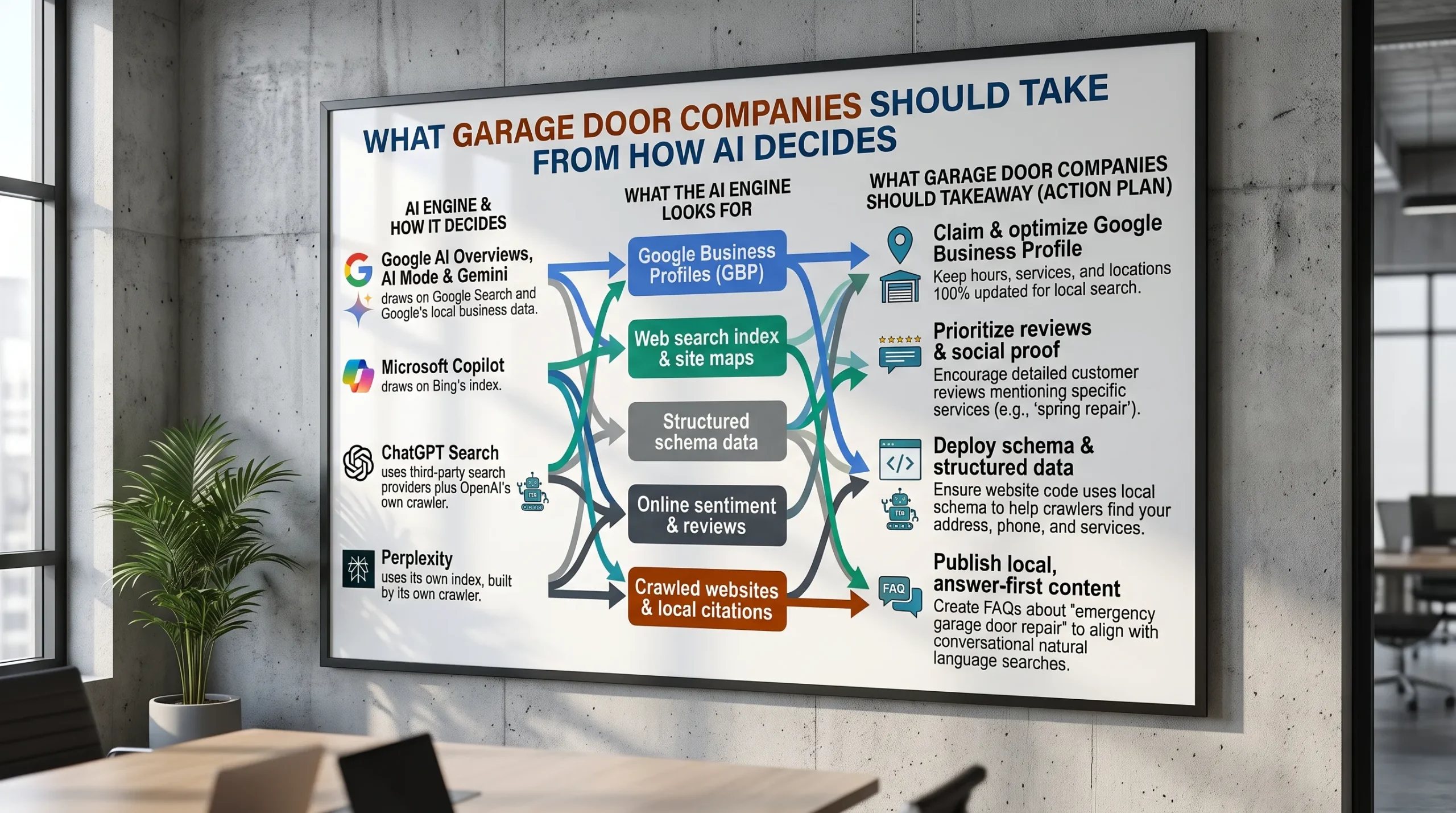
What garage door companies should take from how AI decides
AI decides which local businesses to recommend in a predictable way. It searches, it matches the question, it checks location, and then it trusts the businesses whose facts are readable, consistent, and confirmed by reviews and outside sources. None of those factors can be bought. All of them can be built.
Start with the factor where you are weakest. For most garage door companies, that is either inconsistent listings or too few mentions outside their own website. If you would like a team that works only with door and gate companies to find your gaps, Door & Gate Domination can audit how each AI engine sees your business today.
Get your free AI visibility audit today and see exactly which of the seven factors is holding your company back.