


Quick answer: To get your garage door company recommended by AI, make it easy for ChatGPT, Google AI Overviews, Gemini, Perplexity, and Copilot to find you, understand you, and trust you. Start by understanding how AI engines choose local businesses. Then build authority with a crawlable website, answer-first content, schema markup, and consistent business listings. Finally, build reputation with steady, recent reviews and real mentions across the web. There is no “submit to ChatGPT” button. AI recommends the garage door companies whose information is clear, consistent, and confirmed by other sources.
Key takeaways
- AI engines recommend the businesses they can verify, not the ones that shout the loudest. Clear, consistent facts about your company matter more than clever copy.
- If AI crawlers are blocked from your site, you cannot be cited. Checking your robots.txt and hosting settings is the fastest win on this list.
- Your Google Business Profile, website, and directory listings must say the same thing: same name, phone, address, service area, and services.
- Fresh reviews carry real weight. Homeowners now check AI tools alongside Google for local recommendations, and those tools summarize what your customers say.
- Traditional SEO is still the foundation. Most AI answers are built on top of search indexes, so a site that ranks well is far easier for AI to recommend.
Part 1: Understand AI. Before you change anything, know how the engines work and what they already say about you.
1. Learn how AI engines pick a local garage door company

How AI chooses which garage door company to recommend
AI engines recommend garage door companies by combining a live web search with what the model already knows, then choosing the businesses that look most relevant and most trustworthy. None of them keeps a secret list you can buy your way onto.
Each engine pulls from a slightly different place. Google’s AI Overviews and AI Mode draw on Google’s own search index. Microsoft Copilot draws on Bing. ChatGPT search uses third-party search providers plus its own crawler. Perplexity runs its own index. That is why a company can show up in one engine and be missing from another.
Across all of them, three questions decide who gets named:
- Relevance: Does this company clearly offer the service the homeowner asked about, in the area they asked about?
- Trust: Are the company’s facts consistent, and do customers say good things about it?
- Corroboration: Do other sources (directories, review sites, local news, associations) confirm the same story?
We break down each factor in detail in How Does AI Decide Which Local Businesses to Recommend? If Google is your main concern, our guide to getting recommended in Google’s AI Overviews goes deeper on that one engine.
Bring in a specialist if: you serve several cities or run multiple locations. Each location needs its own clear signals, and mistakes multiply fast.
2. Find out what AI says about your company today
How to check if ChatGPT recommends your garage door company
The fastest way to know where you stand is to ask the engines the same questions your customers ask. Do this before you change anything, so you have a baseline.
Run these prompts in ChatGPT, Gemini, Perplexity, Copilot, and Google AI Mode:
- “Best garage door repair company in [your city]”
- “Who installs new garage doors near [your neighborhood or ZIP]?”
- “Emergency garage door spring repair in [your city]”
- “Is [your company name] a good garage door company?”
- “[Your company name] reviews”
For each answer, write down whether you were named, where you appeared in the list, what the AI said about you, and which sources it cited. Note anything wrong, like an old phone number or a service you do not offer. Wrong facts are a sign that your listings disagree with each other (Step 6 fixes that).
Answers change from day to day, so repeat the test monthly with the same prompts. Our ChatGPT playbook for contractors covers ChatGPT-specific testing in more depth. Ongoing tracking like this is the core of answer engine optimization.
Bring in a specialist if: AI engines describe your company incorrectly, or confuse you with a competitor that has a similar name.
3. Target the questions homeowners actually ask AI
How to write garage door content that AI engines can quote
Homeowners talk to AI in full questions, so your website needs pages that answer those questions directly. A page titled “Services” gives an AI engine nothing to quote. A page that answers “Why is my garage door opener clicking but not opening?” gives it a ready-made answer with your name on it.
Start with the questions your office hears every week:
- Symptom questions: “Why won’t my garage door close all the way?”
- Cost questions: “How much does garage door spring replacement cost in [city]?”
- Decision questions: “Should I repair or replace my garage door?”
- Trust questions: “How do I find a trustworthy garage door company near me?”
Answer each one in the first two or three sentences of the page, then explain. This is the same answer-first approach behind strong garage door SEO, and it is why AEO and SEO are not competing strategies. Our breakdown of how AEO and SEO work together for contractors explains the overlap, and our guide to content marketing for garage door companies shows how to plan a steady publishing schedule.
Bring in a specialist if: you do not have time to publish at least a few genuinely useful pages each month. Thin, rushed content does more harm than no content.
Part 2: Build Authority. Give AI engines a website they can read and facts they can confirm.
4. Make sure AI crawlers can actually read your website
How to unblock AI crawlers on a garage door website
If an AI engine’s crawler is blocked, your site cannot be cited, no matter how good it is. This is the most common hidden problem we look for first, and it is usually a quick fix.
Open your robots.txt file (yourdomain.com/robots.txt) and confirm these crawlers are not blocked:
- Googlebot for Google Search, AI Overviews, and AI Mode
- Bingbot for Bing and Microsoft Copilot
- OAI-SearchBot for ChatGPT search
- PerplexityBot for Perplexity
OpenAI’s own documentation states that sites opted out of OAI-SearchBot will not be shown in ChatGPT search answers. You can still block GPTBot, which OpenAI uses for model training, without affecting ChatGPT search. Perplexity’s crawler documentation explains its robots.txt settings the same way.
For Google, there is no special AI setting to turn on. According to Google’s guidance on AI features and your website, a page only needs to be indexed and eligible to show in Search with a snippet. The same SEO fundamentals apply.
Two more checks catch problems robots.txt misses:
- Hosting and firewall settings. Some CDN and security tools block AI bots by default. Ask your host or developer to confirm the crawlers above are allowed.
- Text in images. If your service area, phone number, or prices only appear inside images or graphics, AI engines may not read them. Put key facts in plain HTML text.
Bring in a specialist if: you are not comfortable editing robots.txt. One wrong line can block Google itself.
5. Structure your website answer-first, with schema markup
How to add schema markup to a garage door website for AI search
AI engines pull short, self-contained answers from pages. The easier your pages are to break into clean answers, the more often you get quoted. Schema markup then labels those facts so machines do not have to guess.
Structure every key page the same way:
- One service per page. Spring repair, opener repair, new door installation, and commercial doors each get their own page.
- Answer in the first two sentences. Then give the details, steps, and options.
- Question-style subheadings. “How long does a garage door spring last?” beats “Spring Info.”
- Tables for comparisons. Door materials, opener types, or repair versus replace.
- A real FAQ section built from questions customers actually ask.
Then add structured data (JSON-LD) to tell AI engines exactly what they are looking at:
Schema type | Where it goes | What it tells AI |
HomeAndConstructionBusiness (a LocalBusiness subtype) | Homepage and contact page | Your name, phone, address, hours, service area |
Service | Each service page | What the service is and where you offer it |
FAQPage | Pages with an FAQ section | Question and answer pairs ready to quote |
Article (with named author) | Blog posts | Who wrote it and when |
Review / AggregateRating | Only where rules allow | Customer sentiment (follow Google’s review snippet guidelines) |
If your current site cannot support this structure, it may be time for website design built with AI search in mind. For a page-by-page checklist, see what should be on a garage door company website.
Bring in a specialist if: your site runs on a page builder that makes schema hard to edit, or you see errors in Google’s Rich Results Test.
6. Make your business information identical everywhere
How to keep garage door business listings consistent for AI
AI engines trust facts they can confirm in more than one place. When your Google Business Profile says one phone number and Yelp says another, the AI either picks one at random or skips you for a company with cleaner data.
Start with your Google Business Profile, since Google’s AI features lean on it heavily. Google’s own tips to improve your local ranking on Google come down to verifying your business, keeping information complete and accurate, and managing reviews. In practice, for a garage door company that means:
- Choose the most specific primary category that matches your core service, then add secondary categories.
- List every service you offer, with a short description of each.
- Set your service area to the cities you actually serve.
- Keep hours current, including emergency or after-hours availability.
- Add real photos of your trucks, team, and completed jobs.
Our guide to Google Business Profile for garage door companies walks through each field.
Next, match that exact information across Bing Places, Apple Business Connect, Yelp, the BBB, Facebook, Nextdoor, your local chamber of commerce, and any manufacturer dealer locators you appear on. Those dealer listings and trade association memberships are especially strong, because they are third parties vouching for you. Verified programs like Google Local Services Ads add another layer, since Google screens participating businesses before they can advertise.
We cover the full list of signals in How Can Garage Door Companies Build Trust Signals for AI Search?
Bring in a specialist if: you have moved, rebranded, or changed phone numbers in the last few years. Old listings keep feeding wrong data to AI until someone cleans them up.
Part 3: Build Reputation. Give AI engines proof, from real customers and real third parties, that you do good work.
7. Earn steady, recent reviews that mention your services
How to get more reviews that help AI recommend your garage door company
Reviews are one of the main ways AI engines judge whether to recommend you, and recent reviews count more than old ones. A company with a steady stream of reviews from the last few months can look stronger than one with a bigger total that stopped coming in years ago.
Homeowners are already using AI to find local businesses. BrightLocal’s 2026 Local Consumer Review Survey of U.S. adults found AI tools like ChatGPT rising to third place as a source for local business recommendations. The same survey found consumers now use an average of six review sites, and Google’s share as a review source fell from 83% in 2025 to 71%.
To build a steady flow of reviews:
- Ask every customer, every job. Have the technician ask in person at the end of the visit, while the customer is happy.
- Send the link the same day. A text with a direct review link gets far more responses than an email a week later.
- Spread across platforms. Google first, then Yelp, Facebook, the BBB, and any platform your market uses.
- Invite detail, not a script. Asking “Would you mind mentioning what we fixed?” helps AI connect your name with specific services. Never write the review for them.
Stay on the right side of the rules. The FTC’s rule on consumer reviews bans fake reviews and bans incentives tied to positive reviews. Google goes further and prohibits offering any incentive, such as a discount, in exchange for a review. Do not buy reviews, and do not filter who gets asked based on whether they will leave a good one.
For a deeper look at the link between reviews and AI answers, read Do Online Reviews Affect AI Recommendations for Garage Door Companies? For step-by-step review-request tactics, see how to get more 5-star reviews for your garage door business.
Bring in a specialist if: review requests keep slipping through the cracks. Automating the request after every closed job solves most of this.
8. Respond to every review, good and bad
How review responses shape what AI says about your garage door company
AI engines do not just count your stars; they summarize what customers say about you. Your replies become part of that picture, so every response is a chance to add accurate context.
Good responses are short, specific, and human:
- Thank the customer by name and mention the actual job (“Glad the new opener is running quietly”).
- Keep a natural tone. Generic, copy-and-paste replies read as fake to customers and add nothing for AI.
- Reply within a day or two, so recent reviews always show engagement.
For negative reviews, stay calm and factual. Acknowledge the problem, state what you did or will do, and offer to continue offline. A fair, professional reply often matters more to the next homeowner than the complaint itself. Our playbook on how to respond to negative reviews includes examples, and our article on how AI search summarizes your customer reviews shows why tone matters.
Bring in a specialist if: you are falling behind on replies across several platforms. Professional reputation management keeps responses fast and consistent.
9. Get your company mentioned beyond your own website
How to earn third-party mentions that AI engines trust
AI engines give extra weight to what other people say about you, because a company can say anything about itself. Every credible mention on another site is a vote that your business is real, local, and active.
Practical ways for a garage door company to earn mentions:
- Local media and community. Sponsor a youth team, donate a door to a local charity build, or offer a seasonal safety tip to a local news outlet.
- Industry groups. Join trade associations and keep your member listing current.
- Manufacturer programs. Authorized dealer and installer listings from door and opener brands are strong third-party confirmation.
- Local “best of” lists. Many cities and local publications run annual reader polls. Ask customers to vote.
- Community forums. Answer genuine questions on Nextdoor or local Reddit threads as a helpful local expert, not as an ad.
- Video. Short how-to and job videos on YouTube and social platforms give AI engines more content tied to your name.
Keep your profiles active with steady, useful posts through social media marketing. Paid ads do not buy AI recommendations directly, but pay-per-click advertising brings in more jobs, and more jobs mean more reviews, more branded searches, and more mentions over time.
Bring in a specialist if: you have strong reviews but almost no presence outside Google and your own site. That gap is often what keeps a good company out of AI answers.
DIY or specialist: which AI steps can you handle yourself?
Garage door AI visibility tasks, by who should own them
Most owners can handle the testing, listings, and review requests in-house. The technical and ongoing pieces are where a specialist usually pays off.
Step | Phase | Owner can do it | Bring in a specialist when |
1. Learn how AI picks businesses | Understand AI | Yes | You serve multiple cities or locations |
2. Test what AI says about you | Understand AI | Yes, monthly | AI shows wrong facts or confuses you with a competitor |
3. Target homeowner questions | Understand AI | Partly (you know the questions) | You cannot publish useful pages consistently |
4. Unblock AI crawlers | Build Authority | Only if comfortable with robots.txt | Any doubt at all; one bad line can block Google |
5. Answer-first pages and schema | Build Authority | Content, yes; schema, rarely | Your site builder makes schema hard, or tests show errors |
6. Consistent listings | Build Authority | Yes, for a few core listings | You have moved, rebranded, or changed numbers |
7. Earn recent reviews | Build Reputation | Yes, with a simple routine | Requests keep getting missed after jobs |
8. Respond to every review | Build Reputation | Yes | Replies fall behind across several platforms |
9. Earn third-party mentions | Build Reputation | Partly | You are strong on Google but invisible elsewhere |
Conclusion: make your garage door company the obvious answer
Getting recommended by AI starts with the basics done well
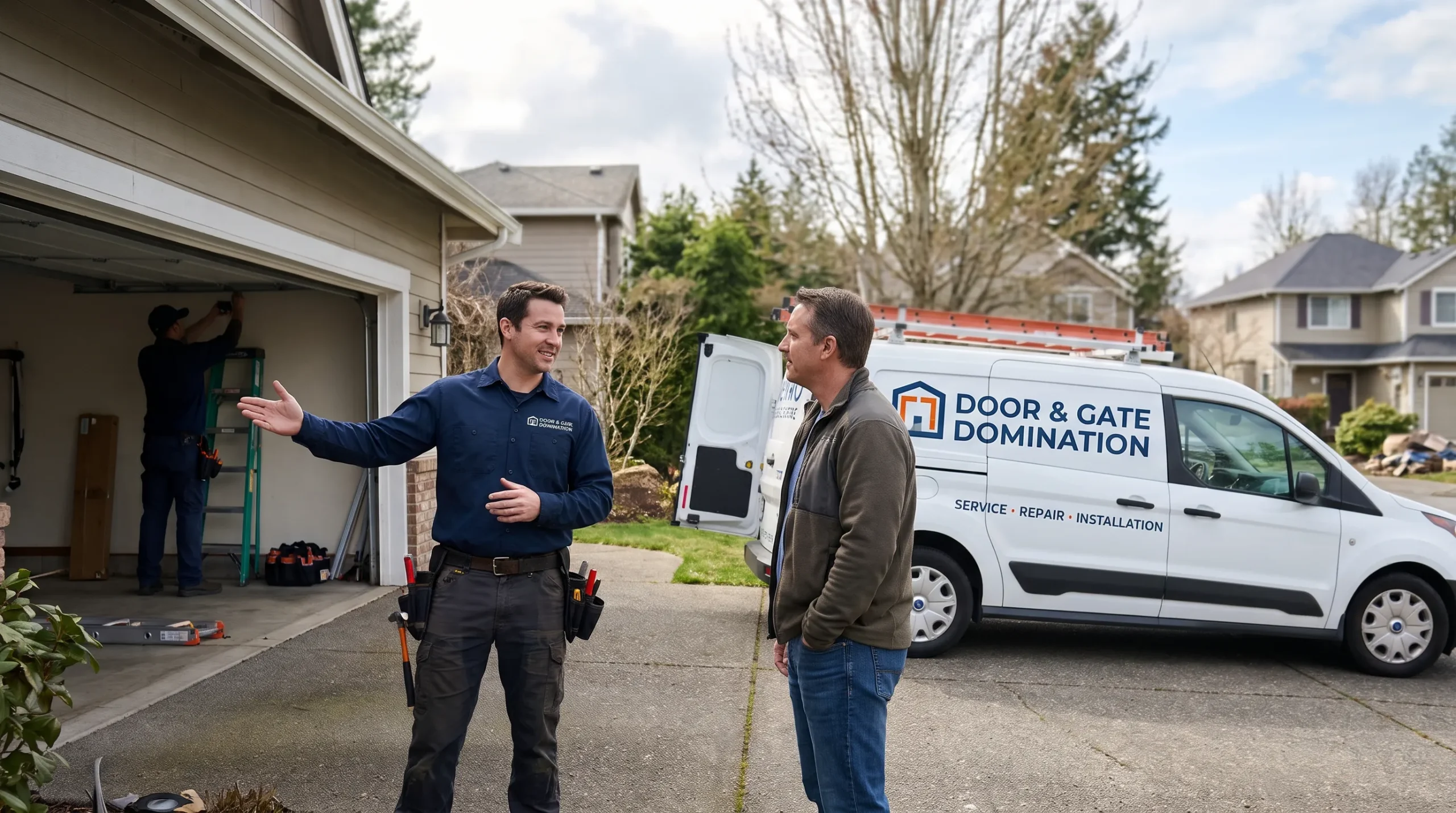
AI engines recommend garage door companies they can find, understand, and verify. Understand how the engines choose. Build authority with a crawlable, answer-first website and listings that all agree. Then build reputation with steady reviews, thoughtful replies, and real mentions across your community. None of these steps is a trick, and that is exactly why they work: they make your company the clearest, most trustworthy answer to the questions homeowners are already asking.
If you would rather have a team that works only with door and gate companies handle this for you, Door & Gate Domination can audit what AI says about your business today and build the plan to fix it.
Book your free AI visibility consultation today and find out exactly where your company stands in ChatGPT, Google AI, and Perplexity.