


Quick answer: Google AI Overviews choose sources from pages already in Google’s search index that are eligible to show a snippet. Google’s core ranking and quality systems decide which of those pages are relevant and trustworthy, and a technique called “query fan-out” runs related searches in the background to find supporting pages for different parts of the answer. For garage door companies, that means the pages that get cited are the ones that already rank well, answer the exact question clearly, and show real expertise.
Key takeaways
- The index comes first. If a page isn’t indexed and snippet-eligible, AI Overviews can’t cite it.
- AI Overviews don’t show for every search. Google only shows one when it decides a summary adds value, which is most often on detailed questions.
- Query fan-out widens the net. Google may run several related searches to build one answer, so pages that answer follow-up questions get extra chances to be cited.
- Trust decides the shortlist. The same quality systems behind regular rankings filter which pages are safe to summarize.
- There’s no special AI markup. Selection rewards clear, helpful content, not hidden code or AI files.
- Being cited isn’t the finish line. Fewer people click when a summary appears, so cited pages need to convert.
1. AI Overviews start with Google’s search index
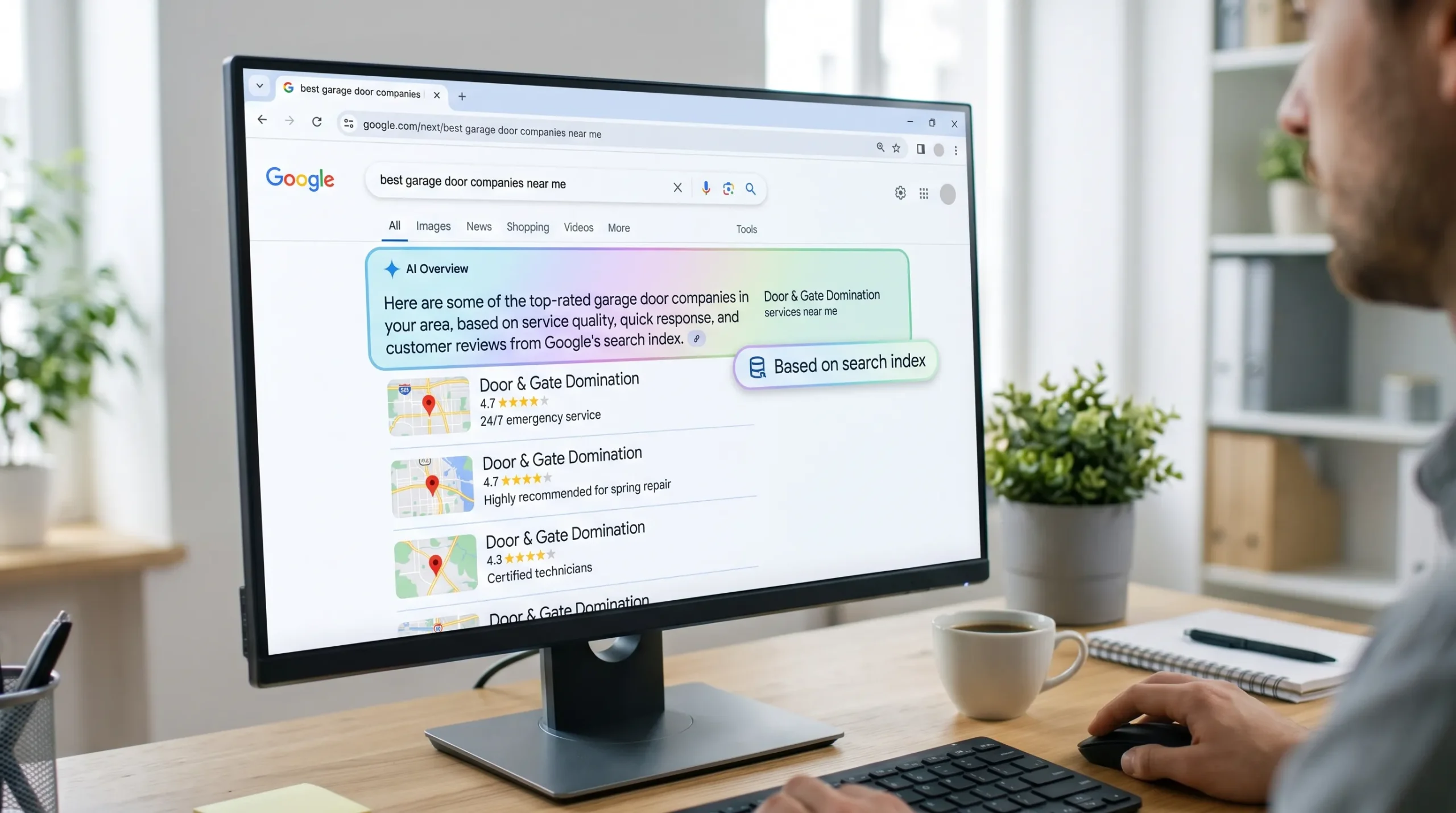
The answer: AI Overviews can only cite pages that Google has indexed and is allowed to show with a snippet. Every citation starts from the same index that powers regular search results.
How Google finds pages that AI Overviews can use
The problem: A garage door company publishes a great page on spring repair costs, but it never appears in AI Overviews or anywhere else in Google.
Why it happens: The page isn’t indexed, or settings like noindex, nosnippet, or a restrictive max-snippet tag stop Google from showing it. Blocked crawling in robots.txt or a hosting firewall has the same effect.
How to fix it:
- Check the page in Search Console’s URL Inspection tool to confirm it’s indexed.
- Remove any unintended noindex or nosnippet tags.
- Make sure robots.txt and any CDN rules allow Googlebot.
- Link to new pages from existing ones so Google discovers them quickly.
Bring in a specialist if: important pages have been stuck as “Discovered, currently not indexed” for weeks.
Eligibility is the first of ten steps we cover in How Garage Door Companies Can Show Up in Google AI Overviews.
2. Google decides when an AI Overview is worth showing
The answer: AI Overviews only appear when Google’s systems judge that a summary adds something beyond the regular results. Many searches never trigger one.
Which searches trigger AI Overviews for garage door topics
The problem: You search “garage door repair near me” and see no AI Overview, so you assume the feature doesn’t matter for your business.
Why it happens: Short, local, ready-to-book searches usually show map results and ads instead. AI Overviews lean toward longer, question-style searches, such as “why does my garage door open a few inches and stop?”
How to fix it:
- Separate your keyword list into service searches and question searches.
- Search your top 20 homeowner questions and note which ones show an AI Overview.
- Prioritize content for the questions that trigger summaries in your market.
Bring in a specialist if: you don’t have the search data to see which questions matter most.
We sort these question types by stage and intent in What Types of Garage Door Questions Can Appear in AI Overviews?
3. Query fan-out gathers supporting sources
The answer: For a single question, Google may run several related searches across subtopics, then cite pages found through those searches. That’s why AI Overviews often link to a wider mix of sites than a normal results page.
How query fan-out affects which garage door pages get cited
The problem: A competitor gets cited for “should I repair or replace my garage door?” even though your page ranks higher for that exact phrase.
Why it happens: Behind the scenes, Google may also search related subtopics, like average door lifespan, spring replacement cost, or signs of track damage. If a competitor’s page answers one of those better, it can earn the citation for that part of the summary.
How to fix it:
- For each main question, list the three to five follow-up questions a homeowner would ask next.
- Answer those follow-ups on the same page or on closely linked pages.
- Use clear subheadings so each answer is easy to find.
Bring in a specialist if: you’re losing citations to competitors whose pages look weaker than yours.
4. Core ranking and quality systems filter the shortlist
The answer: AI Overviews rely on the same core ranking and quality systems as regular Google Search. Pages that already rank well and show strong quality signals are the most likely to be chosen.
Why ranking well still matters for AI Overview citations
The problem: You’re told to “optimize for AI” instead of SEO, and your rankings slip.
Why it happens: There’s a lot of advice suggesting AI Overviews use a separate rulebook. They don’t. Weak rankings usually mean weak citation chances too.
How to fix it:
- Keep investing in the SEO fundamentals that earn rankings.
- Improve your strongest existing pages before publishing new ones.
- Expect results to build over months, as our garage door SEO timeline explains.
Bring in a specialist if: your rankings have dropped and you can’t tell why.
5. Answer the exact question, right away
The answer: Pages that state the answer clearly in the first few sentences are easier for Google to match to a question and summarize. Relevance starts with directness.
How to write garage door content that AI Overviews can cite
The problem: Your page on noisy garage doors spends three paragraphs on company history before mentioning the cause.
Why it happens: Older SEO copy was written for word counts, not for quick answers.
How to fix it:
- Open with a bolded quick answer to the headline question.
- Use headings that match how homeowners phrase the question.
- Give specific details: parts, symptoms, and when to call a pro.
- Keep key information in text, not only in images or video.
Google’s own AI features guidance for site owners confirms that the same SEO best practices apply and no special optimization is required. Our answer engine optimization work focuses on rewriting existing pages into this answer-first format.
Bring in a specialist if: you have dozens of pages that need restructuring and no time to do it.
6. Show trust signals Google can verify
The answer: Google favors sources that show real experience, expertise, and trustworthiness, especially when the answer affects someone’s safety or money. Garage door repair covers both.
How trust signals influence AI Overview source selection
The problem: Your content is accurate, but it has no author, no credentials, and no proof you’ve done the work.
Why it happens: Content often gets published without the technician expertise behind it being visible.
How to fix it:
- Add a named author byline with credentials and years of field experience.
- Include real job photos from your service area.
- Give honest safety warnings, like leaving torsion spring work to trained techs.
- Build a steady flow of genuine reviews through reputation management. Our post on reputation management for garage door contractors covers the review side in depth.
Trust carries extra weight with AI summaries. The feature has faced public criticism for inaccurate answers, as the history of Google AI Overviews shows, and credible sources give Google safer material to work from.
Bring in a specialist if: your team has the expertise but nobody documents it online.
7. Keep your business details consistent everywhere
The answer: Consistent business information across your website, Business Profile, and social channels helps Google confidently understand who you are and where you work. Confusion about your business makes you a riskier source.
How business consistency helps garage door companies get cited
The problem: Your service area, phone number, or business name differs across your site, Business Profile, and directories.
Why it happens: Details change over time and not every listing gets updated.
How to fix it:
- Audit your Business Profile using our Google Business Profile guide.
- Match your name, address, and phone exactly across every listing.
- Keep your social profiles active and consistent with your website. Our social media services handle this for contractors.
Bring in a specialist if: you have duplicate or suspended listings.
8. Cover the topic, not just the keyword
The answer: A cluster of linked pages that covers a topic from several angles gives query fan-out more of your pages to find. Depth across related questions beats one isolated post.
How topic clusters increase AI Overview citation chances
The problem: You have one page on garage door openers and nothing on remote problems, sensor issues, or opener lifespan.
Why it happens: Content gets published one post at a time without a plan.
How to fix it:
- Choose a pillar topic and list every related question under it.
- Write a focused page for each major question.
- Link the pillar to each page, and each page back to the pillar.
- Plan the whole set in advance using our guide to building your SEO strategy.
Bring in a specialist if: your blog has many posts competing for the same searches.
9. Skip the tactics that don’t affect selection
The answer: Special AI files, extra schema types, and sheer page volume don’t earn citations. Google says no new machine-readable files or special markup are needed.
Common myths about how AI Overviews pick sources
The problem: A vendor sells you an “AI-ready” package, or you publish hundreds of near-identical city pages.
Why it happens: Confident advice spreads faster than Google’s actual guidance.
How to fix it:
- Remove any vendor-added files or markup that doesn’t match visible content.
- Consolidate thin or duplicate pages into fewer, stronger ones.
- Put that budget into better answers, real photos, and expert authorship.
Bring in a specialist if: you’re not sure what a past vendor added to your site. Our 2026 garage door marketing plan shows where the budget should go instead.
10. Stay eligible and confirm you’re being cited
The answer: Check that your site hasn’t been excluded from AI features, then track which pages actually appear. Selection only helps if you know it’s happening.
How to confirm Google can use your site in AI Overviews
The problem: You’ve done the work but can’t tell whether any pages are being cited.
Why it happens: Many owners never check their Search Console settings or AI reporting.
How to fix it:
- Confirm your site is set to “include” under the Search generative AI control in Search Console. Sites that opt out get no traffic or impressions from these features.
- Review Search Console’s generative AI performance report to see which pages appear.
- Compare cited pages against your target question list.
Bring in a specialist if: you want monthly reporting that ties citations to leads.
We walk through the full reporting setup in How Can a Garage Door Company Track Its AI Overview Visibility?
11. Turn citations into calls
The answer: Make every cited page easy to act on, and use paid local channels for the urgent searches AI Overviews don’t cover. A citation only pays off when it produces a booked job.
How garage door companies convert AI Overview citations into leads
The problem: Your pages get cited, but calls don’t increase.
Why it happens: People click less when an AI summary appears. A 2025 Pew analysis found clicks on traditional results dropped noticeably on pages with AI summaries, as Search Engine Land’s coverage of the Pew AI Overviews study reports. The visitors who do click need a fast path to book.
How to fix it:
- Add a click-to-call button and a short booking form near the top of every cited page.
- Match the offer to the question, like same-day service on a broken-spring page.
- Capture emergency “near me” searches with Google Local Service Ads.
- Support high-intent searches with paid search, using our guide to Google Ads for garage door companies.
Bring in a specialist if: you need organic visibility, local ads, and call tracking working as one system.
What influences AI Overview source selection (and what doesn’t)
Factor | Influences selection? | What to do |
Page is indexed and snippet-eligible | Yes, required | Check URL Inspection and remove blocking tags |
Page ranks well for the question | Yes, strongly | Keep up SEO fundamentals |
Direct answer near the top | Yes | Lead with a bolded quick answer |
Coverage of follow-up questions | Yes, through query fan-out | Build topic clusters |
Visible expertise and trust signals | Yes | Named author, real photos, reviews |
Consistent business details | Helps | Align website, Business Profile, and listings |
Special AI files or “AI schema” | No | Skip them |
Word count alone | No | Answer clearly instead of padding |
Hundreds of near-duplicate pages | No, can hurt | Consolidate into stronger pages |
Conclusion
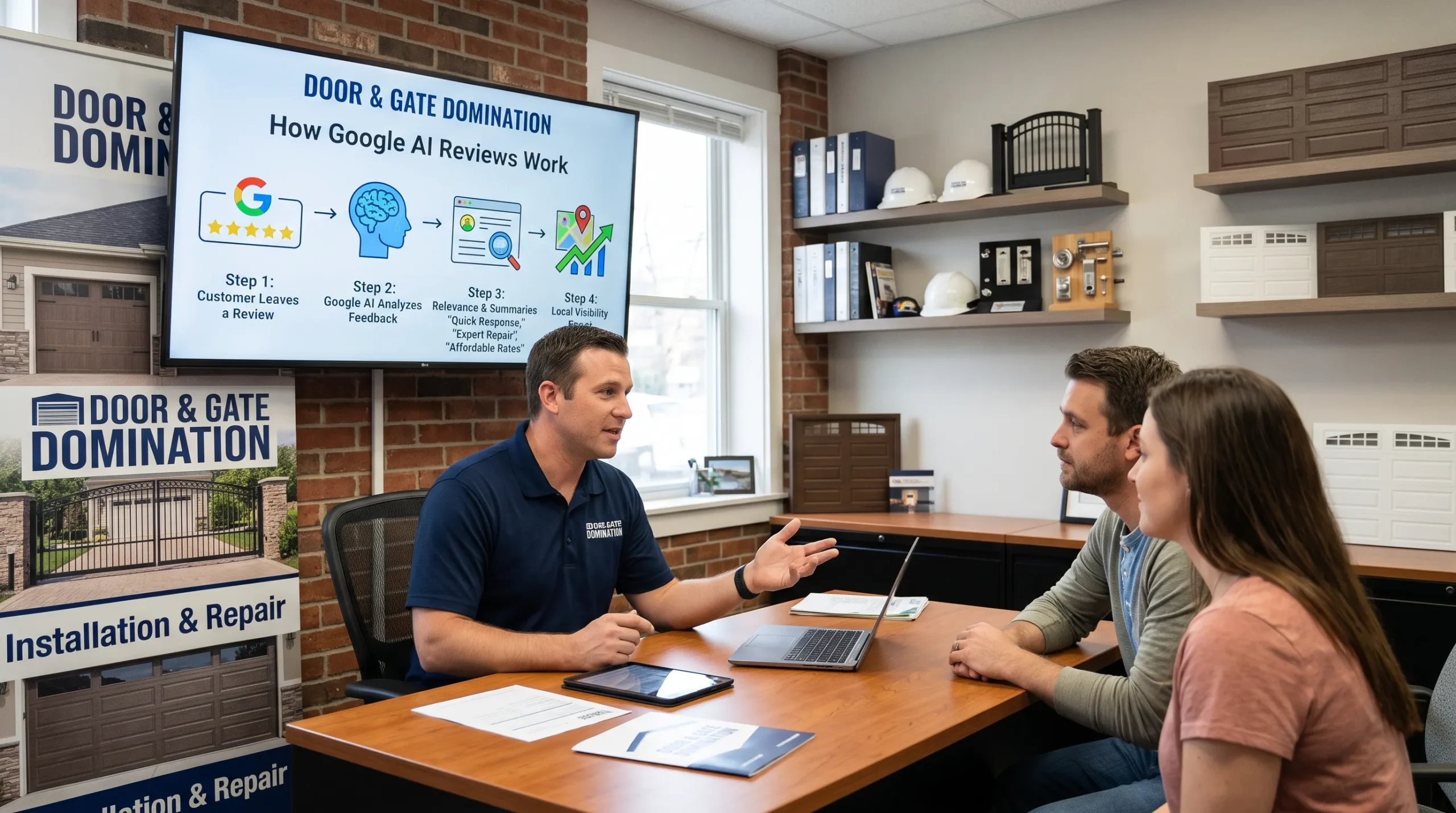
Google AI Overviews don’t pick sources at random or through a secret formula. They start with indexed pages, filter them through the same ranking and quality systems as regular search, and widen the net with query fan-out. Garage door companies that learn how that process works, publish clear and trustworthy answers, and build their pages to convert are the ones that get cited and get called.
If you want a team that works only with garage door, gate, and fence contractors to handle this for you, Door & Gate Domination can audit which of your pages are eligible, find the questions you’re missing, and build the content that earns citations.
Book your free strategy session now to see where your site stands in AI Overviews.