


Quick answer
Garage door companies turn AI search traffic into leads by sending AI visitors to a page that matches their exact question, then making it effortless to call or book from a phone. Show what the AI summary left out, like a price range, same-day availability, warranty, and the cities you serve, and put real reviews right next to the call button. Answer calls and form leads fast, and track every AI-referred lead through to a booked job so you know which pages are paying off.
Key takeaways
- AI visitors have usually read a summary already. They want confirmation and a phone number, not a sales pitch.
- Link each question to its matching service page, not your homepage.
- A tap-to-call button and a three-field form above the fold on mobile do more than any redesign.
- Price ranges in words, availability, and service area details close the gap AI summaries leave.
- Speed wins: the first company to answer usually gets the job.
- Tag AI traffic in analytics and ask every caller how they found you, so you can tie AI visibility to revenue.
1. Send AI visitors to the page that matches their question
How to match garage door landing pages to AI search questions
The page an AI visitor lands on should answer the same question they just asked. If someone asked ChatGPT about a broken spring and clicked your link, they should land on your spring repair page, not your homepage.
The problem: Many garage door sites have one general services page. AI tools link to whatever page best matches, and if nothing matches closely, the visitor lands somewhere generic and leaves.
Why it happens: Sites get built around the company, not around the problems homeowners have.
How to fix it:
- Build a dedicated page for each high-value service: spring repair, opener repair and installation, cable and roller repair, off-track doors, and new door installation.
- Put the page’s main question and answer at the very top.
- Link related question pages to each other, so a visitor reading about noisy doors can reach roller replacement in one tap.
- Keep those pages strong in regular search results with ongoing search engine optimization, since AI tools often pull from pages that already rank.
When to bring in help: If you’re not sure which pages AI tools link to today, review the landing pages report in your analytics before building anything new. For the basics behind all of this, start with What Is AEO and Why Does It Matter for Garage Door Companies?. Our guides on landing pages for garage door repair leads and increasing your website conversion rate go deeper.
2. Make calling and booking effortless on mobile
How to add tap-to-call and booking that converts AI visitors
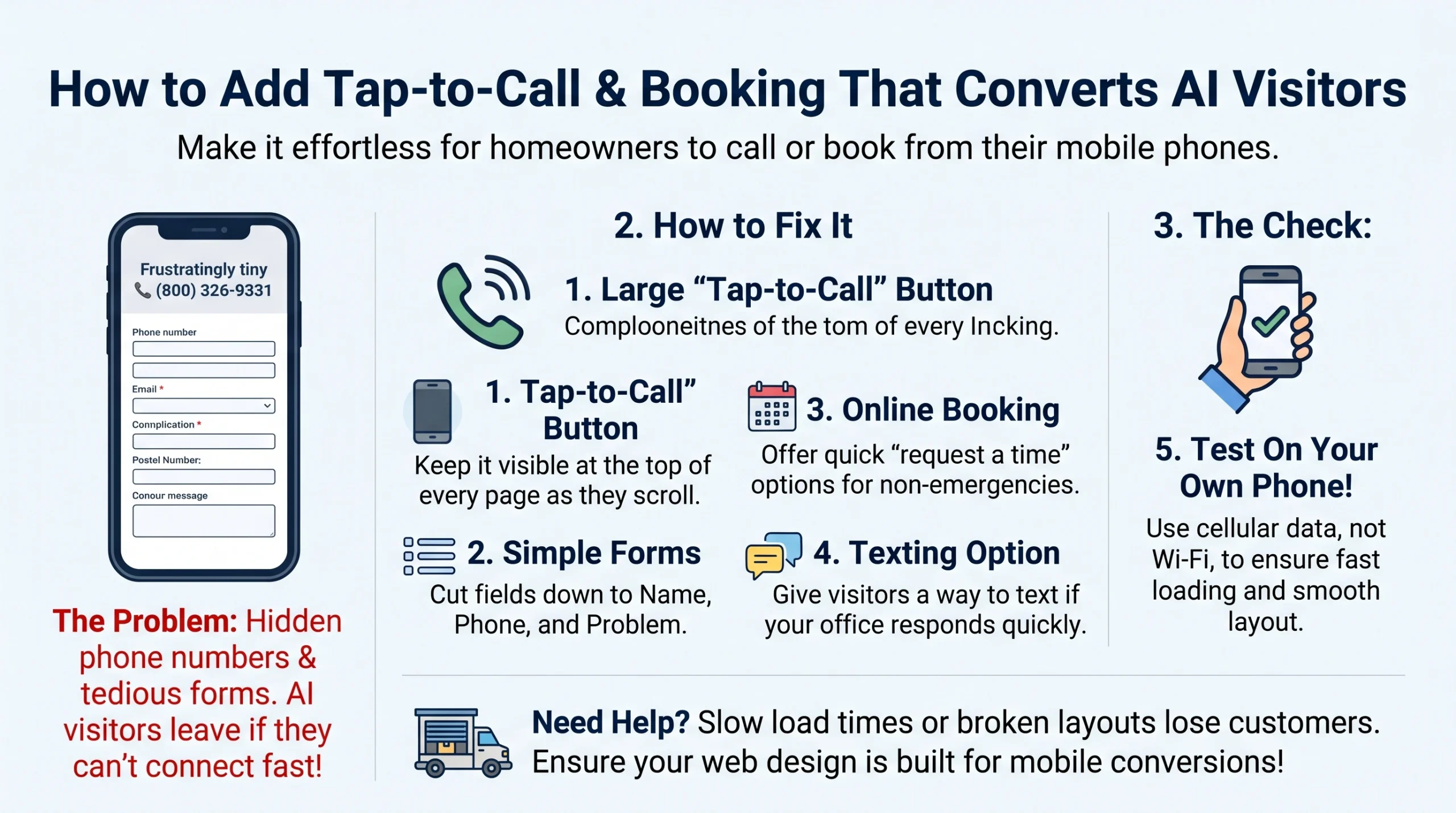
Most homeowners with a stuck door are on their phone. If they can’t call or book within a few seconds, they go back to the AI answer and try the next company.
The problem: Phone numbers hidden in the footer, forms with ten fields, and booking tools that only work on desktop.
Why it happens: Sites are often designed and approved on a desktop screen, so mobile problems go unnoticed.
How to fix it:
- Put a large tap-to-call button at the top of every page on mobile, and keep it visible as visitors scroll.
- Cut forms down to name, phone, and a short description of the problem.
- Offer online booking or a “request a time” option for non-emergency jobs.
- Add a text option if your office can respond to texts quickly.
- Test every page on your own phone, with cellular data, not Wi-Fi.
When to bring in help: If your pages load slowly or the layout breaks on phones, it’s time for web design built for conversions. See what high-converting garage door websites have in common and why mobile-friendly websites for garage door contractors win more calls.
3. Show what the AI summary left out
What garage door details turn AI visitors into callers
AI summaries answer the general question. They rarely tell the homeowner what your company charges, when you can come out, or whether you serve their street. Those are the details that decide who gets the call.
Why every visitor counts: AI answers send fewer clicks than regular search results. Research from the Pew Research Center found that Google users clicked a link inside an AI summary in only 1% of visits. When clicks are that rare, the page has to close the deal on the first visit.
How to fix it: Add these details near the top of every service page:
- A price range in words, like “most spring repairs fall in the low hundreds of dollars,” if your team is comfortable sharing it.
- Availability, like “same-day and weekend appointments.”
- The cities and neighborhoods you serve.
- Your warranty on parts and labor.
- Brands you install and repair.
- Whether you offer free estimates for new doors.
When to bring in help: If you’re not sure what’s missing, run through our audit on whether your website is scaring away garage door customers. And if AI isn’t sending you visitors yet, start with How Can Garage Door Companies Get Their Content Cited by AI?.
4. Put proof right next to the call button
How reviews and trust signals convert AI search traffic
An AI answer may have recommended you, but the homeowner still wants to see proof before calling a stranger to their house. Reviews, photos, and credentials placed near the call button answer the question “Can I trust these people?” in a glance.
The problem: Reviews buried on a separate testimonials page, stock photos of smiling models, and no sign of who will actually show up.
Why it happens: Trust content gets treated as decoration instead of part of the sales process.
How to fix it:
- Show two or three recent, detailed reviews beside the call button on every service page.
- Display your star rating and review count from Google.
- Use real photos of your techs, trucks, and finished jobs.
- Add licenses, insurance, warranties, and manufacturer dealer badges you actually hold.
- Include a short “meet the team” line, like the lead tech’s name and years in the trade.
Watch out for: Anything that isn’t genuine. The Federal Trade Commission bans fake reviews and testimonials, including AI-generated ones, and prohibits suppressing negative reviews. Real reviews, including an occasional honest complaint handled well, build more trust than a wall of perfect ratings. Our playbook on how to respond to negative reviews shows how to turn criticism into credibility.
5. Answer fast and capture every lead
How fast follow-up turns AI leads into booked garage door jobs
The first company to respond usually gets the job. A homeowner with a door stuck open won’t wait an hour for a callback when two other companies were named in the same AI answer.
The problem: Missed calls after hours, voicemails that sit until morning, and web forms nobody checks until the end of the day.
Why it happens: Small offices get busy, and lead follow-up depends on whoever happens to be free.
How to fix it:
- Answer every call live during business hours, and use an answering service or on-call rotation after hours.
- Send an automatic text reply to every missed call and form submission within a minute.
- Call back web leads within minutes, not hours.
- Use a simple script: confirm the problem, give the next available time, and book it on the call.
- Follow up with anyone who asked for a quote but didn’t book.
Apply it to every channel: The same follow-up speed matters for leads from paid search, Google Business Profile calls, and referrals. Learn how marketing automation for garage door companies handles instant replies, and what separates a quality lead in marketing from a tire kicker.
6. Track AI leads from first click to booked job
How to track garage door leads from ChatGPT and AI search
Tracking tells you which AI sources and pages bring in real jobs, not just visits. Without it, AI traffic hides inside “direct” or “referral” and you can’t tell whether your AEO work is paying off.
How to fix it:
- In Google Analytics, create a report or segment for AI sources: chatgpt.com, perplexity.ai, gemini.google.com, and copilot.microsoft.com. OpenAI notes that site owners can track ChatGPT referral traffic in analytics tools like Google Analytics.
- Mark calls, form fills, and bookings as conversions so you see leads, not just visits.
- Use call tracking numbers on key pages so phone leads get credited to the right source. Our call tracking and reporting page explains how it works.
- Ask every new caller, “How did you hear about us?” and log answers like “ChatGPT” or “Google’s AI.”
- Check Bing Webmaster Tools, whose AI Performance report shows which of your pages are cited in Microsoft Copilot answers.
- Once a month, match AI-sourced leads to booked jobs and revenue in your CRM or job software.
Put the numbers to work: Double down on the pages that turn AI visits into jobs, and fix the ones that get visits but no calls. Use our guide to marketing KPIs for garage door contractors to decide what to measure. For the full system that feeds this funnel, see How to Get More Garage Door Leads With AEO, or let a managed answer engine optimization program run it for you.
AI search visitors vs. traditional search visitors
AI visitors arrive further along in their decision, so the page they land on has a different job to do.
|
Traditional search visitor |
AI search visitor |
|
|
What they’ve seen |
A list of links and ads |
A written answer that may name your company |
|
What they already know |
Very little about the problem or your company |
The likely cause of the problem and a short list of companies |
|
What they want from your page |
Information to compare options |
Confirmation, a price range, and a fast way to book |
|
How long they’ll look |
Several pages, sometimes several sites |
Often just one page before deciding |
|
Best landing page |
Service or category page |
The exact service page that matches their question |
|
Biggest conversion killer |
Weak rankings and thin content |
Hidden phone number, long forms, slow replies |
|
How to track them |
Organic search in analytics |
AI referral sources, call tracking, and “How did you find us?” |
Turn every AI visit into a booked garage door job
Getting named by AI is only worth it if the visit turns into a call. Match each question to the right page, make calling effortless on a phone, fill in the details the AI summary skipped, put real proof beside the call button, respond fast, and track every lead to a booked job. Those six fixes turn AI visibility into revenue you can measure.
Door & Gate Domination works only with garage door, gate, and fence contractors, and connects AI visibility, landing pages, and lead tracking into one system built around booked jobs.
Want to see how many leads AI search is sending you right now, and how many you’re losing? Book your strategy session and we’ll map it out with you.