


Quick answer
To get more garage door leads with AEO, make your company the clearest, most trusted answer AI tools can find. Answer real homeowner questions on your website in plain language, keep your Google Business Profile and reviews strong, add schema markup, let AI crawlers read your pages, and make it easy for AI-referred visitors to call or book. AEO builds on SEO instead of replacing it, so the garage door companies that get named in ChatGPT, Google AI Overviews, and Perplexity are usually the ones already doing the fundamentals well.
Key takeaways
- AEO (answer engine optimization) gets your company named inside AI answers. SEO gets your pages ranked. You need both.
- AI tools recommend businesses they can understand and verify, so complete business info, consistent listings, and real reviews matter as much as blog posts.
- Pages that answer one homeowner question clearly in the first two sentences are the easiest for AI to quote.
- Fewer people click through from AI answers, so the visitors who do arrive are closer to booking. Your site has to convert them fast.
- Track AI referrals in your analytics and call tracking every month, then double down on the pages that bring in jobs.
- Most of this work is DIY-friendly. Schema, crawler access, and tracking setup are where an experienced agency saves the most time.
1. Understand what AEO is and how it differs from SEO
How AEO helps garage door companies get more leads from AI search
AEO is the work of making your business the source an AI tool quotes or recommends when a homeowner asks a question. SEO earns your page a spot in the results. AEO earns your company a mention inside the answer itself.
The problem: A lot of owners hear “AEO” and assume they need to scrap their current marketing and start over. Others ignore it because it sounds like a fad.
Why it happens: AEO gets pitched as something brand new. In practice, AI tools lean on the same signals search engines have always used: clear pages, accurate business info, and trust from customers and other websites.
How to fix it:
- Keep your search engine optimization running. AI tools pull heavily from pages that already rank and get indexed.
- List the 20 to 30 questions your office hears most on the phone, such as “Why won’t my garage door close all the way?” or “How much does a new spring cost?” Those are the prompts homeowners now type into ChatGPT.
- Decide which of those questions your site answers today and which it doesn’t. The gaps are your AEO roadmap.
- Get the team on the same page about the basics. Our guide, What Is AEO and Why Does It Matter for Garage Door Companies?, covers the definitions in plain language, and this breakdown of how AEO and SEO work together for contractors shows where the two overlap.
When to bring in an agency: If your site barely ranks today, fix that first. AEO on top of weak SEO rarely moves the needle.
2. Publish answer-first content for the questions homeowners actually ask
How to write garage door content that AI tools quote

AI tools quote pages that answer one question directly, early, and without fluff. If a homeowner asks “Is it safe to open my garage door with a broken spring?”, the page that says “No, and here’s why” in its first sentence has the best shot at being cited.
The problem: Most garage door websites have a services page and a generic blog. Neither answers the specific, worried questions homeowners ask at 9 p.m. when the door won’t open.
Why it happens: Content usually gets written around keywords like “garage door repair [city]” instead of the real questions behind them.
How to fix it:
- Turn each question from Step 1 into its own page or a clearly labeled section, with the question as the heading.
- Answer it in the first one or two sentences, then explain the details, the safety risks, and when to call a pro.
- Name your service area and the brands you work on (LiftMaster, Genie, Chamberlain, Clopay, and so on) where it’s natural.
- Add a short FAQ to your key service pages, using the wording customers actually use.
- Update the page date and the facts at least once a year so AI tools see it’s maintained.
For a step-by-step system, read How Can Garage Door Companies Get Their Content Cited by AI? and our playbook on how contractors get listed in ChatGPT.
When to bring in an agency: If you don’t have time to publish two or three strong pages a month, a managed answer engine optimization program keeps the content moving while you run the trucks.
3. Make your Google Business Profile complete and consistent
How a Google Business Profile affects garage door AI recommendations
When a homeowner asks Google’s AI for a garage door company nearby, the business details it shows usually come from Business Profiles. A profile with missing services, wrong hours, or a vague service area gives AI less reason to recommend you.
The problem: Many profiles were set up years ago and never touched again. Categories are thin, services are missing, and the phone number doesn’t match the website.
Why it happens: Owners treat the profile as a listing, not as a data source that Google and other AI tools read.
How to fix it:
- Set “Garage door supplier” or the closest match as your primary category, then add every relevant secondary category.
- List each service you offer (spring replacement, opener installation, off-track repair, commercial doors) with a short description.
- Define your real service area by city, and keep your name, address, and phone number identical everywhere online.
- Add fresh job photos every month and answer common questions in your profile posts.
See our full guide to the Google Business Profile for garage door companies, plus how to get your business recommended by Google’s AI Overviews.
When to bring in an agency: If your profile was suspended, has duplicate listings, or shows the wrong address, get expert help. Those issues can take weeks to untangle.
4. Make your website easy for AI crawlers and search engines to read
How to add schema markup and open your garage door site to AI crawlers
AI tools can only recommend what they can read. That takes two things: crawlers allowed onto your site, and structured data (schema markup) that spells out who you are, what you do, and where you work.
The problem: Some garage door websites block AI crawlers without the owner knowing, often through a security plugin or a hosting setting. Others hide key info inside images or pop-ups that crawlers skip.
Why it happens: Crawler rules get set once by a developer and forgotten. Schema is invisible on the page, so nobody notices when it’s missing.
How to fix it:
- Open yourdomain.com/robots.txt and check that you aren’t blocking Googlebot, Bingbot, or OAI-SearchBot. OpenAI, the company behind ChatGPT, uses OAI-SearchBot to find pages for ChatGPT search, and blocking it keeps your content out of those answers.
- Add LocalBusiness schema with your name, phone, address or service area, hours, and services. Add FAQPage schema to pages with a real FAQ section.
- Put your services, service cities, and phone number in plain text on the page, not only inside images or sliders.
- Make sure pages load fast on a phone. Homeowners with a stuck door are almost always on mobile.
If you’re rebuilding, start with our checklist of what should be on a garage door company website. A site built with web design that treats speed and structure as requirements makes every later AEO step easier.
When to bring in an agency: Schema errors and crawler rules are easy to get wrong and hard to spot. If you’re not comfortable editing code or testing markup, hand this step off.
5. Earn reviews and mentions that AI engines trust
How reviews and local citations help garage door companies show up in AI answers
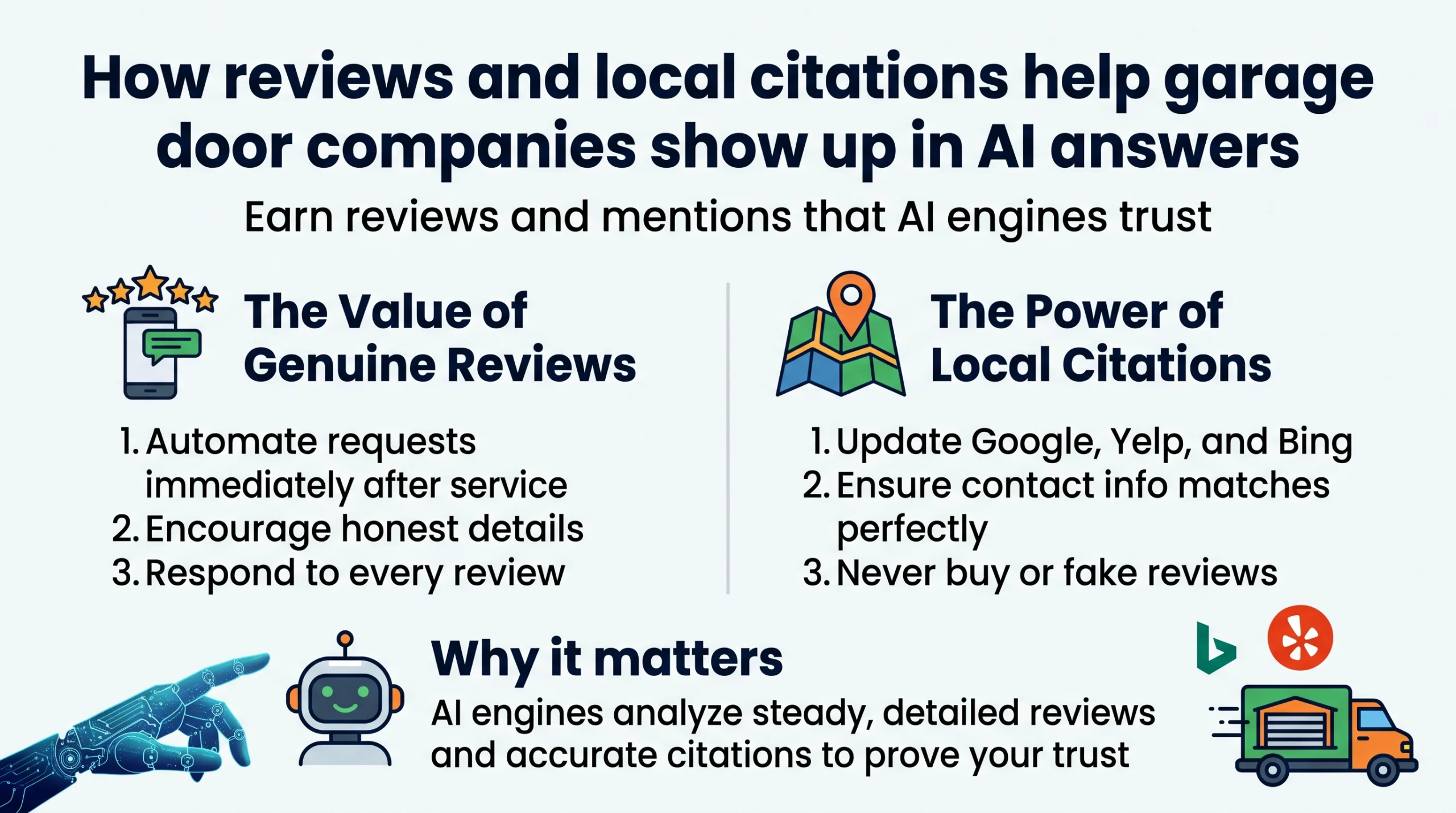
AI tools look for proof that other people trust you. Steady, detailed reviews and consistent mentions on other reputable sites are two of the strongest signals a garage door company can build.
The problem: Many companies have a burst of old reviews and then nothing. Others have listings on directories with outdated phone numbers or old addresses.
Why it happens: Review requests depend on techs remembering to ask. Directory listings get created once and never checked again.
How to fix it:
- Ask every customer for a review, ideally by text right after the job is paid. Automate it so it doesn’t depend on memory.
- Encourage honest detail. A review that says “replaced a broken torsion spring same day in Mesa” tells AI far more than “great service.”
- Respond to every review, good or bad, with a short, specific reply.
- Keep your listings consistent on Yelp, the BBB, Bing Places, Apple Business Connect, Nextdoor, and manufacturer dealer locators.
- Never buy reviews, write them yourself, or offer discounts only for positive ones. The Federal Trade Commission now bans fake reviews, including AI-generated ones, and can seek civil penalties against businesses that knowingly use them.
For more tactics, see our 15 best ways to get more Google reviews for garage door companies, how AI search summarizes your customer reviews, and the benefits of local citations for garage door contractors.
When to bring in an agency: If you have dozens of inconsistent listings or a run of negative reviews, a reputation cleanup is faster with a team that does it daily.
6. Turn AI-referred visitors into booked jobs
How to convert AI search traffic into garage door leads
AI answers send fewer clicks, but the people who do click are usually further along. They’ve already read a summary, and they’re looking for a company to call. Your page has to confirm the answer and make booking easy within seconds.
The problem: A homeowner clicks through from an AI answer about a broken spring and lands on a generic homepage. They can’t find the phone number, a price range, or proof you serve their town, so they go back and pick the next company.
Why it happens: Most sites were built for browsers who compare several companies. AI visitors skip that stage.
How to fix it:
- Match the landing page to the question. Link spring questions to your spring repair page, not the homepage.
- Put a tap-to-call button and a short booking form above the fold on mobile.
- Show what AI summaries leave out: a price range in words, same-day availability, warranty terms, and the cities you serve.
- Place two or three recent reviews right next to the call button.
- Keep forms to name, phone, and the problem. Every extra field costs you leads.
Research from the Pew Research Center found Google users clicked a regular search result in 8% of visits when an AI summary appeared, compared with 15% when it didn’t. With fewer clicks to go around, each one needs to count. Get the full playbook in How Can Garage Door Companies Turn AI Search Traffic Into Leads?, and use our guide to garage door website conversion to find leaks on your current site.
When to bring in an agency: If your site gets traffic but the phone doesn’t ring, you likely have a conversion problem, not a visibility problem. A conversion audit pays off before any new content does.
7. Track AI referrals and keep refining
How to measure garage door leads from ChatGPT, Copilot, and AI Overviews
You can’t grow what you don’t measure. AI referrals show up in your analytics, your call tracking, and a growing set of AI reports from the search engines themselves.
The problem: Most garage door companies lump AI visits into “referral” or “direct” traffic and never see them. When the phone rings, nobody asks how the caller found them.
Why it happens: Default analytics reports don’t label AI traffic, and AI tools often don’t pass full referral data.
How to fix it:
- In Google Analytics, filter traffic sources for chatgpt.com, perplexity.ai, copilot.microsoft.com, and gemini.google.com.
- Use call tracking numbers on your key pages so AI-driven calls get attributed correctly.
- Have your office ask every new caller, “How did you find us?” and log answers like “ChatGPT” or “Google’s AI answer.”
- Check Bing Webmaster Tools, which now reports how often your pages are cited in Microsoft Copilot answers, and review Search Console each month.
- Once a month, ask ChatGPT, Gemini, and Perplexity who they recommend for garage door repair in your city, and note whether you appear.
Tie those numbers back to booked jobs using our guide on how to track marketing ROI for a garage door business.
When to bring in an agency: AEO builds over months. If you need calls this week, run paid search alongside it so the schedule stays full while organic and AI visibility grow.
DIY vs. bringing in an agency: which AEO tasks to handle yourself
Most AEO work is something an owner or office manager can start this week. The technical pieces are where mistakes cost the most.
|
AEO task |
DIY-friendly? |
What you can do yourself |
When to bring in an agency |
|
List homeowner questions |
Yes |
Pull them from calls, texts, and reviews |
You want keyword and AI prompt data to rank them |
|
Write answer-first pages |
Yes, with time |
Draft answers in your own words |
You can’t publish consistently every month |
|
Google Business Profile |
Yes |
Fill every field, add photos and services |
Suspensions, duplicates, or wrong addresses |
|
Robots.txt and crawler access |
Partly |
Check that AI crawlers aren’t blocked |
Your plugin, host, or firewall is blocking bots |
|
Schema markup |
Rarely |
Use a basic plugin for LocalBusiness |
Custom schema, errors, or multi-location sites |
|
Reviews and citations |
Yes |
Automate review requests, fix listings |
Dozens of inconsistent listings or a reputation cleanup |
|
Conversion fixes |
Partly |
Add tap-to-call and shorten forms |
Traffic is steady but calls are flat |
|
AI referral tracking |
Partly |
Filter AI sources in analytics |
Call tracking, attribution, and monthly reporting |
Start getting more garage door leads from AI search
AEO isn’t a separate channel you bolt on. It’s the natural result of a site that answers real questions, a profile that’s complete, reviews that are honest and steady, and pages built to turn visitors into calls. Start with the questions your office hears every day, fix what AI can’t read, and track every lead that comes from an AI answer.
If you’d rather have a team that works only with garage door, gate, and fence contractors handle it, Door & Gate Domination builds and manages AEO programs that tie AI visibility directly to booked jobs.
Ready to find out whether ChatGPT and Google’s AI recommend your company? Book your strategy session and we’ll show you where you stand and what to fix first.