


Quick answer
Garage door companies get their content cited by AI by publishing pages that answer one real homeowner question clearly in the first sentence or two, backed by specific details like parts, brands, price ranges, and service cities. Add question-style headings, a short FAQ, schema markup, and a named expert, then make sure AI crawlers can read the page. Reviews and mentions on other trusted sites give AI the confidence to cite you. Refresh pages regularly and track which ones get cited so you can do more of what works.
Key takeaways
- AI tools quote the page that answers the question fastest and most clearly, not the longest page.
- One focused page per homeowner question beats one giant page that covers everything.
- Specific details (spring types, opener brands, cities, price ranges in words) make your content more quotable.
- A named, experienced author and real job examples make AI more confident citing you.
- Crawler access, schema markup, and off-site reviews are what let AI find and trust your content.
- Track citations monthly, then update the pages that are close to being cited.
1. Lead every page with a direct answer
How to write answer-first garage door pages AI can quote
Put the answer in the first one or two sentences. AI tools scan for the passage that answers the question most directly, and a page that makes readers wade through an intro rarely gets quoted.
What it looks like: A page titled “Can I open my garage door with a broken spring?” should start with “No. A broken torsion spring means the door’s full weight, often 150 pounds or more, is on the opener and your arms.” The explanation, safety risks, and repair options come after.
How to do it:
- Write the question as the page title or main heading.
- Answer it in one or two plain sentences, with no warm-up.
- Follow with the why, the details, and when to call a pro.
- Read the first two sentences alone. If they don’t fully answer the question, rewrite them.
Watch out for: Long intros about your company history, “In today’s world” openers, and burying the answer under a sales pitch. For more writing basics, see our guide on how to write a blog post for your website. This tactic is one piece of a bigger system, covered in How to Get More Garage Door Leads With AEO.
2. Build one page per homeowner question
How to choose garage door topics AI search wants to cite
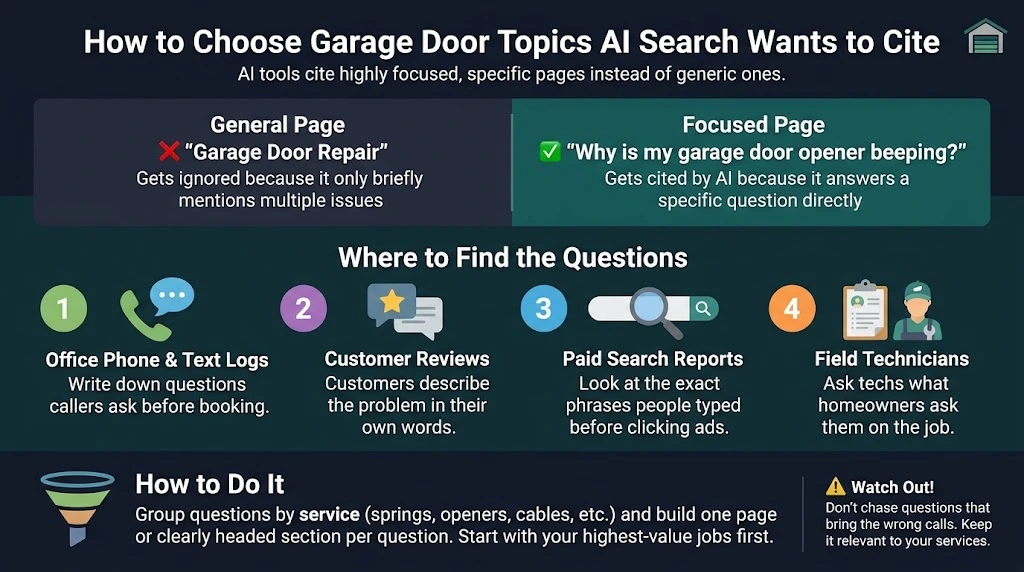
AI tools cite focused pages. A page that answers “Why is my garage door opener beeping?” has a much better shot at that exact question than a general “Garage Door Repair” page that mentions beeping once.
Where to find the questions:
- Your office phone and text logs. Write down the questions callers ask before they book.
- Your reviews. Customers often describe the problem in their own words.
- Your paid search search terms report, which shows the exact phrases people typed before clicking your ads.
- Techs in the field. Ask them what homeowners ask while they work.
How to do it: Group the questions by service (springs, openers, cables, off-track doors, new doors), then build one page or clearly headed section per question. Start with the questions tied to your highest-value jobs.
Watch out for: Chasing questions that bring in the wrong calls. If you don’t do commercial dock doors, don’t write about them. If the terminology is new to your team, share What Is AEO and Why Does It Matter for Garage Door Companies? first. Our content marketing playbook for garage door companies and list of garage door keywords that actually drive calls will help you prioritize.
3. Use question headings and short FAQ sections
How to structure garage door content with headings AI can extract
Clear headings tell AI exactly what each part of a page answers. When the heading is the question and the paragraph under it is the answer, AI can lift that pair almost word for word.
How to do it:
- Break long pages into sections with question-style headings, like “How long does a garage door spring last?”
- Keep each answer to two to four sentences, then add detail below if needed.
- Use numbered lists for steps and tables for comparisons, like repair vs. replace.
- Add a five to ten question FAQ at the bottom of key service pages.
- Write title tags and headings that match how people actually phrase the question.
Watch out for: Clever headings that hide the topic (“Spring Into Action!”) and giant walls of text. Our guide to improving your titles for search engine optimization covers headline writing in more detail, and strong search engine optimization makes sure those well-structured pages get found in the first place.
4. Add specific facts: parts, brands, price ranges, and cities
Why specific garage door details get cited more often
Specific content gets cited. Vague content gets skipped. AI tools look for pages that add concrete, useful details they can pass on to the person asking.
What it looks like: Compare “We fix all kinds of garage door problems” with “We replace torsion and extension springs, repair LiftMaster, Genie, and Chamberlain openers, and serve Mesa, Gilbert, and Chandler with same-day appointments.” The second one answers real questions.
Details worth adding:
- Part names and types (torsion vs. extension springs, belt vs. chain openers).
- Brands you install and repair.
- Price ranges in words, like “most spring replacements fall in the low hundreds of dollars.”
- Typical timelines, like “most opener installs take two to three hours.”
- The exact cities and neighborhoods you serve.
- Warranty terms and safety notes.
Watch out for: Made-up numbers. Only publish prices, timelines, and stats your team can stand behind. Inaccurate details hurt trust with homeowners and with AI.
5. Show real experience and put a named expert on the page
How E-E-A-T helps garage door content get cited by AI
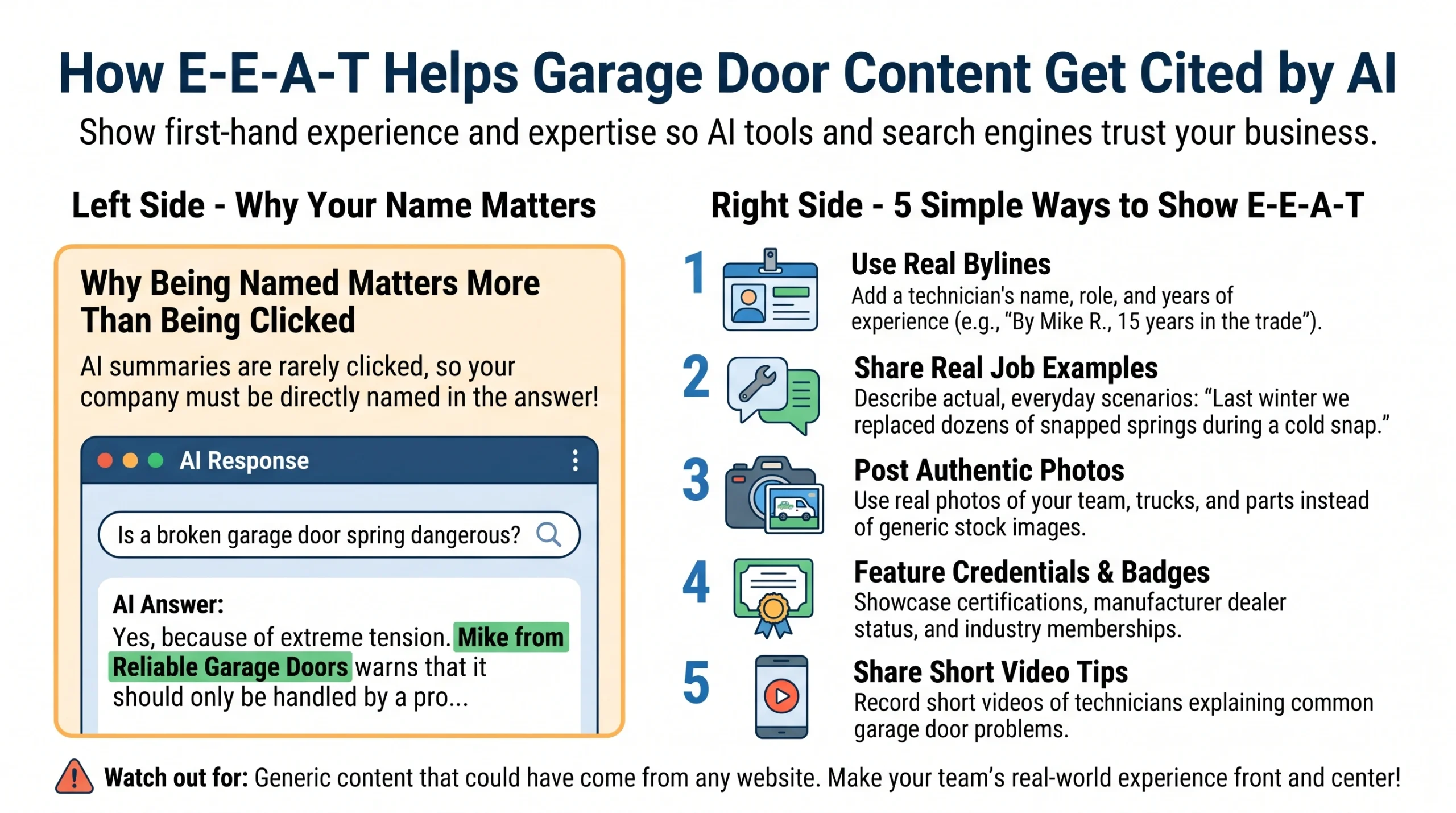
AI tools and search engines favor content that shows first-hand experience and real expertise. For a garage door company, that means content that clearly comes from people who do the work every day.
Why your name needs to be in the answer: Being named matters more than being clicked. Research from the Pew Research Center found that Google users clicked a link inside an AI summary in only 1% of visits. If AI quotes your advice, you want your company name attached to it, not just a small source link below.
How to do it:
- Add a byline with a real person’s name, role, and years in the trade, like “Written by Mike R., lead technician, 15 years installing garage doors.”
- Include real job examples: “Last winter we replaced dozens of springs that snapped during the first cold snap.” Only use examples that actually happened.
- Add your own photos of real jobs, parts, and your trucks instead of stock images.
- Mention certifications, manufacturer dealer status, and industry memberships you actually hold.
- Record short videos of techs explaining common problems.
Watch out for: Generic content that could have come from any website. Our guides on building a trusted garage door brand and video marketing for garage door repair show how to put your team’s experience front and center.
6. Add schema markup and keep your pages crawlable
How schema markup and crawler access help AI cite garage door pages
AI can only cite pages it can reach and understand. Crawler access lets AI tools read your pages, and schema markup labels what’s on them.
Check crawler access first: OpenAI, the company behind ChatGPT, uses a crawler called OAI-SearchBot to find pages for ChatGPT search. If your robots.txt file, security plugin, or hosting firewall blocks it, your content can’t be used in ChatGPT’s summaries and snippets. Do the same check for Googlebot and Bingbot.
How to do it:
- Visit yourdomain.com/robots.txt and look for any rule that blocks search crawlers.
- Add LocalBusiness schema with your name, phone, service area, hours, and services.
- Add FAQPage schema to any page with a real FAQ section, and Article schema with the author to blog posts.
- Test your markup with a schema validator after every change.
- Keep key text out of images, sliders, and pop-ups, where crawlers can miss it.
Watch out for: Schema that doesn’t match what’s on the page, or FAQ markup for questions that aren’t actually shown. Mismatches erode trust. A site built with solid web design handles speed, structure, and markup from the start. For more on the technical side, read our AI search optimization blueprint for the zero-click era.
7. Earn mentions and reviews outside your website
How off-site mentions help AI trust your garage door content
AI tools cross-check what you say about yourself against what others say about you. Reviews, directory listings, and mentions on other trusted sites all confirm that your content comes from a real, reputable business.
How to do it:
- Ask every customer for a review, and encourage them to mention the service and their city.
- Keep your listings consistent on Google, Bing Places, Apple Business Connect, Yelp, the BBB, and Nextdoor.
- Get listed on manufacturer dealer locators for the brands you install.
- Look for local press, sponsorships, and community pages that can mention or link to you.
- Answer questions on community forums in a helpful, non-salesy way.
Watch out for: Shortcuts with reviews. The Federal Trade Commission bans fake reviews, including AI-generated ones, requires employees and other insiders to disclose their connection when they post reviews, and prohibits suppressing negative reviews. See our tips on getting more 5-star reviews for your garage door business and mastering backlinks in SEO.
8. Refresh your content and track your citations
How to track whether AI cites your garage door content
Citations change as competitors publish and AI tools recrawl the web. Tracking shows you which pages are working, and refreshing keeps them current.
How to track it:
- In Bing Webmaster Tools, open the AI Performance report to see how often your pages are cited in Microsoft Copilot answers and which queries trigger those citations.
- In Google Analytics, filter traffic sources for chatgpt.com, perplexity.ai, and gemini.google.com.
- Once a month, ask ChatGPT, Gemini, and Perplexity your top ten homeowner questions and note which companies and pages they cite.
How to refresh it:
- Update prices, dates, photos, and product details at least once a year.
- Strengthen pages that get traffic but no citations by tightening the first two sentences.
- Add new FAQ questions as callers ask them.
What comes next: Getting cited is half the job. The other half is turning those visitors into calls, which we cover in How Can Garage Door Companies Turn AI Search Traffic Into Leads?. If you don’t have the time to publish, track, and refresh every month, a managed answer engine optimization program can handle it.
Content AI cites vs. content AI skips
The difference usually comes down to focus, specifics, and proof. Use this table to audit your existing pages.
|
Element |
Content AI tends to cite |
Content AI tends to skip |
|
Opening |
Answers the question in the first one or two sentences |
Starts with company history or a long intro |
|
Focus |
One clear question per page or section |
Many topics mixed on one page |
|
Headings |
Written as the question homeowners ask |
Clever or vague (“Spring Into Action!”) |
|
Details |
Parts, brands, price ranges in words, cities served |
“We fix all garage door problems” |
|
Author |
Named technician or expert with real experience |
No author, or “Admin” |
|
Proof |
Real job photos, examples, reviews, certifications |
Stock photos and generic claims |
|
Technical setup |
Crawlable, schema markup, fast on mobile |
Blocked crawlers, text in images, slow pages |
|
Freshness |
Updated at least yearly with current info |
Old prices, old dates, discontinued products |
Make your garage door content the answer AI chooses
AI cites content that answers fast, gets specific, and comes from a business it can verify. Start with the questions your office hears most, write one focused page for each, put a real expert’s name on it, and make sure crawlers can read it. Then track your citations and keep improving the pages that are close.
Door & Gate Domination works only with garage door, gate, and fence contractors, and builds content programs designed to get cited by AI and turn that visibility into booked jobs.
Want to see which of your pages AI already cites and which ones it skips? Book your strategy session and we’ll walk you through it.