


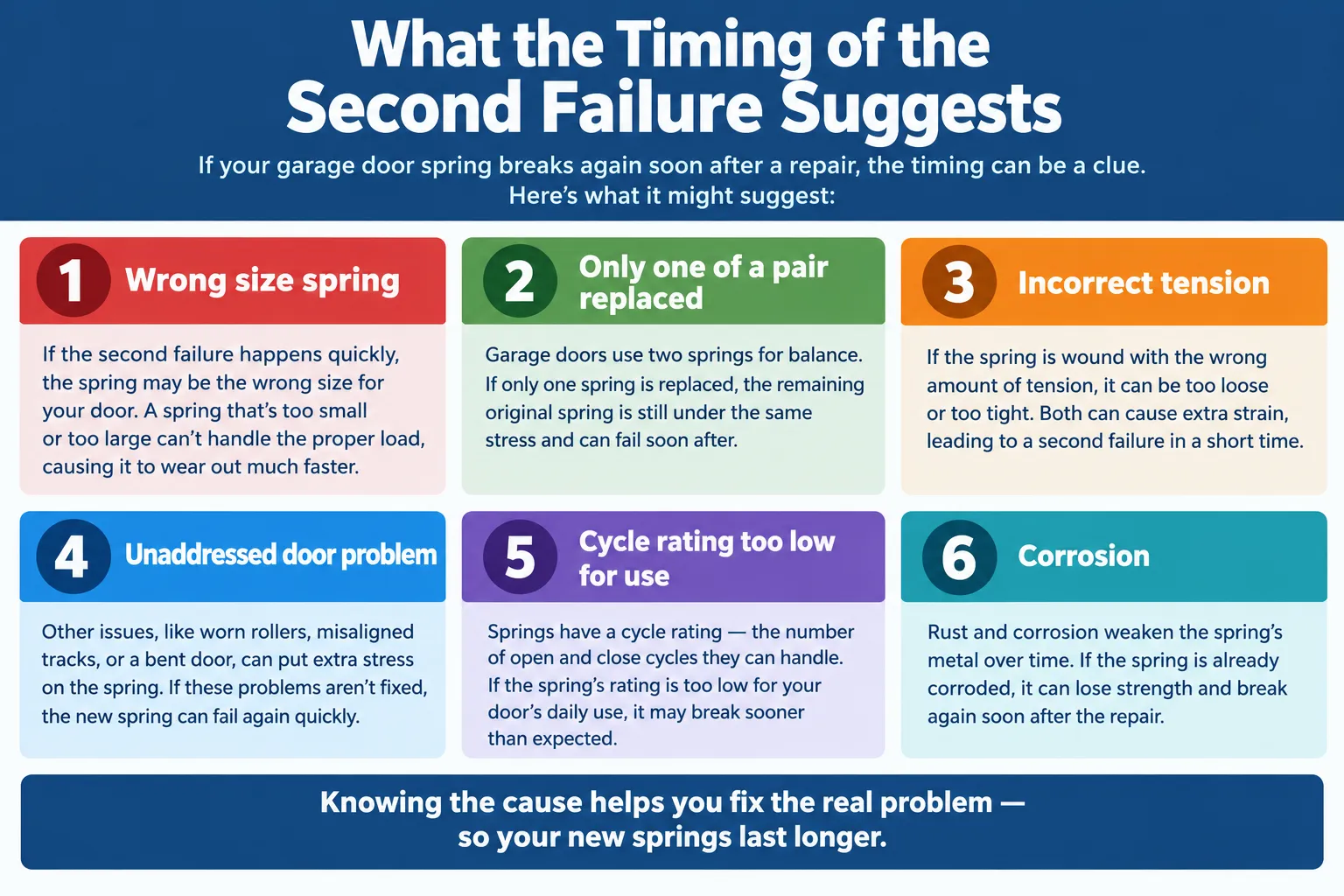
A spring that fails again soon after being replaced is telling you something specific, and it is almost never bad luck. The six causes below account for nearly all of it: the wrong size spring was installed, only one of a pair was replaced, the tension was set incorrectly, an underlying problem with the door was never addressed, the spring’s cycle rating does not match how much you use the door, or corrosion is working faster than the spring can tolerate. How quickly the second failure arrived narrows the list considerably. Days or weeks points at the installation. Months points at sizing or balance. A year or more points at duty and environment.
Key takeaways
- Springs are engineered to a cycle count, so an early second failure means something is loading the spring beyond what it was built for.
- The timing of the repeat failure is the most useful diagnostic information you have. Write down both dates.
- A new spring paired with an old one is the single most common cause, and it is preventable.
- Most of these causes are correctable, which means finding out which one applies is worth more than assuming the worst.
- A repeat failure is a reason to have the whole door assessed, not just the spring replaced a second time.
- Never attempt to handle, adjust, or release a garage door spring yourself. The stored tension can cause severe injury or death, including on a spring that has already broken.
Start with the timing
Before anything else, establish two dates: when the previous spring was installed, and when it failed. That gap does more diagnostic work than any single observation about the door.
A spring that lasted days or a small number of weeks almost always points at the installation itself, either the part chosen or the way it was set up. A spring that lasted several months to a year usually points at sizing or at an unresolved balance problem. A spring that lasted a couple of years but still well short of expectation usually points at how hard the door is worked or at the environment it lives in.
This matters practically, because it changes who you should be talking to and what you should be asking. It also matters because a company that responds to a repeat failure by simply installing another identical spring has not diagnosed anything. That pattern is one of several covered in How Do You Avoid a Garage Door Spring Replacement Scam? 10 Warning Signs to Watch For.
1. The replacement spring was the wrong size for your door
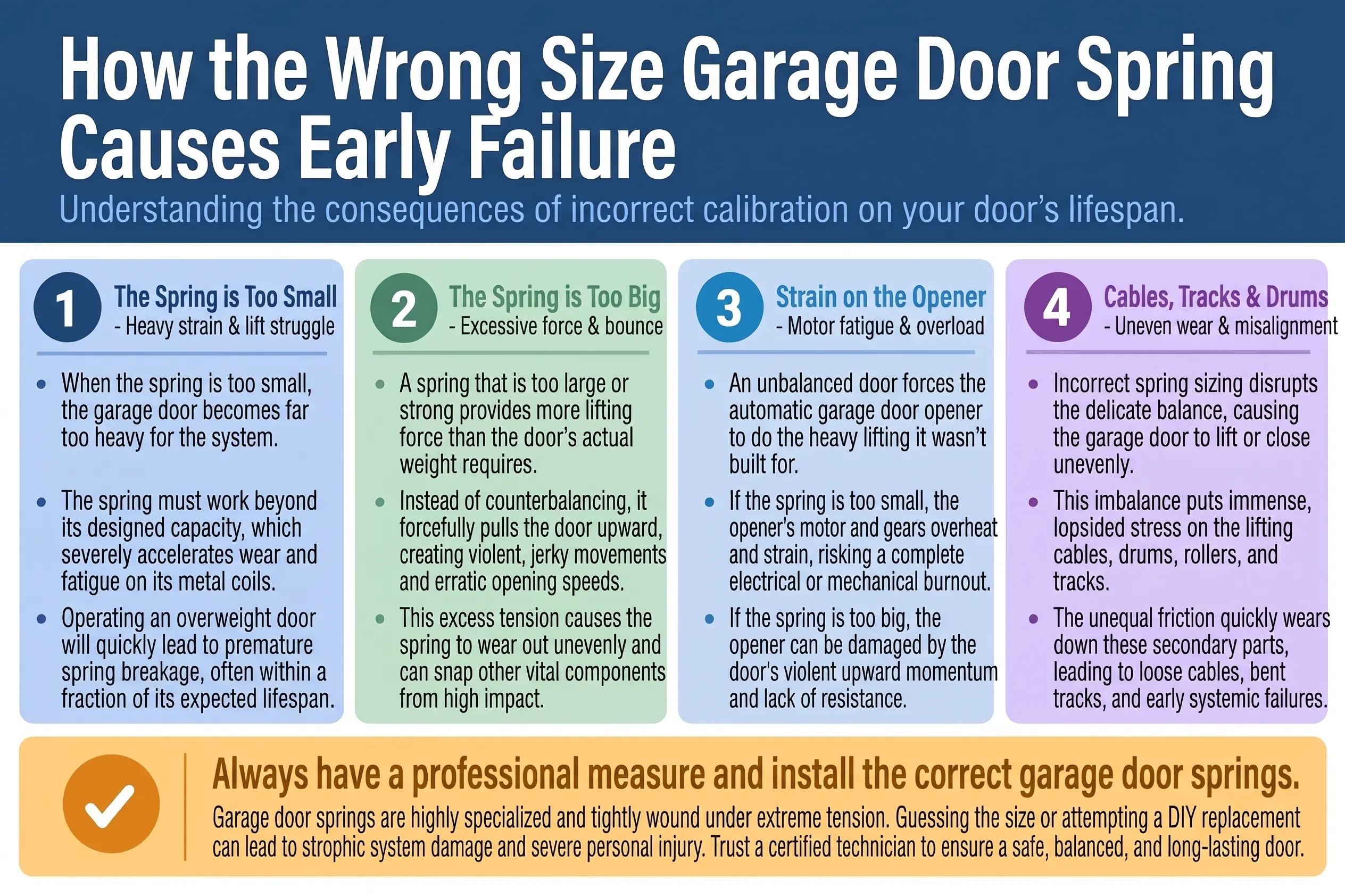
How the wrong size garage door spring causes an early failure
Springs are matched to the specific door they serve, and a spring that is not correctly matched works harder than it was designed to for its entire life. Three dimensions determine the match: the thickness of the wire, the length of the spring, and its inside diameter. Together these decide how much lifting force the spring produces and how much stress each cycle puts on the steel.
Get that match wrong and the outcome is predictable. An undersized spring is asked to hold more weight than it was engineered for on every single cycle, and it consumes its rated life at an accelerated rate. From the outside nothing looks unusual. The door opens, the door closes, and then well ahead of schedule the spring fails.
This is more common than it should be, because correct sizing requires knowing what the door actually weighs rather than estimating from its appearance. A proper garage door assessment includes establishing the door weight rather than assuming it from the door’s size or material.
What to ask: “What were the wire size, length, and inside diameter of the spring you installed, and how did you determine the door weight?”
2. Only one spring of a pair was replaced
Why replacing one garage door spring leads to another failure
On a two-spring door, installing one new spring alongside one worn spring creates an imbalance that neither spring was designed to handle. A pair is meant to share the lifting load evenly. A new spring produces its full rated force. An old one, near the end of its cycle life, does not. The new spring ends up carrying more than its share on every cycle.
The consequences arrive in two forms. The new spring wears faster than it should because it is doing more work than it was rated for. And the door lifts unevenly, which puts strain on the cables, the drums, and the opener, so the eventual failure may not even be the spring.
This is the most common preventable cause on this list, and it is why the standard recommendation exists in the first place. The full reasoning, including the situations where replacing one is defensible, is in Should Both Garage Door Springs Be Replaced at the Same Time? 6 Things That Decide It.
What to ask: “Was the other spring replaced at the same time, and if not, how was the door balanced afterward?”
3. The spring was not set to the correct tension
What happens when a garage door spring is wound incorrectly
A correctly sized spring set to the wrong tension behaves like the wrong spring. Springs have to be wound to a specific number of turns for the door’s height and weight. Too few and the spring cannot properly counterbalance the door, leaving the opener and the spring itself doing work they were not meant to do. Too many and the spring is being stressed beyond its intended working range on every cycle.
The tells are usually visible in how the door behaves. A door that feels heavy at the bottom, drifts down when stopped partway, does not stay put where you leave it, or pulls hard against the opener is a door that is not balanced. Those symptoms are worth reporting to whoever assesses it next, because they narrow the cause considerably.
Setting tension correctly is a defined procedure with a correct answer, not a matter of feel, which is one reason installation quality varies so much between operations. The same is true of the force and limit settings on an automatic gate operator: set outside the correct range, the equipment runs at strain permanently and fails early in whatever component is weakest.
What to ask: “Was the door balance checked after the spring was installed, and what did it show?”
4. Something else on the door was never addressed
When a garage door problem keeps breaking springs
A spring can be the correct part, correctly installed, and still fail early if it is fighting something else on the door. This is the cause people most often miss, because attention naturally goes to the component that broke rather than to the conditions it was operating in.
The usual culprits: tracks that are bent or out of alignment, worn or seized rollers creating friction, frayed cables or damaged drums that cause the door to lift unevenly, or a door frame that is no longer square. Each of these makes the door harder to move than its weight alone would suggest, and the spring absorbs that difference on every cycle.
A repeat failure is the strongest available signal that the diagnosis stopped at the spring. The right response is an assessment of the whole assembly, not another spring. Guidance on how to evaluate what you are being told in these situations is available in this residential guide on garage door scam avoidance.
If the underlying issue turns out to be structural rather than mechanical, the conversation changes shape entirely, and the situations where that is genuinely the case are set out in When Is Replacing a Garage Door Actually Necessary? 7 Situations Where Repair Isn’t Enough.
What to ask: “Were the tracks, rollers, cables, and drums inspected when the spring was replaced, and what condition were they in?”
5. The spring’s cycle rating does not match how you use the door
Why a high use garage door needs a higher cycle spring
Springs are rated for a number of cycles, and a rating that suits an average household is short for a household that uses the garage as its front door. One cycle is one full open and close. A standard spring rating covers a lot of cycles, which sounds like a great deal until you count how many times a busy family actually opens the door in a day.
Do that arithmetic and the picture changes. A household cycling the door ten or twelve times daily works through a standard rating far faster than one cycling it twice. Higher cycle-rated springs exist precisely for this situation, and choosing one is a legitimate conversation to have, provided it is presented as a decision about your usage rather than as a fix for a problem that has a different cause.
Where this reaches its limit is a residential door doing genuinely commercial work. Doors on managed properties running access control and constant entry are specified differently from the start because the duty cycle is a different category of demand. The way the commercial side of the trade approaches this is discussed in this piece on marketing strategies for overhead door companies.
What to ask: “Roughly how many times a day do we use this door, and what cycle rating was the spring you installed?”
6. Corrosion is working on the spring faster than expected
How rust shortens the life of a garage door spring
Rust does not just sit on the surface of a spring, it changes how the steel behaves under load. Corrosion between the coils increases friction with every cycle and creates pitting on the wire surface. Those pits become stress concentration points, and spring steel under repeated high load fails at its weakest point.
This is a slower cause than the others, which is why it usually explains a second failure that came sooner than expected rather than one that came suspiciously fast. It also explains why identical doors in different locations have such different spring lifespans. An unheated garage in a humid or coastal region is a materially harsher environment than a sheltered inland one, and the same conditions that consume fence hardware and outdoor fixtures are working on the spring the entire time.
The relevant point for your decision: this is the one cause on the list that is managed rather than fixed. It does not mean anyone did anything wrong. It does mean the replacement interval on your door is genuinely shorter than average, and knowing that is useful.
What to ask: “Was there visible corrosion on the old spring, and does our environment shorten what we should expect?”
What the timing of the second failure suggests
Cause | Typical timing of the repeat failure | What points to it |
Wrong size spring | Weeks to several months | No door weight established, cannot state the spring dimensions installed |
Only one of a pair replaced | Months | The other spring is visibly older, door lifts unevenly |
Incorrect tension | Days to weeks | Door drifts when stopped, feels heavy, or fights the opener |
Unaddressed door problem | Varies, often months | Binding, catching, uneven travel, worn rollers or frayed cables |
Cycle rating too low for use | A year or more, still short of expectation | Heavy daily use, standard rating installed without discussion |
Corrosion | Shorter than average, but not sudden | Visible rust between coils, damp or coastal environment |
Two things this table makes clear. First, an early failure and a merely disappointing one have different explanations, so the date matters. Second, four of the six causes are things someone should have identified during the original visit, which is why a repeat failure is a reasonable moment to bring in a fresh assessment rather than returning to the same conclusion.
What to do now
Do not simply have another spring installed. That is the response that produces a third failure. Establish the two dates, note how the door has been behaving, and ask for an assessment of the whole assembly, including tracks, rollers, cables, drums, and balance, before any part is fitted.
Then ask the questions listed under each cause above. You do not need technical knowledge for any of them. What you are listening for is whether the answers describe your specific door or describe springs in general, because a company that can tell you the dimensions of the part it installed and what your door weighs has done the work, and one that cannot has not. The industry itself makes this point regularly, including in public commentary from door industry professionals and in the scam awareness material published by the International Door Association.
If you run a company that does diagnose the whole door and you keep losing work to operations that fit a part and leave, the problem is that the difference is invisible to the homeowner until after the second failure. Door & Gate Domination works exclusively with garage door, gate, and access companies on making that difference visible before the call. Related reading: how garage door company marketing attracts more clients and garage door keywords that actually drive calls.
Want the homeowners on their second failure to find you instead? Talk to us about your market.