


You avoid a garage door spring replacement scam by watching what happens before anyone touches your door. The pattern is almost always the same: a diagnosis given before an inspection, a company you cannot identify, a scope of work that grows once someone is on site, and pressure to approve it all immediately. Honest spring work is boring to watch. Someone looks at the door, shows you the failed part, explains what it does, and tells you what the repair involves. If you are not getting that, stop and get another opinion. The 10 signs below are the ones that show up most often, in the order you are most likely to hit them.
Key takeaways
- Most spring scams are identifiable during the phone call, before anyone arrives at your house.
- A real diagnosis requires someone to look at the door. Anyone who names your problem sight unseen is guessing or selling.
- The single most useful question you can ask is “can you show me what failed and explain what it does.” Evasion is your answer.
- Scope that expands after work begins is the most common pattern in the complaints homeowners file.
- Never attempt to release, adjust, remove, or reinstall a garage door spring yourself. They hold enough stored tension to cause severe injury or death, and this is true even of a spring that has already broken.
- Getting a second opinion costs you a delay, not your door. A stuck door is an inconvenience. An unnecessary replacement is permanent.
Why springs specifically
Springs are where this happens because springs are invisible to you and essential to the door. They counterbalance the weight of the panels, which is why a door that feels manageable by hand becomes immovable the moment a spring fails. You cannot see whether yours is sized correctly. You cannot see how much life is left in it. You cannot verify most of what you are told about it. That information gap is what gets exploited, and it is why general advice about how to find a trusted garage door service provider near you matters more here than on almost any other home repair.
The industry knows this. The industry scam awareness guidance from the International Door Association exists precisely because a small number of operators have built a business model around the gap, and legitimate companies lose work to them.
1. The diagnosis arrives before anyone looks at the door
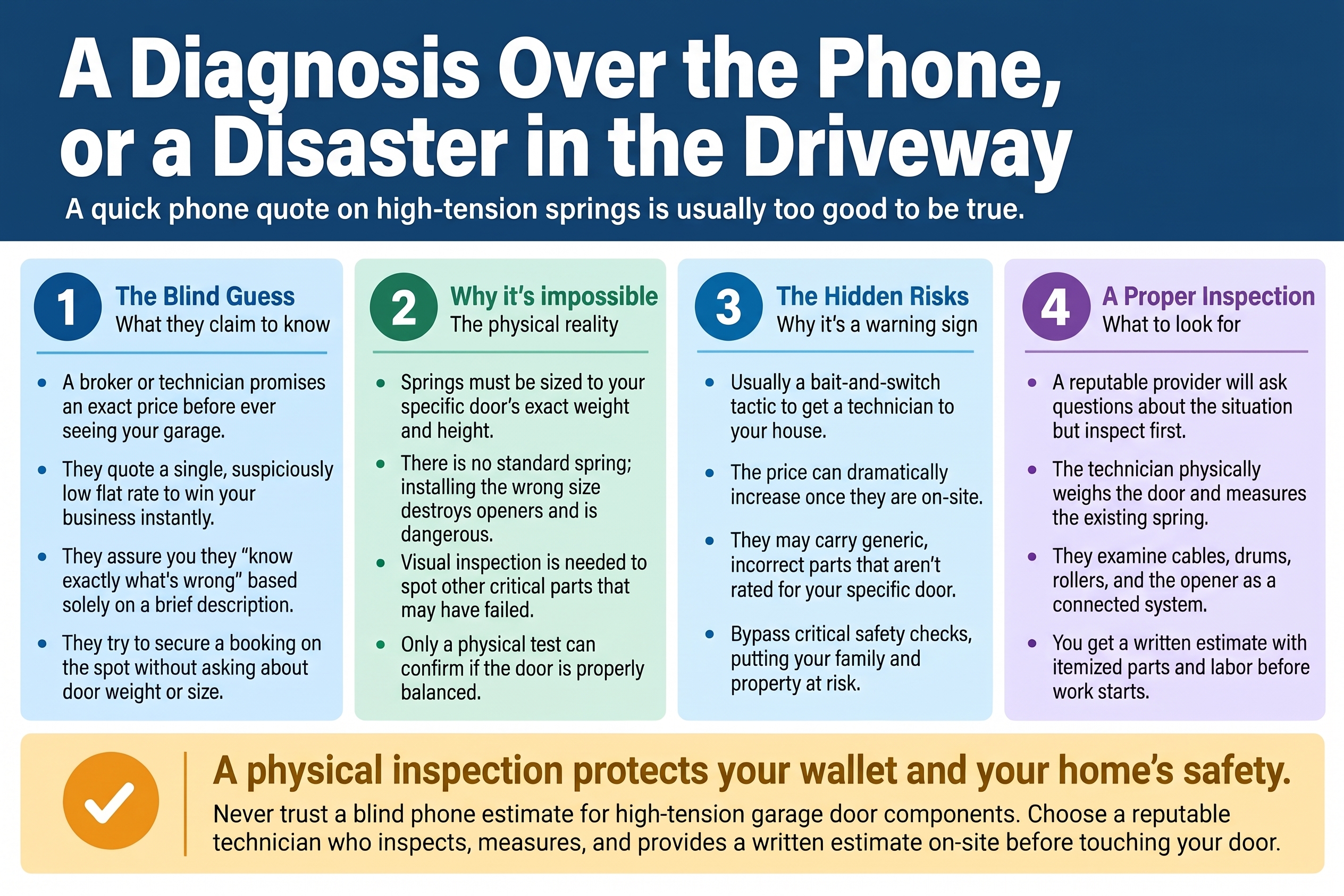
Why a garage door spring diagnosis over the phone is a warning sign
If someone names your exact problem and your exact repair during the first phone call, they are not diagnosing. They are quoting a script. A broken spring has a few recognizable symptoms, so a competent person may well say “that sounds like a spring, and here is what we would need to check.” That is a hypothesis. It is different from a confirmed diagnosis and a committed scope of work.
The reason this matters: the phone-stage quote is what sets your expectation. When the number or the scope changes later, you have already mentally committed and are standing in your driveway with a door that will not move. That is the position the script is designed to create.
What to do instead: ask what they need to look at before they can tell you what the repair involves. A straight answer will mention the springs themselves, the cables, the drums, the door’s balance, and how the door was set up originally. A vague answer, or an insistence that they already know, tells you what you need.
When to get a second opinion: any time the person on the phone will not distinguish between what they suspect and what they know.
You will also see this pattern in the cheap national service-call ads that route your call to whoever bought the lead that day. Those ads are not run by the company that shows up, which is part of why the person arriving has no stake in the diagnosis being right. The economics behind that model are covered in more depth in this piece on why contractors should stop buying shared contractor leads.
2. You cannot confirm who you are actually hiring
How to tell if a garage door company is a real local business
If you cannot establish the company’s real name, its physical location, and the name of the person coming to your house, you do not know who you are hiring. This is the most basic check available to you and it eliminates a large share of the problem before it starts.
Look for consistency. A company that does real garage door work in your area has a traceable footprint: the same business name on the website, the phone listing, the review profiles, and the vehicle that pulls up. Operations built for a short run do not have that. The name on the invoice differs from the name you called. The address is a mail drop or absent entirely. Nobody will tell you the technician’s name in advance.
What to do instead: before you book, ask for the company’s legal business name and the name of the person who will arrive. Then check that the name you were given appears in the same form everywhere you can find it.
When to get a second opinion: if the business name shifts between your call, the website, and the paperwork.
3. The person who arrives cannot explain what failed
Why a technician should show you the broken garage door spring
The strongest single signal of honest work is a willingness to show you the failed part and explain what it does. Someone who has actually diagnosed your door can walk you to it, point at the spring, and tell you what happened in plain language. A broken torsion spring is visibly separated. That is not subtle, and there is no reason to hide it.
The failure mode here is evasion dressed as expertise: technical language delivered quickly, an unwillingness to slow down, a suggestion that you would not understand. Genuine competence has the opposite tell. People who know a system well can explain it simply and do not mind being asked.
What to do instead: ask two questions. “Can you show me the part that failed?” and “What does that part do?” You are not testing their knowledge. You are testing whether they will engage.
This is also the moment to be clear with yourself about a hard limit. Do not touch the spring, do not attempt to release its tension, and do not let anyone talk you into assisting. This applies to a spring that has already broken. Guidance on the same point appears in a manufacturer guide on avoiding garage door scams.
When to get a second opinion: if you ask to see the failed part and the answer is a reason why you cannot.
4. You are told both springs must go, without a reason you can follow
How to tell if replacing both garage door springs is necessary
Replacing both springs when one broke is often a legitimate recommendation, which is exactly why it gets used dishonestly. There are real reasons a pair gets replaced together, and there are situations where it is unnecessary. The distinction is not whether they recommended it. The distinction is whether they can explain which situation you are in.
An honest version sounds specific: it references how old the springs are, whether they were installed as a matched pair, what the second one looks like now, and how your door is set up. A dishonest version sounds like policy. “We always do both” is not a reason. It is a way of avoiding one.
What to do instead: ask them to tell you the condition of the spring that did not break, and how they determined it. Then ask what happens if only the broken one is replaced. A real answer will describe a trade-off. A scripted answer will describe a rule.
Because this comes up on nearly every spring call, it is worth understanding the underlying logic before you are standing in the garage being asked to decide. That is covered in full here: Should Both Garage Door Springs Be Replaced at the Same Time? 6 Things That Decide It.
When to get a second opinion: if the recommendation is presented as universal policy rather than a finding about your specific door.
5. The recommendation jumps straight to a full door replacement
Why a garage door replacement recommendation deserves a second look
A broken spring does not mean you need a new door. The spring is a wear component. It is built to fail eventually and to be replaced when it does. When a spring call converts into a door replacement conversation within minutes of someone arriving, that escalation deserves scrutiny, because the gap between the two jobs is enormous and the decision is irreversible.
There genuinely are situations where replacement is the correct call, usually involving the condition of the panels, the structural integrity of the door, or damage that goes well beyond the spring. Those situations are identifiable and explainable. What should worry you is escalation without evidence: a recommendation that arrives before an inspection of anything other than the spring, or one that leans on how old the door is rather than what is wrong with it.
What to do instead: ask what specifically about your door makes repair the wrong choice. Ask to be shown it. Then decline to decide that day.
The full set of circumstances where replacement is genuinely warranted is worth reading before you are in the conversation: When Is Replacing a Garage Door Actually Necessary? 7 Situations Where Repair Isn’t Enough.
When to get a second opinion: always, on any same-visit recommendation to replace the entire door.
6. You are pushed to approve the work immediately
Why urgency pressure during a garage door repair is a warning sign
Urgency is the most reliable component of a scam, because the entire model depends on you not having time to compare. A door with a broken spring is genuinely inconvenient and, if it is partially open or has been forced up, genuinely unsafe to operate. Both of those things can be true while the decision still waits until tomorrow.
The manufactured version of urgency has a particular sound to it. The availability window closes today. The crew is in the area right now. The problem will get worse by the hour. Established companies that also service automatic gate equipment and other scheduled work run on routes and calendars, and they can generally tell you when they could come back. Operations built on same-visit closing cannot, because a delayed decision is a lost sale.
What to do instead: say you want to think about it, and watch what happens next. The reaction tells you more than anything said before it. Note that securing the door so it is not left unsafe is a separate question from approving a full scope of work, and a reasonable company will treat it as one.
When to get a second opinion: any time you feel you cannot leave the decision until the next day.
7. The scope of work keeps growing after work begins
How to handle a garage door repair scope that keeps expanding
Scope creep after approval is the most common complaint pattern in this trade. The job starts as a spring replacement. Then the cables need doing. Then the drums. Then the rollers, the bearings, the opener. Each addition is individually plausible, which is what makes the sequence effective. By the time the pattern is visible, the door is disassembled and you are negotiating from a weak position.
The distinction to hold onto is timing. A competent inspection identifies related wear before work starts, because the person looking at your springs can see your cables and drums at the same time. Discovering each additional item only after the previous one is approved is a sequence, not a series of discoveries. The same escalation pattern shows up in access control work on gated properties, where the customer similarly cannot verify what is necessary.
What to do instead: at approval, ask directly whether anything else on the door will likely need attention. Get the full list then. If new items appear later, ask why they were not visible during the inspection.
When to get a second opinion: if items are added after disassembly begins and the explanation for the timing does not hold up.
8. Nobody will put the scope of work in writing
Why you should get garage door repair scope in writing before approving
A refusal to write down what is being done is a refusal to be held to it. This is not a formality. Written scope is what converts a conversation into something checkable, and it is the reason a written record is standard practice in every trade where the customer cannot verify the work themselves.
The scope should name what is being replaced, what is being left alone, and what was found during the inspection. It does not need to be long. It needs to exist before the work starts, not after. Resistance usually arrives as friction rather than refusal: it will slow things down, it is not how they normally work, they can sort it out at the end.
What to do instead: ask for the scope in writing before approving. If the answer is that it will come afterward, that is your answer.
When to get a second opinion: if you cannot get the planned work documented before it begins.
9. The company has no traceable review history
How to check a garage door company’s review history before approving work
Look at whether the review history exists, is consistent, and is attached to the same business name you were given. You are not looking for a perfect rating. Every company that does real volume has unhappy customers. You are looking for a record that is long enough and specific enough to tell you something.
What should concern you: a profile with no history before the last few weeks, reviews that describe a service the company does not offer, or a review history you cannot connect to the business name on your paperwork. Also check whether the name appears consistently across the company’s other service lines, such as fence or gate work, since established local operations tend to have a coherent presence across everything they do.
It is worth knowing that review profiles are themselves a target for manipulation, in both directions. Fabricated positive reviews and coordinated negative ones are both real problems, as this piece on Google review extortion scams covers. This is why the volume and specificity of the history matter more than the average score.
What to do instead: read the substance of a handful of reviews rather than the rating. Look for whether people describe the actual work.
When to get a second opinion: if the review history is thin, recent, or attached to a different business name.
10. The same spring fails again shortly after the repair
What it means when a garage door spring breaks again after a repair
A spring that fails again soon after being replaced usually means one of two things: the wrong part was installed, or something else on the door was never addressed. Springs do wear out, but not on that timeline. An early repeat failure is information, and it is worth pursuing rather than absorbing.
This is also the sign that arrives too late to prevent, which is why it belongs at the end of this list. If you are reading this after a second failure, the useful move is not to assume you were scammed. It is to find out which of the possible causes applies, because several of them are correctable and several of them point to something still wrong with the door.
What to do instead: document when the original work was done and what was installed, then have someone independent look at the door and the setup, not just the spring.
The specific causes and what each one indicates are worked through here: Why Did My Garage Door Spring Break Again After a Repair? 6 Possible Causes.
When to get a second opinion: any repeat failure inside the first year.
Normal practice compared to warning signs
Situation | What normal practice looks like | What a warning sign looks like |
The first phone call | Describes what they need to inspect before committing to a scope | Names your exact problem and repair sight unseen |
Company identity | Same business name across site, listing, paperwork, and vehicle | Name changes between your call and the invoice |
The diagnosis | Shows you the failed part and explains what it does | Declines to show it, or explains in a way that resists questions |
Both springs | Explains the condition of the unbroken spring and how it was assessed | States it as company policy without reference to your door |
Door replacement | Points to specific structural or panel conditions and shows you | Escalates during the same visit based on the door’s age |
Timing | Offers a return visit and separates safety from full approval | Availability closes today, decision cannot wait |
Scope | Full likely list identified at inspection, before work starts | Items appear one at a time after disassembly begins |
Documentation | Written scope of planned work before approval | Paperwork only at the end, or resistance to writing it down |
Review history | Long, specific, consistent with the business name | Recent, thin, or attached to a different name |
Repeat failure | Investigates the setup and what was installed | Treats an early second failure as normal wear |
What this comes down to
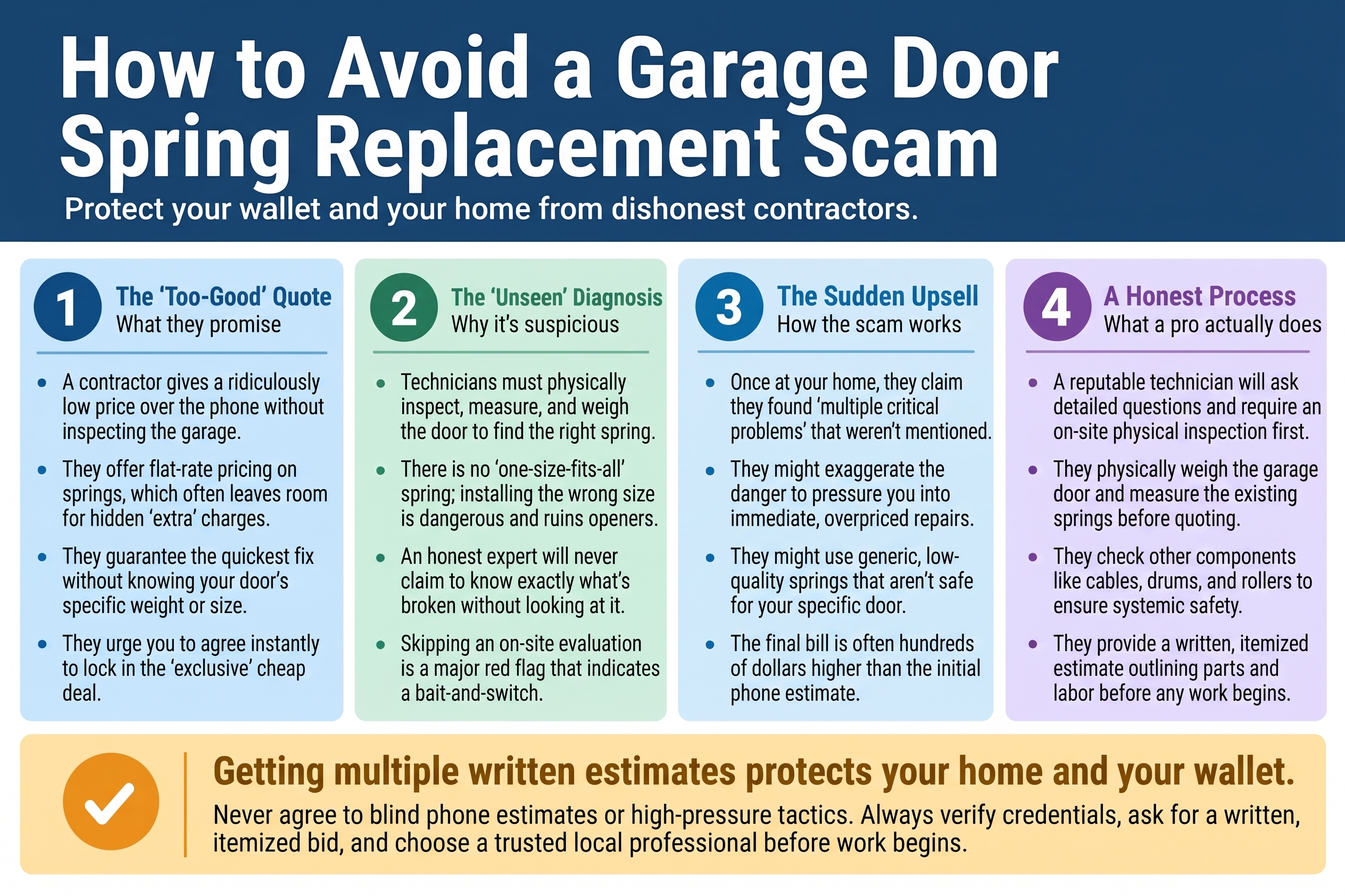
Every sign on this list is a version of the same thing: whether the person in front of you is willing to be checked. Honest spring work invites verification, because verification confirms it. The alternative depends on you not asking. That is the whole distinction, and it is available to you without knowing anything technical about springs. An industry advisory on fraudulent garage door operators makes a version of the same point: willingness to be verified is the tell.
If you are on the other side of this, running a company that does this work properly and losing jobs to operators who do not, the problem is not your work. It is that the suspicious customer cannot tell you apart from the operation that burned their neighbor, and increasingly they are deciding before they ever call you. That is a visibility and trust problem, and it is solvable. Door & Gate Domination works exclusively with garage door, gate, and access companies on exactly that gap. Further reading on the positioning side: how to build a trusted garage door brand and reputation management for garage door contractors.
If you want the customers searching for warning signs to find you instead of your competitors, talk to us about your market.