


In most cases, yes, and there is a real reason for it rather than a sales reason. If your door has two springs, they were almost certainly installed together, they have opened and closed the same number of times, and they are the same age. When one fails, the other is not fine. It is simply next. That said, “we always do both” is not an explanation, and there are situations where replacing only the failed spring is defensible. The difference comes down to six specific things about your door, all of which someone standing in your garage can check and describe to you.
Key takeaways
- Springs fail by cycle count, not calendar age, so a matched pair that has done identical work is likely near the same point in its life.
- The first question is whether your door even has two springs. Plenty of doors have one, which settles the matter immediately.
- A mismatched pair, one new and one worn, pulls unevenly and transfers the imbalance into the cables, the drums, and the opener.
- “Company policy” is not a reason. A real recommendation references the condition of the surviving spring and how it was assessed.
- The work of accessing the spring system is the same whether one spring or two is being handled, which is part of why doing both together is common practice.
- Never attempt to handle, adjust, or release a garage door spring yourself. The stored tension is capable of causing severe injury or death, and this remains true of a spring that has already broken.
Why this question comes up on nearly every spring call
A homeowner calls because the door will not open. One spring is visibly broken. The recommendation comes back covering both. From where you are standing, that looks like an add-on, and sometimes it is. The recommendation being common does not make it automatic, and the fact that most people cannot evaluate it is exactly why it deserves a clear explanation from whoever is making it.
Trade guidance addresses this directly. The International Door Association’s guidance on avoiding garage door scams makes a similar point about recommendations that arrive without reasoning attached: the issue is rarely the recommendation itself, it is the absence of anything behind it.
What follows are the six things that actually decide it. If the person recommending the work cannot speak to at least a few of them, you have not been given a diagnosis.
1. Whether your door has one spring or two
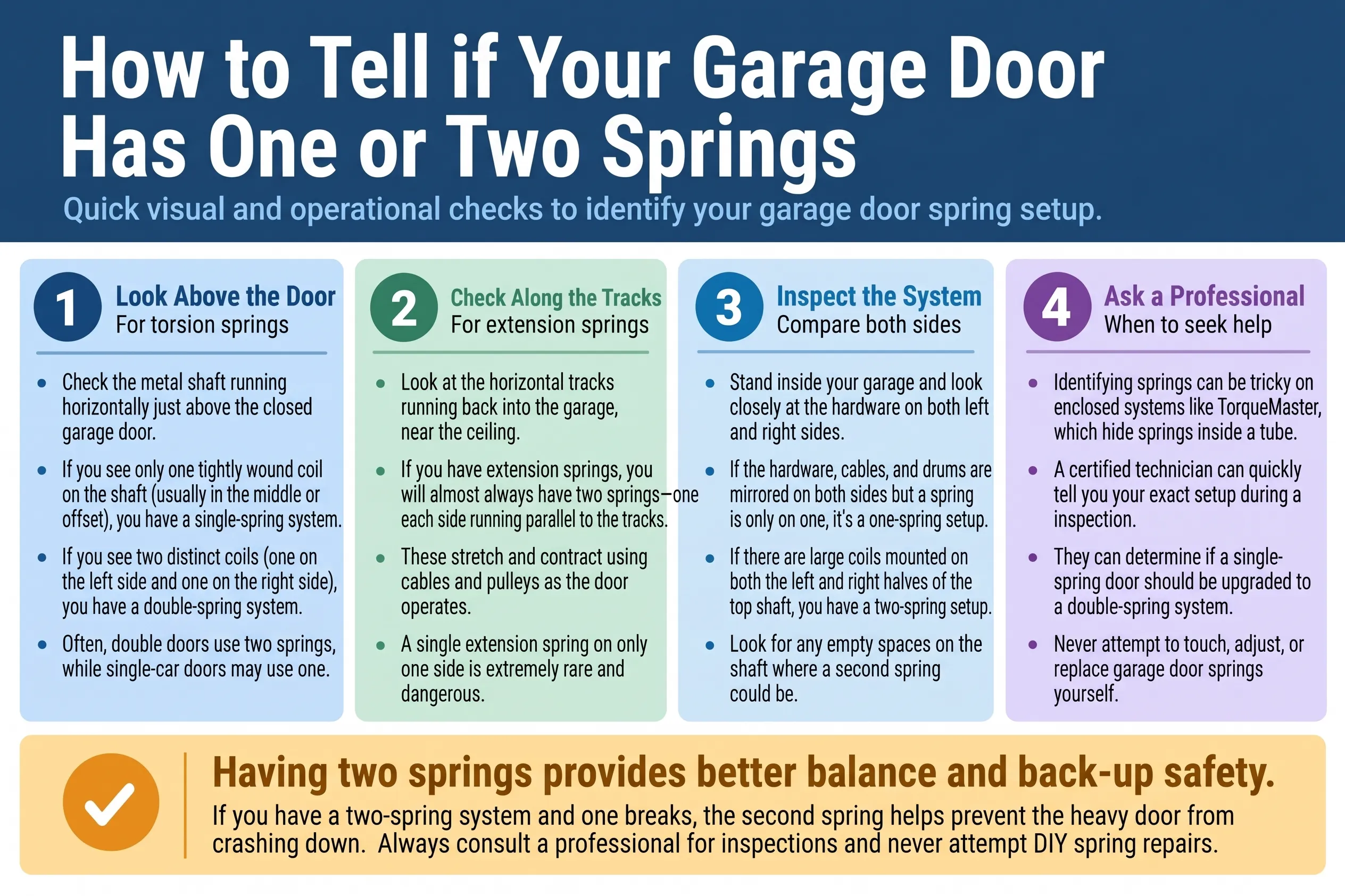
How to tell if your garage door has one or two springs
Not every door has a pair, so this question sometimes resolves before it starts. Lighter and narrower doors, including many single-car doors, are frequently set up with a single spring. If yours is one of them, there is no second spring to discuss, and any recommendation to replace “both” is describing a door other than yours.
Doors also differ in where the spring system sits. Some have a shaft mounted above the opening with the spring or springs wound around it. Others use springs running along the tracks on either side. The arrangement affects what a replacement involves and what counts as a matched set.
This is worth confirming first because it is the fastest way to test whether the person in your garage is describing your specific door or working from a script. Anyone who has done a real garage door inspection can tell you what configuration you have and point at it.
Ask this: “How many springs does my door have, and where are they?”
2. The age and cycle history of the spring that did not break
Why the unbroken garage door spring matters after one fails
Springs are rated by cycles, meaning one full open and close, not by years. This is the single most useful thing to understand about the whole question. Two springs installed on the same day, on the same door, operated by the same household, have completed the same number of cycles. They are not two independent components that happen to sit next to each other. They are a matched set that has done identical work for identical time.
So when one reaches the end of its life, the other is not in fresh condition. It is at roughly the same point, and its remaining service life is measured in the same terms as the one that just failed. That is the actual argument for replacing both, and it is a sound one.
The argument weakens in specific circumstances: if the springs were installed at different times, if the door was reconfigured at some point, or if one was already replaced individually in the past. Those situations exist and they change the answer, which is why the recommendation should reference your door’s history rather than a general rule.
Blanket policy language is one of the recognizable patterns covered in How Do You Avoid a Garage Door Spring Replacement Scam? 10 Warning Signs to Watch For. A recommendation that cannot connect itself to something about your door is the thing to notice.
Ask this: “Were these springs installed at the same time, and how many cycles would you estimate they have done?”
3. Whether the pair is actually matched to your door
How to know if your garage door springs are the correct size
Springs are sized to the weight and travel of the specific door they serve, and a set that was wrong from the start behaves differently from a set that simply wore out. Wire diameter, coil length, and inside diameter all have to suit the door. Get that wrong and the spring works harder than it should for its entire life, which shortens it.
This matters to your decision in two ways. If the existing pair is undersized, replacing only the broken one leaves a component that will fail early again. If the pair is correctly sized and has simply reached the end of its cycle life, you have a straightforward wear situation.
It is also common to find doors carrying a history of piecemeal work: one spring replaced years ago by one company, the other original, nothing documented, nobody able to say what is installed. That situation genuinely argues for resetting the door with a proper matched pair, and a competent assessment will say so and explain why rather than just asserting it.
Understanding what is normal in current practice helps here, and the trade press covers this kind of thing regularly, including in ongoing garage door industry news coverage.
Ask this: “Are the springs currently on my door correctly sized for it, and how can you tell?”
4. The visible condition of the surviving spring
What a worn garage door spring looks like before it fails
A spring nearing the end of its life often shows it, and this is something you can be shown rather than told. Coils that have spread apart, visible rust between the coils, a spring that has lost its original tight uniform appearance: these are observable conditions, and the person recommending the work should be willing to point at them and explain what they indicate.
Environmental exposure accelerates all of it. Humidity, salt air, and temperature swings work on spring steel the same way they work on any other outdoor metal, which is why the same coastal conditions that shorten fence hardware life also shorten spring life. A garage that is unheated, unusually damp, or near the coast is operating in harder conditions than a sheltered inland one.
The key point for your decision: if the surviving spring shows meaningful deterioration, replacing both is not an upsell, it is the obvious call. If it looks genuinely sound and its history is short, that is a real conversation. Either way, ask to see it. A recommendation you can look at yourself is a different thing from one you have to take on faith, a distinction also drawn in this manufacturer’s buying guide on garage door scams.
Ask this: “Can you show me the spring that did not break and point out what you are seeing?”
5. What a mismatched pair does to the rest of the door
Why replacing one garage door spring can cause uneven wear
This is the technical argument that most homeowners never hear, and it is the strongest one. A pair of springs is meant to share the load evenly. When one is new and one is worn, they no longer pull with equal force. The door begins to lift unevenly, and that imbalance does not stay contained in the spring system. It transfers into the cables, the drums, the tracks, and the opener, all of which are now working against a door that is fighting itself.
The consequences arrive gradually rather than immediately, which is what makes them easy to dismiss at the moment of decision. A door may operate acceptably for a while on a mismatched pair. What tends to follow is accelerated wear on components that were fine before, and a second failure sooner than expected.
The same balance principle governs other powered systems on a property. An automatic gate that is out of balance puts its operator under continuous strain in exactly the same way, and the failure eventually shows up somewhere other than where the imbalance started.
This is also the most common route to a repeat failure shortly after a repair, which is worked through in Why Did My Garage Door Spring Break Again After a Repair? 6 Possible Causes.
Ask this: “If only one spring is replaced, how will you balance the door?”
6. How hard your door works
How often you use your garage door changes the answer
Cycle count is driven by household behavior, and households vary enormously. A door that is the main entrance to the house, opening and closing many times a day, accumulates cycles at a rate that a door used twice a day never approaches. Two identical springs installed on identical doors can be at completely different points in their lives.
This cuts in both directions. Heavy use strengthens the case for replacing the pair, because the surviving spring has taken the same heavy use and its remaining life is short. Light use on a relatively young set makes the case for replacing one more reasonable, provided the other six factors support it.
Commercial and high-traffic installations sit at the far end of this, which is why doors at properties running access control systems and managed entry are typically maintained on a schedule rather than reactively. The economics of failure are different when a door cycles constantly.
If your door is very old and has been accumulating problems beyond the springs, the question may not be springs at all. That is a different assessment, covered in When Is Replacing a Garage Door Actually Necessary? 7 Situations Where Repair Isn’t Enough.
Ask this: “Given how often we use this door, how much life would you expect the remaining spring to have?”
When replacing both makes sense, and when one is reasonable
Factor | Points toward replacing both | Points toward replacing one |
Spring configuration | Door has a matched pair on a shared shaft | Door has a single spring, so the question does not apply |
Installation history | Both installed at the same time, same age | The surviving spring was replaced recently and separately |
Cycle history | Both have accumulated the same heavy use | The set is young and the door sees light use |
Sizing | Existing springs are undersized for the door | Springs are correctly sized and documented |
Visible condition | Rust, spread coils, or visible fatigue on the survivor | Survivor is clean, tight, and shows no deterioration |
Balance | Door needs to lift evenly with matched components | Balance can be verified and demonstrated afterward |
Explanation given | Specific to your door, and you were shown the evidence | Also specific, with a clear plan for balancing the door |
The pattern in the right-hand column is worth noticing. Replacing one spring is defensible, but only when several conditions hold at once and someone can articulate them. If the reasoning for either choice is a policy rather than a finding, that is the problem, not which option was chosen.
The short version
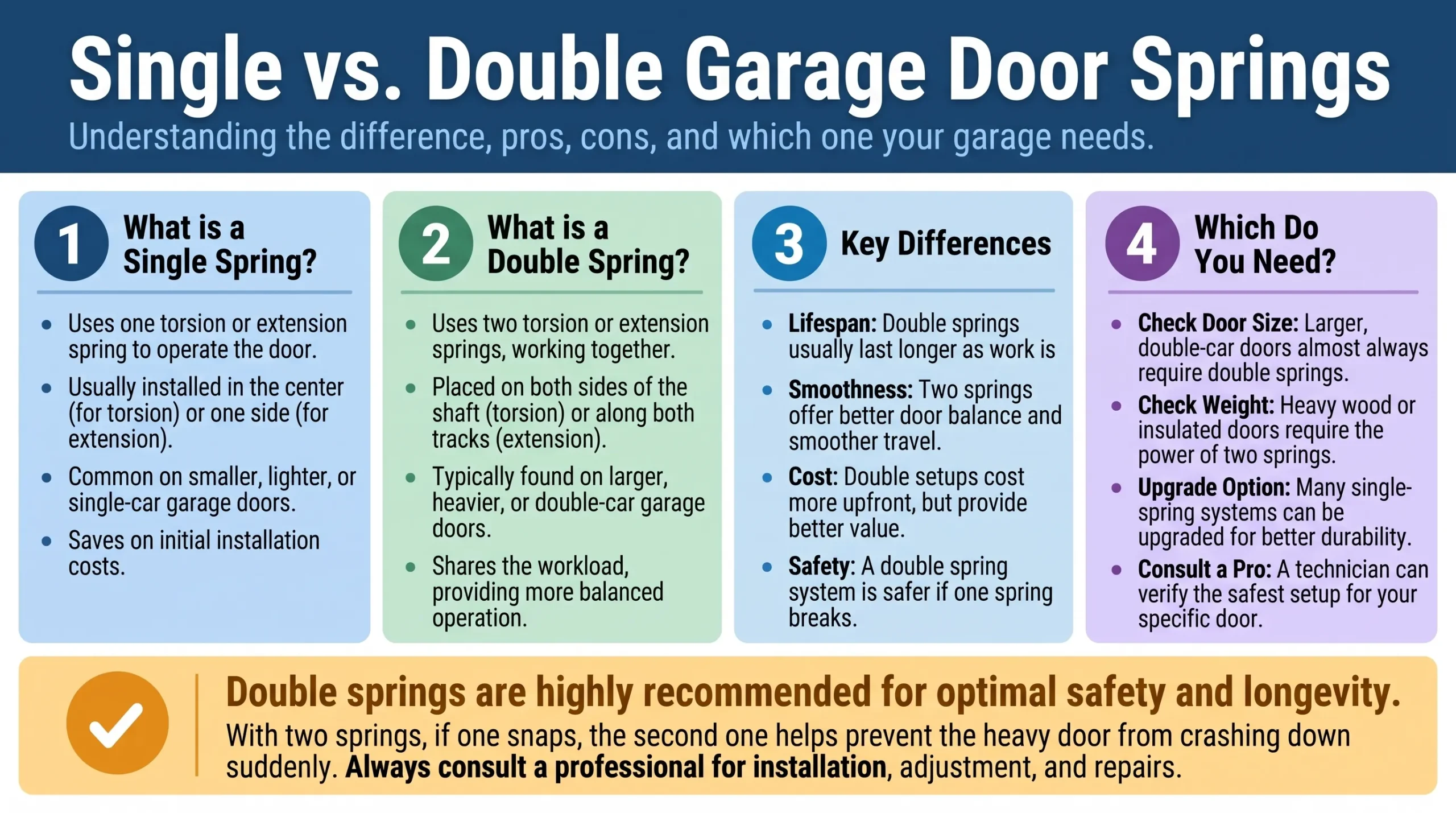
Both springs, most of the time, for reasons that hold up: they are the same age, they have done the same work, they are near the same point, and running a new one alongside a worn one creates a balance problem that eventually takes out something else on the door. That is a real answer, and it is the one an honest assessment usually arrives at.
What should not happen is arriving there without explanation. You are entitled to hear which of the six factors above applies to your door, and to be shown the spring that did not break. Willingness to be checked is the practical test, a point made repeatedly in industry commentary on operators working in the sector.
If you run a company doing this work correctly and you are tired of losing jobs to operations that do not, the underlying problem is that customers cannot tell the difference before they call. Door & Gate Domination works exclusively with garage door, gate, and access companies on closing that gap. Related reading: how to get more garage door repair calls and how to get more 5 star reviews for your garage door business.
Want the customers researching this question to find you first? Talk to us about your market.