


Replacement is genuinely necessary when the door itself is compromised, not when a part on it has worn out. Springs, cables, rollers, hinges and openers are all replaceable components, and a failure in any of them is a repair. What cannot be repaired is a door whose panels are structurally damaged, corroded through, no longer available as replacement sections, or fundamentally wrong for the opening it sits in. Those are the situations below. If none of them describes your door, you are being told you need a new door for a reason that has nothing to do with your door.
Key takeaways
- A broken spring is never by itself a reason to replace a door. It is a wear part reaching the end of its cycle life.
- The question to ask is whether the problem is in a component or in the door structure, because that distinction decides everything.
- Panel damage matters by extent and location, not by how bad it looks. One dented section is usually a section, not a door.
- Repeated failures in different systems on the same door are the strongest honest signal that you are past component-level fixes.
- A door that was wrong for its opening from the start will keep failing regardless of how many parts are replaced.
- Never attempt to handle, adjust, or release a garage door spring yourself. The stored tension can cause severe injury or death, including on a spring that has already broken.
Why this recommendation deserves scrutiny
The escalation from a repair call to a replacement conversation is one of the fastest-moving decisions a homeowner gets asked to make, and it is irreversible. It is also one of the recognizable patterns worth knowing about in advance, which is covered from the other direction in How Do You Avoid a Garage Door Spring Replacement Scam? 10 Warning Signs to Watch For.
To be clear: replacement is often the right call. Doors do reach the end of their service lives, and there is nothing suspicious about being told so. What separates a real recommendation from an escalation is that a real one points at a specific condition of the door itself and can show it to you. The seven situations below are what those conditions actually look like.
1. Impact damage across multiple panels
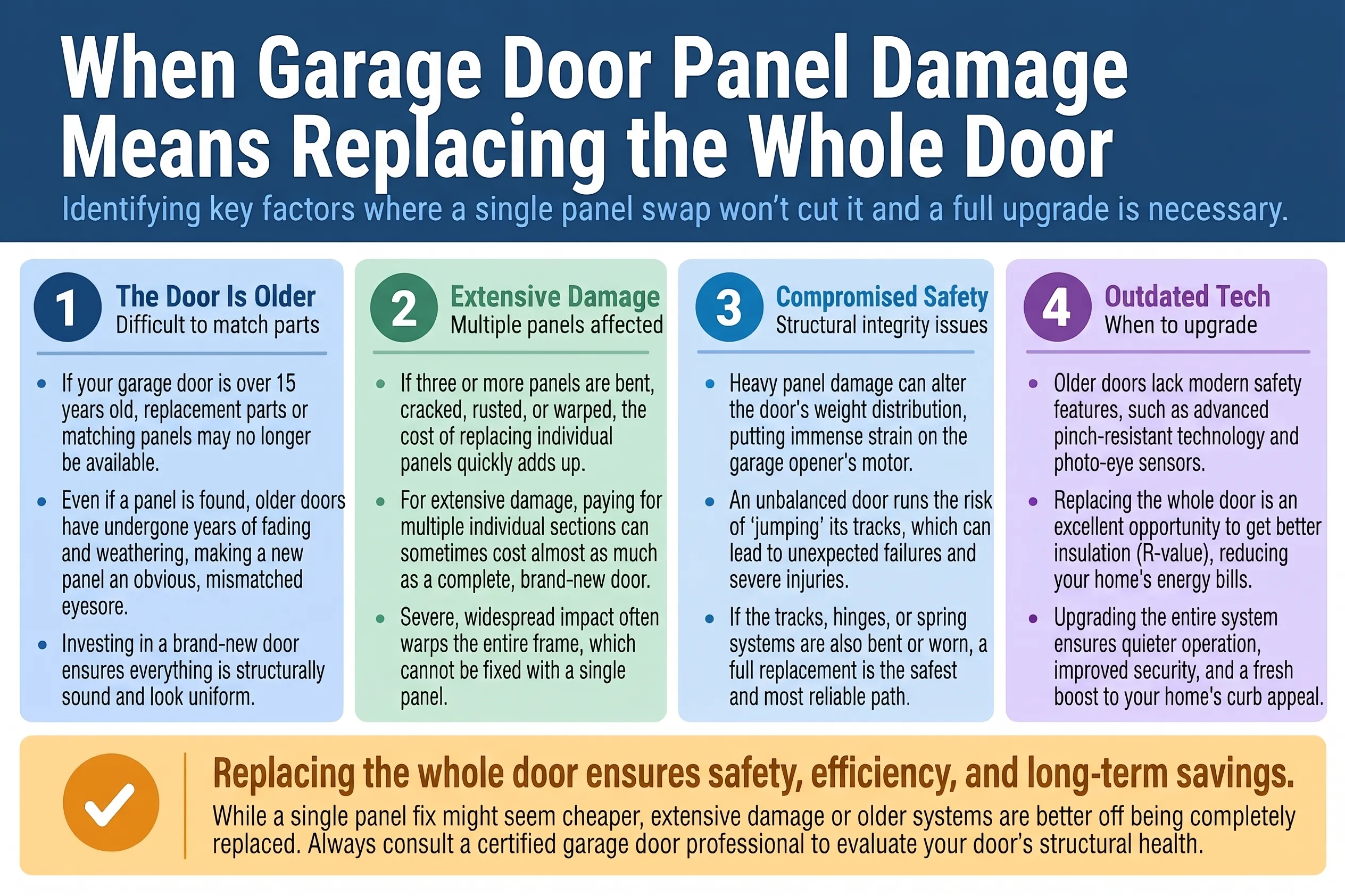
When garage door panel damage means replacing the whole door
A single damaged section is usually a section. Damage spanning several sections is usually a door. Most doors are built as a series of horizontally hinged panels, and individual sections can be swapped. That is the standard answer when a vehicle backs into the bottom panel or something strikes one area.
The picture changes when the impact has affected multiple sections, bent the tracks, twisted the frame the door runs in, or knocked the whole assembly out of square. At that point you are not replacing a panel within a sound structure, you are trying to rebuild a structure that is no longer straight. Doors are load-bearing assemblies under spring tension, and a frame that is out of true will keep transferring stress into everything mounted to it.
Assessing this properly means looking at the tracks and the opening, not just the visible dent. Anyone doing a real garage door assessment should be walking the tracks and checking whether the door still sits square in its opening before saying anything about replacement.
What to ask: “How many sections are affected, and is the track or frame still straight?”
2. Corrosion or rot through the panel material
How rust or rot in a garage door decides repair or replacement
Surface corrosion is cosmetic. Corrosion that has gone through the material is structural, and structural is not repairable. The bottom section takes the worst of it, because it sits closest to standing water, road salt, and whatever runs across the garage floor. On wooden doors the equivalent is rot working up from the bottom rail.
The test is whether the material still holds fasteners and still carries load. A panel with surface rust that has not penetrated can often be addressed. A panel where the metal has thinned to the point of perforation, or where wood has gone soft, cannot be made structural again, and it is carrying hardware that is under tension.
Environment drives the timeline. Coastal salt air, high humidity, and repeated freeze and thaw cycles work on door panels the same way they work on every other outdoor assembly, which is why homes that go through fence hardware quickly tend to go through door hardware quickly too. If your door is in that environment, corrosion is a maintenance question long before it becomes a replacement question.
What to ask: “Has the corrosion gone through the material, or is it on the surface?”
3. The same door keeps failing in different places
When repeated garage door repairs mean the door is finished
One component failing is a repair. Several unrelated components failing in sequence is a pattern, and the pattern is the information. Springs, then cables, then rollers, then hinges, then the opener straining: when a door works through its systems one after another over a relatively short period, the individual repairs are all legitimate and the overall situation still points somewhere else.
There are two honest explanations. The door and its hardware are simply all the same age and are reaching end of life together, which is common and predictable. Or something structural is causing the failures, such as a door out of balance or out of square, in which case each replaced part is being fed into the same underlying problem.
The distinction matters because the first is a genuine replacement situation and the second is a diagnosis that has not been done. Before accepting either, it is worth understanding how normal component wear actually sequences on a door, particularly with springs, which is covered in Should Both Garage Door Springs Be Replaced at the Same Time? 6 Things That Decide It.
What to ask: “Are these failures related to each other, or is the hardware just all the same age?”
4. Replacement sections for your door no longer exist
What to do when garage door panels are no longer available
Sometimes the door is repairable in principle and not repairable in practice, because the section you need is not made anymore. Doors have long service lives, and the panel profiles, hardware patterns, and section dimensions used on a door installed decades ago are frequently out of production. Nothing is wrong with the rest of the door. There is simply nothing to put in the damaged position.
There is a partial version of this too, where a compatible section exists but will not visually match the rest of the door because of profile changes, finish differences, or fading on the existing panels. That is a real situation and it is a legitimate thing to be told, though it is a different conversation from a structural one, and it should be presented as an appearance decision rather than a safety one.
Manufacturers and trade bodies publish guidance on this and related decisions, including a residential buying guide addressing garage door scams, which is worth reading before you are standing in the garage deciding.
What to ask: “Is the section unavailable, or is it available but will not match?”
5. The door lacks current safety behavior
When an older garage door should be replaced for safety reasons
A door and opener system that does not reverse when something is in its path is a safety problem, and it is the one situation on this list where waiting is a genuinely bad idea. Modern residential systems are expected to detect an obstruction and reverse. Older installations predating that expectation, or installations where the reversing behavior no longer works and cannot be made to work, are operating a heavy powered assembly with no protection underneath it.
The nuance: this is often an opener issue rather than a door issue, and openers are replaceable independently. A functioning door with an outdated opener does not need a new door. Where it does become a door question is when the door itself cannot support current safety hardware, or when the assembly is in poor enough condition that the reversing behavior cannot be reliably restored.
Trade guidance on residential door safety and on evaluating what you are told is available through the International Door Association’s scam awareness resources. If you have children or pets and you are unsure whether your system reverses correctly, treat that as the priority regardless of what else is being discussed.
What to ask: “Is this a door problem or an opener problem?”
6. The door was never right for the opening
Why a mismatched garage door keeps failing no matter what is repaired
A door that is the wrong weight, size, or configuration for its opening will keep generating failures, and no amount of component replacement fixes the mismatch. This happens more than people expect, usually from an installation done quickly, done by whoever was available, or done with whatever door was on hand. The symptoms show up years later as chronic problems that nobody connects back to the original setup.
The signature is that the same class of failure keeps recurring. Springs that do not last. Cables that fray on one side. An opener that runs hot. A door that lifts unevenly or drifts. Each of those gets repaired individually, and each comes back, because the counterbalance system is being asked to hold something it was not sized for.
The same principle governs any powered assembly on a property. An automatic gate fitted with an operator that is undersized for the leaf weight will fail repeatedly in whatever component is weakest, and replacing that component never resolves it.
When the mismatch is in the door itself rather than the hardware, replacement is the honest answer. When it is in the hardware, it is not. The recurring-spring version of this is worked through in Why Did My Garage Door Spring Break Again After a Repair? 6 Possible Causes.
What to ask: “Is the door correctly sized and weighted for this opening?”
7. What the garage is used for has changed
When a change in how you use your garage means a new door
Replacement can be the right call even when nothing is wrong with the door, if the demands on it have changed. A garage converted into a workshop, home gym, or living space now has a comfort requirement the original door was never built for. A household that has gone from opening the door twice a day to a dozen times has changed the cycle load on the whole assembly.
This is the one situation on the list where replacement is a choice rather than a necessity, and it should be framed that way. There is nothing wrong with choosing a door better suited to how you now live. What should not happen is that choice being presented as a structural failure that it is not.
The far end of this is a residential door being asked to do work it was never designed for. Commercial openings, high-cycle use, and properties with managed entry and access control run on different equipment for exactly this reason, and the demands there are covered in this piece on B2B marketing for commercial overhead doors.
What to ask: “Is the current door failing, or is it just not suited to what we need now?”
Repair territory compared to replacement territory
Situation | Usually a repair | Usually a replacement |
Springs | Broken or worn springs, at any age | Not on their own, ever |
Cables, rollers, hinges | Any single component failure | Not on their own |
Panel damage | One section, frame still square | Multiple sections, or frame out of true |
Corrosion or rot | Surface only, material still sound | Penetrated the material, no longer structural |
Repeat failures | Related failures traced to one cause | Unrelated systems failing together at end of life |
Section availability | Matching section still obtainable | Section out of production entirely |
Safety reversing | Opener replaceable, door sound | Door cannot support current safety hardware |
Fit for the opening | Hardware mis-sized, door correct | Door itself wrong for the opening |
Changed use | Comfort improvements possible on a sound door | You want different performance from the door |
The pattern in the right-hand column: almost every genuine replacement situation involves the door structure itself, not something bolted to it. That is the test to carry into the conversation.
The short version
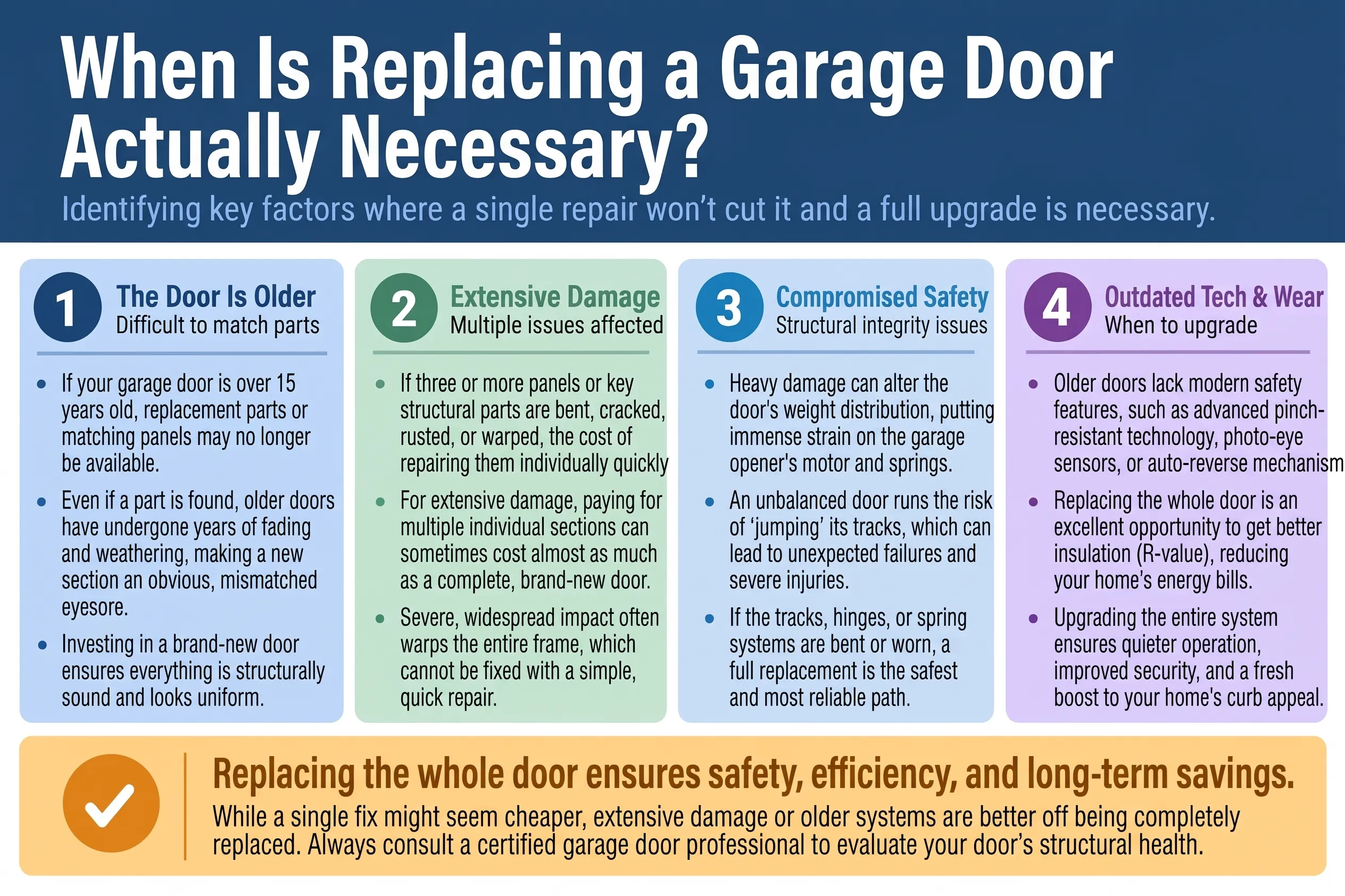
If someone is recommending a new door, ask them to point at the door. Not at its age, not at the parts that failed, at the door. Structural damage across sections, corrosion through the material, a frame out of square, sections that no longer exist, a door that never fit its opening: those are visible things that can be shown to you and explained.
A broken spring is not one of them. Neither is a worn cable, a failed roller, or an aging opener. Those are components with finite lives, and replacing them is the normal maintenance of owning a door. The willingness to make that distinction out loud is the practical test of who you are dealing with, a theme running through industry commentary from door association members.
If you run a company that draws this line honestly and watches jobs go to operations that do not, the difficulty is that homeowners cannot see the difference until someone is already in their garage. Door & Gate Domination works exclusively with garage door, gate, and access companies on making that difference visible earlier. Related reading: how to respond to negative reviews and video marketing for garage door repair.
Want homeowners researching this to find you before someone else is standing in their garage? Talk to us about your market.